

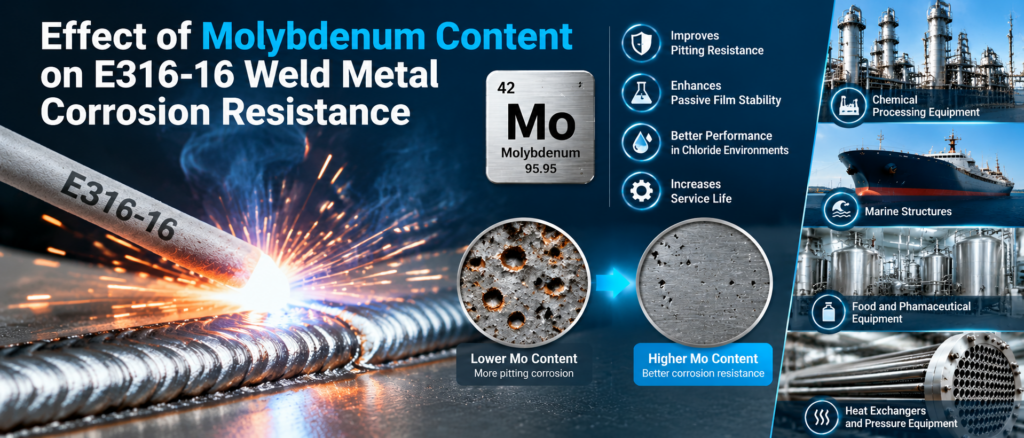
Effect of Molybdenum Content on E316-16 Weld Metal Corrosion Resistance
Introduction
E316-16 stainless steel welding electrodes are widely recognized for their excellent corrosion resistance, stable arc performance, and suitability for welding corrosion-resistant austenitic stainless steels. A key factor influencing the durability of E316-16 weld metal is the presence of molybdenum (Mo), an alloying element that significantly improves resistance against localized corrosion, especially pitting and crevice corrosion in aggressive environments.
Understanding the role of molybdenum in E316-16 weld metal helps engineers select suitable welding materials for chemical processing equipment, marine structures, heat exchangers, and other applications exposed to corrosive media.
The Role of Molybdenum in E316-16 Weld Metal
Molybdenum is added to stainless steel alloys to enhance corrosion resistance, particularly in chloride-containing environments. In 316-type stainless steels, molybdenum contributes to improved resistance against localized corrosion mechanisms compared with molybdenum-free stainless steel grades.
In E316-16 weld metal, molybdenum works together with chromium and nickel to maintain a stable austenitic structure while improving the protective ability of the passive oxide layer.
The main benefits of molybdenum include:
- Improved resistance to pitting corrosion
- Enhanced protection against crevice corrosion
- Better performance in acidic and chloride environments
- Increased durability under harsh service conditions
How Molybdenum Improves Corrosion Resistance
1. Increasing Pitting Corrosion Resistance
Pitting corrosion is one of the most common failure mechanisms affecting stainless steel components exposed to chlorides, seawater, and chemical solutions.
Molybdenum improves E316-16 weld metal performance by:
- Reducing chloride-induced passive film breakdown
- Promoting faster repassivation after surface damage
- Stabilizing the chromium-rich protective oxide layer
A higher and more optimized molybdenum content generally improves the weld metal’s ability to withstand localized corrosion attacks.
2. Enhancing Passive Film Stability
The corrosion resistance of stainless steel depends heavily on the formation of a stable passive film.
During welding, thermal cycles can affect the microstructure and surface properties of weld metal. The presence of molybdenum helps maintain a more stable passive layer by improving the chemical resistance of the oxide film.
This allows E316-16 weld deposits to maintain corrosion protection even after exposure to:
- Chloride solutions
- Chemical processing environments
- High humidity conditions
- Marine atmospheres
Relationship Between Molybdenum Content and Weld Performance
The amount of molybdenum in E316-16 weld metal must be carefully controlled.
Insufficient Molybdenum Content
When molybdenum content is too low, the weld metal may experience:
- Reduced pitting resistance
- Lower protection in chloride environments
- Increased susceptibility to localized corrosion
This can shorten the service life of welded components.
Optimized Molybdenum Content
A properly controlled molybdenum level provides a balance between:
- Corrosion resistance
- Weldability
- Mechanical properties
- Microstructural stability
Optimized E316-16 weld metal can deliver reliable performance for long-term industrial service.
Microstructural Effects of Molybdenum in E316-16 Weld Metal
Molybdenum also influences the weld metal microstructure.
During solidification, alloying elements affect phase balance and corrosion behavior. Proper molybdenum content helps maintain a suitable austenitic matrix with controlled ferrite formation.
The resulting weld structure provides:
- Improved resistance to solidification cracking
- Better corrosion performance
- Stable mechanical properties
The interaction between molybdenum, chromium, and nickel determines the final performance of E316-16 weld deposits.
Applications Requiring High Molybdenum Performance
Due to its corrosion-resistant characteristics, E316-16 welding electrodes are commonly selected for applications such as:
Chemical Processing Equipment
Chemical plants often require welded joints capable of resisting corrosive liquids and acidic environments.
Marine Structures
Marine environments contain high chloride concentrations that accelerate corrosion. Molybdenum-enhanced weld metal provides improved protection against seawater-related corrosion.
Pharmaceutical and Food Processing Equipment
Cleanability, corrosion resistance, and long-term reliability are essential for stainless steel equipment used in hygienic industries.
Heat Exchangers and Pressure Equipment
Components exposed to temperature variations and corrosive fluids benefit from the enhanced stability provided by molybdenum-containing weld metal.
Factors Affecting E316-16 Corrosion Resistance Besides Molybdenum
Although molybdenum plays a critical role, overall weld corrosion performance also depends on:
Welding Heat Input
Excessive heat input may influence microstructure and corrosion resistance.
E316-16 Shielding and Welding Technique
Proper welding procedures help prevent defects that could become corrosion initiation points.
E316-16 Surface Treatment
Cleaning, passivation, and removal of welding residues can significantly improve corrosion performance.
E316-16 Chemical Composition Control
The balance of chromium, nickel, molybdenum, and other alloying elements determines final weld quality.
E316-16 Conclusion
Molybdenum content is a crucial factor controlling the corrosion resistance of E316-16 weld metal. By improving passive film stability and increasing resistance to pitting and crevice corrosion, molybdenum enables welded joints to perform reliably in demanding environments.
For industries requiring durable stainless steel welding solutions, understanding the relationship between molybdenum content and weld metal performance is essential for achieving long-lasting corrosion protection and structural reliability.