

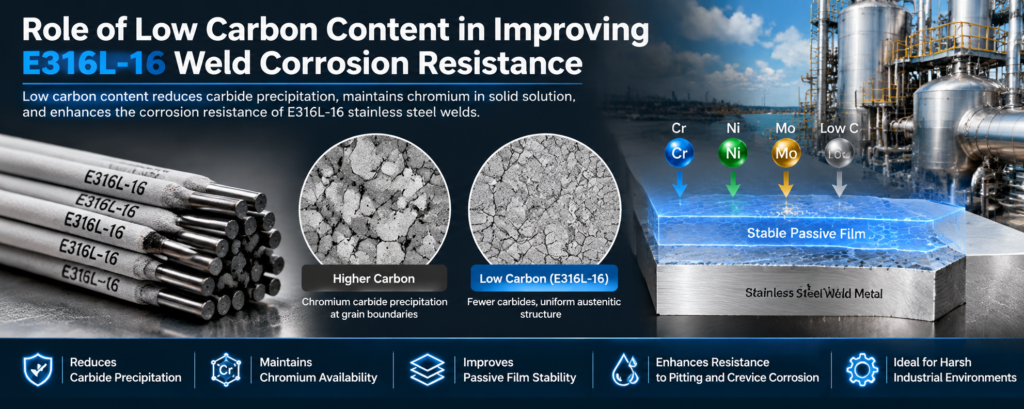
Role of Low Carbon Content in Improving E316L-16 Weld Corrosion Resistance
Introduction
E316L-16 stainless steel electrodes are widely used for welding corrosion-resistant austenitic stainless steels where long-term durability and metallurgical stability are required. The outstanding corrosion performance of E316L-16 welds is strongly associated with its controlled low-carbon composition, combined with a Cr-Ni-Mo alloy system.
In stainless steel welding, carbon content plays a critical role in determining the resistance of weld metal and heat-affected zones (HAZ) against sensitization and intergranular corrosion. Excess carbon can react with chromium during thermal cycles, forming chromium carbides at grain boundaries. This process reduces local chromium concentration and weakens the passive protection of stainless steel.
The low-carbon design of E316L-16 minimizes carbide precipitation, helping maintain chromium availability, stabilize the passive film, and improve corrosion resistance in aggressive environments.
1. Importance of Carbon Control in Stainless Steel Welds
Carbon is an important alloying element in steels because it can increase hardness and strength. However, in corrosion-resistant austenitic stainless steels, excessive carbon may negatively affect corrosion performance.
During welding, the material experiences rapid heating and cooling cycles. When the temperature enters the sensitization range, carbon atoms can diffuse toward grain boundaries and react with chromium:
Cr + C → Chromium Carbides (Cr23C6)
The formation of chromium carbide consumes chromium near grain boundaries, creating chromium-depleted zones.
These depleted regions have:
- Reduced passive film stability
- Higher electrochemical activity
- Increased susceptibility to intergranular corrosion
Therefore, controlling carbon content is essential for maintaining corrosion resistance after welding.
E316L-16 is classified as a low-carbon stainless steel electrode, with carbon content controlled to limit carbide formation during welding and subsequent service exposure.
2. Effect of Low Carbon Content on Chromium Carbide Precipitation
2.1 Prevention of Sensitization
Sensitization is one of the main causes of corrosion failure in welded stainless steel structures.
When conventional stainless steel weld metals contain higher carbon levels, chromium carbide precipitation may occur at grain boundaries during slow cooling or repeated thermal exposure.
The consequences include:
- Chromium depletion around grain boundaries
- Reduced corrosion resistance
- Increased risk of weld decay
The low carbon content of E316L-16 significantly reduces the amount of available carbon for carbide formation, allowing chromium to remain distributed throughout the austenitic matrix.
As a result, the welded joint maintains better resistance against intergranular corrosion.
2.2 Maintaining Passive Film Stability
The corrosion resistance of stainless steel depends on the formation of a thin and stable passive oxide layer.
This passive film mainly contains chromium oxides, which protect the underlying metal from chemical attack.
When chromium is consumed by carbide precipitation, fewer chromium atoms are available to support passive film regeneration.
Low-carbon E316L-16 weld metal helps preserve chromium concentration, improving:
- Passive film recovery
- Surface stability
- Resistance to localized corrosion initiation
This mechanism is particularly important for equipment exposed to chloride-containing environments.
3. Synergistic Role of Carbon Reduction and Molybdenum Addition
Although carbon control is essential, the corrosion resistance of E316L-16 also benefits from its molybdenum-containing alloy design.
The Cr-Ni-Mo system provides multiple corrosion protection mechanisms:
Chromium (Cr)
Chromium promotes the formation of a protective passive oxide layer and improves general corrosion resistance.
E316L-16 Nickel (Ni)
Nickel stabilizes the austenitic structure and enhances ductility and toughness after welding.
E316L-16 Molybdenum (Mo)
Molybdenum improves resistance to:
- Chloride-induced pitting corrosion
- Crevice corrosion
- Acid-containing environments
The combination of low carbon content and molybdenum addition allows E316L-16 welds to maintain both structural stability and corrosion resistance under demanding service conditions.
4. Influence of Low Carbon Content on Weld Microstructure
The welding process produces a complex solidification structure consisting of:
- Austenitic matrix
- Delta ferrite regions
- Dendritic segregation zones
Carbon content influences the evolution of these microstructural features.
A lower carbon level helps:
- Reduce carbide precipitation along grain boundaries
- Maintain uniform alloy distribution
- Improve microstructural stability
A more homogeneous weld structure reduces localized electrochemical differences between different regions of the weld metal.
This contributes to improved resistance against:
- Pitting initiation
- Grain boundary attack
- Crevice corrosion
5. Corrosion Behavior of E316L-16 in Chloride Environments
Chloride ions are among the most aggressive species affecting stainless steel components.
They can penetrate defects in the passive film and initiate localized corrosion.
Common failure mechanisms include:
Pitting Corrosion
Small localized pits develop when passive film breakdown occurs.
Crevice Corrosion
Restricted areas with limited oxygen supply become vulnerable to corrosion.
Intergranular Corrosion
Chromium-depleted grain boundaries become preferential corrosion paths.
The low-carbon structure of E316L-16 reduces the possibility of chromium depletion, while molybdenum improves resistance against chloride-related attack.
This combined effect makes E316L-16 suitable for applications requiring reliable corrosion performance.
6. Effect of Welding Heat Input on Low-Carbon Performance
Although E316L-16 provides excellent resistance against sensitization, welding parameters still influence final performance.
Important factors include:
E316L-16 Heat Input
Excessive heat input may increase:
- Grain growth
- Element segregation
- Cooling time through sensitization temperature ranges
E316L-16 Cooling Rate
Rapid cooling can reduce unwanted precipitation, while controlled cooling helps maintain balanced weld microstructure.
E316L-16 Multipass Welding
Repeated thermal cycles may affect previously deposited layers, making carbon control especially important in thick-section welding.
Optimizing welding procedures ensures that the low-carbon advantage of E316L-16 is fully maintained.
7. Applications Requiring Low-Carbon E316L-16 Welds
Because of its corrosion-resistant characteristics, E316L-16 is commonly selected for applications including:
- Chemical processing equipment
- Marine structures
- Pharmaceutical manufacturing systems
- Food processing equipment
- Pressure vessels
- Stainless steel piping systems
These applications often require welded joints that can maintain corrosion resistance throughout long-term operation.
8. Comparison Between Standard 316 and Low-Carbon 316L Weld Metal
| Feature | Standard 316 Weld Metal | E316L-16 Weld Metal |
|---|---|---|
| Carbon content | Higher | Lower |
| Carbide precipitation risk | Higher | Reduced |
| Intergranular corrosion resistance | Moderate | Improved |
| Chromium availability | More affected by carbide formation | Better maintained |
| Long-term corrosion stability | Depends on thermal history | Enhanced |
The primary advantage of E316L-16 is not simply lower carbon content, but the ability to preserve the corrosion-resistant alloy structure after welding.
E316L-16 Conclusion
Low carbon content is a key metallurgical factor responsible for the excellent corrosion resistance of E316L-16 stainless steel welds. By reducing chromium carbide precipitation, low carbon design prevents chromium depletion and maintains the stability of the passive protection layer.
Combined with chromium, nickel, and molybdenum alloying, E316L-16 provides improved resistance against intergranular corrosion, pitting corrosion, and chloride-induced degradation.
For stainless steel welding applications where corrosion performance and long-term reliability are critical, controlling carbon content remains one of the most effective strategies for achieving durable weld joints.