

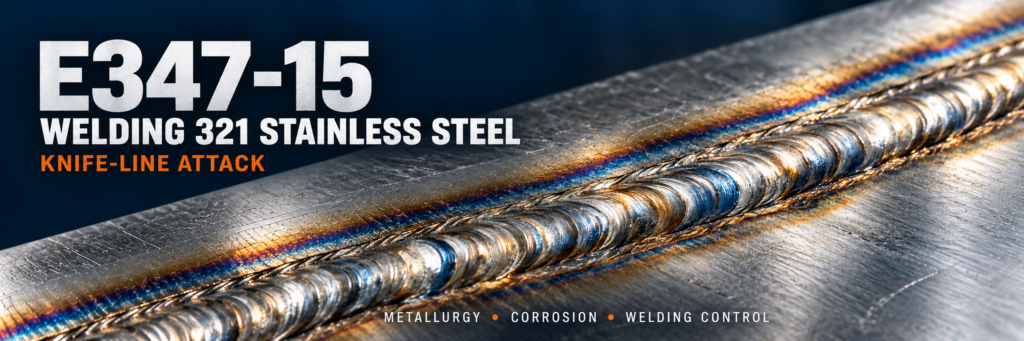
E347-15 Welding of 321 Stainless Steel: Knife-Line Attack
E347-15 is a commonly selected welding electrode for joining 321 stainless steel. Its niobium-stabilized weld metal makes it suitable for this titanium-stabilized base material. However, selecting a stabilized electrode does not automatically protect every part of the welded joint against intergranular corrosion.
One particular concern is knife-line attack, a localized form of corrosion that can develop immediately beside the fusion boundary. Understanding this mechanism is essential when welded components face thermal exposure and aggressive corrosive environments.
This article explains the role of E347-15, how knife-line attack develops in 321 stainless steel, and which fabrication controls deserve attention.
Why Use E347-15 for Welding 321 Stainless Steel?
Type 321 is an austenitic stainless steel stabilized with titanium. Titanium combines with carbon, reducing the carbon available to form chromium carbides that can impair intergranular corrosion resistance.
During welding, the filler metal must produce a suitable weld deposit while maintaining practical arc performance and alloy recovery. Niobium-stabilized 347-type consumables are commonly used for welding 321 stainless steel because titanium is difficult to transfer consistently through the welding arc.
E347-15 provides a niobium-stabilized stainless steel deposit through shielded metal arc welding, also called SMAW or stick welding. Its basic coating is intended for operation with direct current electrode positive, or DCEP.
The key distinction is that E347-15 stabilizes the deposited weld metal; it does not directly stabilize the adjacent 321 base metal.
What Is Knife-Line Attack?
Knife-line attack is a narrow band of intergranular corrosion in the heat-affected zone of stabilized stainless steel, immediately adjacent to the fusion boundary.
Its name describes the thin, line-like appearance of the affected region. Although the visible band may be small, corrosion can penetrate along grain boundaries and compromise joint integrity.
Knife-line attack should not be confused with a fabrication crack. A joint may initially appear sound and develop corrosion damage only after a susceptible microstructure encounters an appropriate corrosive environment.
Knife-Line Attack vs. Conventional Weld Decay
| Feature | Knife-Line Attack | Conventional Weld Decay |
|---|---|---|
| Typical location | Immediately adjacent to the fusion boundary | A sensitized region farther into the heat-affected zone |
| Characteristic materials | Stabilized stainless steels, including 321 and 347 | Susceptible austenitic stainless steels |
| Important mechanism | Dissolution of stabilizing carbides followed by sensitization | Chromium carbide precipitation during a suitable thermal cycle |
| Typical appearance | Very narrow band of intergranular corrosion | Broader region of intergranular attack |
Both involve chromium-depleted grain boundaries, but the thermal history that creates susceptibility differs.
How Knife-Line Attack Develops in 321 Stainless Steel
The mechanism involves a sequence of metallurgical changes rather than one isolated welding parameter.
1. Welding Dissolves Stabilizing Carbides
The 321 base metal immediately beside the molten weld experiences a very high peak temperature. In this narrow region, titanium carbides can dissolve, releasing carbon into the surrounding matrix.
The rest of the heat-affected zone may retain effective stabilization, while this small region temporarily loses that protection.
2. Subsequent Heating Can Cause Sensitization
If the affected region later experiences a suitable time-temperature exposure, chromium carbides can precipitate at grain boundaries before effective titanium stabilization is restored.
Relevant exposure may occur during subsequent welding passes, certain heat treatments, or elevated-temperature service.
Susceptibility depends on the complete thermal history, material chemistry, and precipitation behavior. A single peak temperature or heat-input value cannot fully describe the risk.
3. A Corrosive Environment Attacks the Susceptible Band
Chromium carbide precipitation can leave nearby grain-boundary regions depleted in chromium. When the joint encounters an environment capable of attacking those regions, localized intergranular corrosion may develop.
Sensitization creates susceptibility; the service environment determines whether corrosion occurs and how rapidly it progresses.
Can E347-15 Prevent Knife-Line Attack?
E347-15 is an appropriate filler-metal option for many 321 stainless steel welding applications, but it cannot guarantee protection against knife-line attack in the base-metal heat-affected zone.
Niobium in the weld deposit helps stabilize carbon within the deposited metal. It does not reliably restore titanium carbide stabilization throughout the adjacent 321 heat-affected zone.
For this reason, evaluating only the electrode classification or weld-metal chemistry is insufficient. The assessment must also consider:
- Base-metal composition and delivery condition.
- Joint geometry and material thickness.
- Welding sequence and repeated thermal cycles.
- Any post-weld heat treatment.
- Operating temperature and duration.
- The actual corrosive medium.
A satisfactory weld deposit and a corrosion-resistant heat-affected zone are related but separate requirements.
Welding Controls That Help Manage the Risk
Use a Qualified Welding Procedure
An E347-15 welding procedure should define electrode diameter, current range, polarity, travel speed, joint preparation, welding position, and interpass controls.
Settings should follow the selected electrode’s technical data and the applicable procedure qualification. Generic current tables cannot establish corrosion suitability for every joint.
E347-15 Control Heat Input Without Sacrificing Fusion
Excessive thermal exposure can increase distortion and alter the heat-affected zone. However, reducing heat input too aggressively can introduce lack of fusion or other defects.
The objective is a controlled, repeatable thermal cycle that produces a sound joint. Lower heat input alone does not eliminate carbide dissolution immediately beside the fusion boundary.
E347-15 Manage Interpass Temperature and Welding Sequence
For multipass welding, define and monitor interpass temperature. Plan the pass sequence to avoid unnecessary heat accumulation and repeated local reheating.
Where practical, use controlled bead placement and avoid prolonged arc dwell. Repair passes should also follow the qualified procedure because they introduce additional thermal cycles.
E347-15 Maintain Electrode and Joint Cleanliness
Store E347-15 electrodes according to the manufacturer’s instructions and use the specified re-drying procedure when required. Clean joint surfaces and remove slag between passes.
These measures support weld soundness. They should not be treated as a direct remedy for knife-line attack, which is fundamentally a metallurgical corrosion problem.
E347-15 Does Post-Weld Heat Treatment Prevent Knife-Line Attack?
Post-weld heat treatment is not automatically beneficial for welded 321 stainless steel.
An unsuitable thermal cycle can promote sensitization. A properly designed stabilization treatment may improve resistance in appropriate circumstances, but its effectiveness depends on temperature, holding time, material condition, component geometry, and cooling practice.
Avoid specifying a generic stress-relief cycle simply because the component is welded. Establish the purpose of the treatment first, then verify that the proposed cycle is suitable for the material and service.
For demanding applications, heat-treatment decisions should be supported by metallurgical review and relevant qualification testing.
How to Evaluate E347-15 Welded 321 Stainless Steel
Routine weld inspection and corrosion evaluation answer different questions.
Visual examination and suitable nondestructive testing can identify fabrication imperfections. They do not, by themselves, demonstrate resistance to knife-line attack.
For corrosion-critical applications, an evaluation may include:
- Representative welded coupons: Reproduce production thickness, joint design, pass sequence, and thermal treatment.
- Metallographic examination: Examine the fusion boundary and adjacent heat-affected zone for localized intergranular damage.
- Intergranular corrosion testing: Select an appropriate test method and acceptance criteria for the material and specification.
- Service-relevant exposure: Consider whether laboratory testing represents the actual corrosive environment.
ASTM A262 includes practices for evaluating susceptibility to intergranular attack in austenitic stainless steels. The appropriate practice must be selected carefully; passing one test does not establish suitability for every service environment.
E347-15 Conclusion
Successful E347-15 welding of 321 stainless steel requires more than correct filler selection. The electrode provides niobium-stabilized weld metal, while knife-line attack concerns a narrow region of the titanium-stabilized base metal affected by welding heat.
A qualified welding procedure, controlled thermal history, appropriate heat-treatment decisions, and service-relevant testing provide the strongest basis for managing this risk.