

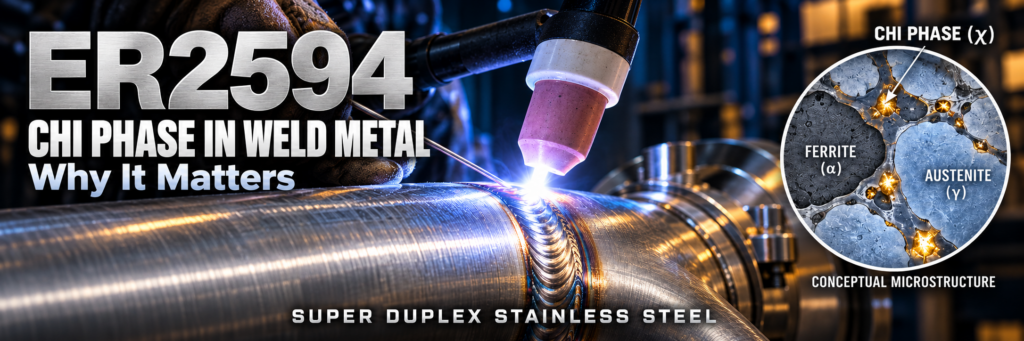
Chi Phase in ER2594 Weld Metal: Why It Matters
ER2594 is a super duplex stainless steel filler metal used where welded joints need high strength and resistance to aggressive environments. Its performance depends on a suitable ferrite–austenite balance and the retention of corrosion-resistant alloying elements in those phases.
However, unfavorable thermal exposure can promote unwanted intermetallic precipitates. Chi phase in ER2594 weld metal is one concern because it concentrates molybdenum and chromium, potentially leaving neighboring regions less resistant to corrosion.
Chi phase deserves attention during welding procedure development, multipass fabrication, repair welding, and failure analysis. Understanding its formation helps explain why a weld can have acceptable bulk chemistry yet deliver disappointing corrosion or toughness results.
What Is Chi Phase?
Chi phase, represented by the Greek letter χ, is an iron–chromium–molybdenum intermetallic phase. In duplex stainless steels, it is typically particularly rich in molybdenum compared with the surrounding matrix.
Unlike ferrite and austenite, chi phase is not an intended constituent of a properly fabricated ER2594 weld.
It can precipitate from ferrite during suitable elevated-temperature exposure, frequently at ferrite–austenite interfaces or other favorable nucleation sites. Its size, distribution, and relationship with other precipitates depend on composition and thermal history.
Chi phase may appear during early precipitation stages and can subsequently be consumed as sigma phase develops. This sequence is not identical under every condition, so detecting one phase does not establish the complete history of the weld.
Why ER2594 Weld Metal Can Form Chi Phase
ER2594 contains substantial chromium and molybdenum to support corrosion resistance. These elements also contribute to the thermodynamic driving force for intermetallic precipitation.
During welding, the deposit solidifies predominantly as ferrite, followed by partial transformation to austenite during cooling. Alloying elements redistribute between the phases, and solidification introduces local chemical variations.
Consequently, chi-phase formation depends on more than the nominal filler composition. Important variables include:
- Local chromium and molybdenum enrichment.
- Ferrite distribution and interphase boundary area.
- Cooling rate after deposition.
- Reheating by subsequent passes.
- The cumulative duration of elevated-temperature exposure.
An ER2594 classification alone cannot predict the precipitation behavior of every diluted weld deposit.
What Temperatures Promote Chi-Phase Formation?
There is no single temperature at which chi phase automatically forms in every ER2594 weld.
Research on comparable 2509-type super duplex weld metal has identified chi particles after exposure around 700–800°C and thin interfacial films under some conditions around 600–700°C. These findings demonstrate that morphology and precipitation behavior change with temperature and holding time. They should not be interpreted as universal ER2594 welding limits.
The practical concern is time spent within a precipitation-sensitive range. Brief passage through that range during a controlled welding cycle differs from prolonged holding or repeated reheating.
Weld-metal chemistry, segregation, and prior thermal cycles influence the relevant time–temperature relationship. A diagram developed for solution-treated base metal should therefore not be applied directly to an ER2594 weld without considering these differences.
Chi Phase vs. Sigma Phase in ER2594 Welds
Chi and sigma are both unwanted intermetallic phases, but they are distinct constituents.
| Characteristic | Chi phase | Sigma phase |
|---|---|---|
| Symbol | χ | σ |
| Crystal structure | Complex cubic | Tetragonal |
| Typical chemistry | Particularly molybdenum-rich | Chromium- and molybdenum-rich |
| Common locations | Ferrite and ferrite–austenite interfaces | Ferrite and interphase boundaries |
| Development | Can occur early and later be consumed | Can grow as ferrite decomposes |
| Identification challenge | Small quantities may be difficult to detect | Often easier to recognize after substantial growth |
Neither phase should be identified from appearance alone. Their morphology can vary, and other constituents may produce similar contrast after etching.
Their effects can also overlap. Corrosion or toughness deterioration may involve chi, sigma, nitrides, secondary austenite, and changes in phase balance acting together.
How Chi Phase Affects Corrosion Resistance
Local Alloy Depletion
The main corrosion concern is the redistribution of alloying elements.
When chi phase forms, it incorporates molybdenum and chromium from the surrounding material. Adjacent regions can become depleted in elements needed to maintain resistance to localized attack.
This helps explain why a weld with apparently adequate overall composition may contain vulnerable microscopic regions.
Greater Susceptibility to Localized Attack
In chloride-containing environments, depleted regions may become preferential initiation sites for corrosion.
The severity depends on the extent and continuity of depletion, surface condition, temperature, and solution chemistry. A small, isolated precipitate and an extended interfacial network do not necessarily produce equivalent behavior.
However, low precipitate volume alone should not be treated as proof of acceptable performance.
Why Bulk PREN Is Not Enough
A common screening expression for pitting resistance is:
PREN = %Cr + 3.3 × %Mo + 16 × %N
This expression is useful for comparing nominal alloy chemistry, but it does not describe precipitation, segregation, or local depletion.
A high bulk PREN cannot confirm that an ER2594 weld is free from chi phase or resistant to localized corrosion.
Where precipitation is suspected, microstructural examination and suitable corrosion testing provide information that a chemistry calculation cannot.
How Chi Phase Can Affect Toughness
Intermetallic precipitation can impair the ability of super duplex weld metal to absorb energy and resist crack propagation.
The effect depends on precipitate amount, morphology, location, and interaction with other microstructural features. Boundary-associated particles or films can be particularly relevant to crack initiation and propagation.
Nevertheless, low impact toughness does not prove that chi phase is responsible. Excessive ferrite, nitrides, inclusions, welding defects, and other precipitates may also contribute.
A defensible failure analysis connects the mechanical results with the actual microstructure.
Welding Conditions That Increase Concern
Excessive Heat Accumulation
High heat input combined with insufficient cooling between passes can extend thermal exposure in previously deposited metal.
The relevant issue is the resulting thermal cycle, rather than heat input considered in isolation.
Multipass Reheating
Earlier weld passes experience additional heating as later passes are deposited. Some regions may receive repeated subsolidus thermal cycles favorable to precipitation.
This makes pass sequence and interpass control important in thick sections.
Repeated Repairs
Repair welding adds thermal exposure to an already welded joint. Several repair cycles can create a different metallurgical condition from the original procedure qualification.
Repair depth, location, deposited volume, and previous thermal history should be considered together.
Unsuitable Post-Weld Heat Treatment
A stress-relief cycle intended for another material family may expose an ER2594 joint to temperatures that promote harmful precipitation.
Post-weld heat treatment should not be added simply because the component is thick or highly restrained.
How to Reduce Chi-Phase Risk in ER2594 Welding
Use a Qualified Thermal Window
Develop a welding procedure that achieves sound fusion and adequate austenite formation while avoiding unnecessary exposure to precipitation-sensitive temperatures.
The lowest possible heat input is not automatically the best choice. Excessively rapid cooling can leave excessive ferrite or encourage other undesirable features.
Control Interpass Temperature
Measure interpass temperature consistently and follow the limits established for the consumable, material, joint, and project specification.
Interpass temperature does not directly represent the temperature at which chi phase forms. It controls the starting condition for subsequent passes and helps limit cumulative heat accumulation.
Manage Pass Sequence and Repairs
Plan bead placement and deposition sequence to control reheating. Avoid unnecessary remelting or repeated local repairs.
For critical fabrication, record repair history so that additional thermal exposure remains traceable.
Control Dilution
Base-metal dilution changes the deposited composition and can influence phase transformation and precipitation behavior.
Dissimilar joints and overlays require particular attention because the weld may differ substantially from undiluted ER2594.
Maintain Appropriate Gas Protection
Suitable shielding and backing gases help control oxidation and nitrogen behavior.
Nitrogen retention supports austenite formation, but gas selection is not a standalone method for preventing chi phase. Gas protection and thermal control address different aspects of weld quality.
How Is Chi Phase Detected?
ER2594 Optical Metallography
Proper preparation and etching can reveal suspicious intermetallic constituents and guide further examination.
However, small chi particles may be missed, and optical appearance alone may not distinguish chi from sigma.
Scanning Electron Microscopy
Backscattered-electron imaging is useful for locating compositionally distinct particles. Molybdenum-rich chi phase can appear bright relative to the matrix.
Brightness is a screening clue, not a definitive phase identification.
ER2594 Elemental and Crystallographic Analysis
Energy-dispersive X-ray spectroscopy can assess whether particles are enriched in molybdenum and chromium. Very small particles require caution because the surrounding matrix can influence the result.
Where necessary, electron backscatter diffraction or transmission electron microscopy can provide crystallographic evidence. X-ray diffraction may struggle to detect very low phase fractions.
ER2594 Performance Testing
Corrosion and impact tests assess consequences that microscopy alone cannot establish.
Neither a corrosion-test failure nor a low impact result uniquely identifies chi phase. The strongest assessment combines test results, microscopy, and welding records.
ER2594 Does Acceptable Ferrite Content Prove the Weld Is Safe?
No. Ferrite measurement evaluates one aspect of the microstructure.
An ER2594 weld can fall within a specified ferrite range while still containing small amounts of harmful precipitates. Ferrite measurements also depend on technique and sampling location.
A fuller assessment considers phase balance, intermetallic precipitation, corrosion resistance, mechanical properties, and the applicable acceptance criteria.
ER2594 Can Chi Phase Be Removed After Welding?
Suitable solution treatment followed by sufficiently rapid cooling can dissolve intermetallic phases in compatible material systems. However, this requires a carefully selected and validated heat-treatment cycle.
It may be impractical for large assemblies, dissimilar joints, or components sensitive to distortion. In those cases, removal and controlled rewelding may be more appropriate.
Grinding, pickling, and passivation cannot remove chi phase distributed within the weld metal. They address surface condition rather than internal precipitation.
Protecting ER2594 Weld Performance
Chi phase matters because corrosion resistance depends on where alloying elements remain after welding, not simply how much chromium or molybdenum appears on a material certificate.
For ER2594 fabrication, effective control combines a qualified thermal window, consistent interpass management, controlled dilution, and appropriate inspection. When corrosion or toughness results are unexpected, examining intermetallic precipitation helps connect the welding history to the finished joint’s performance.