
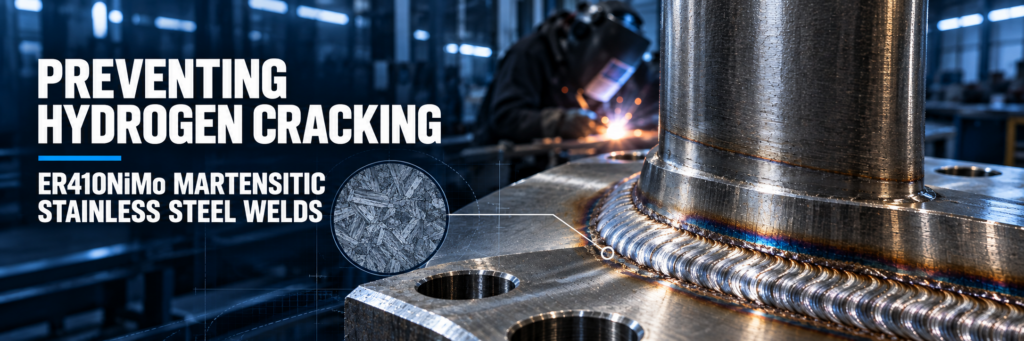
Preventing Hydrogen Cracking in ER410NiMo Martensitic Stainless Steel Welds
Hydrogen cracking is a delayed weld defect that can occur in ER410NiMo weld metal or the heat-affected zone (HAZ). It may appear hours after welding, sometimes after the joint has cooled and passed an initial visual inspection. In martensitic stainless steel welds, the risk is linked to the combination of diffusible hydrogen, a hard or brittle microstructure, and tensile stress.
Preventing hydrogen cracking requires a coordinated welding procedure. Clean, dry materials help limit hydrogen input; a qualified thermal cycle manages cooling and transformation; and appropriate inspection helps detect cracks that develop after welding. No single measure can replace a procedure qualified for the specific base metal, joint design, thickness, restraint, and service requirements.
Why ER410NiMo Welds Can Be Susceptible
ER410NiMo is a martensitic stainless steel filler metal used for joining or repairing compatible martensitic and martensitic-ferritic materials. As the weld metal and HAZ cool, they may form martensitic structures with high hardness and limited ductility. If diffusible hydrogen is present while the joint is under tensile stress, cracking can initiate in the weld or near the fusion boundary.
The risk depends on more than the filler classification. Base-metal chemistry and condition, section thickness, joint restraint, weld sequence, heat input, and the selected post-weld heat treatment (PWHT) all affect the result. Repairs to cast components can also involve local variations in thickness, previous weld metal, or residual stress.
Hydrogen-assisted cracking is different from solidification cracking, which forms as weld metal solidifies. Crack location, appearance, timing, and examination results should be considered together when identifying the failure mechanism.
Control Hydrogen Before and During Welding
Hydrogen can enter the weld from moisture, condensation, oil, grease, paint, rust, cutting fluids, and other surface contamination. Shielding gas systems and consumables can also introduce moisture if they are contaminated or poorly stored.
Before welding, remove contaminants from the joint and surrounding area. Make sure the joint is dry, including the root face and any prepared surfaces. Avoid welding on cold components when condensation may form. Store filler wire and other consumables according to their specified handling requirements.
ER410NiMo solid wire does not use the same rebaking routine as a moisture-sensitive covered electrode. Its surface must still be kept clean and dry. For gas-shielded processes, check the shielding-gas supply, hoses, connections, and flow conditions. Gas quality and equipment condition should meet the procedure requirements.
Use a Qualified Preheat and Interpass Temperature
Preheating can reduce the cooling rate and give diffusible hydrogen more time to leave the weld and HAZ. Maintaining a controlled interpass temperature during multipass welding helps keep the thermal cycle within the qualified range.
The correct temperature is not universal. It depends on the base-metal grade and condition, section thickness, joint geometry, restraint, process, and PWHT plan. A temperature suitable for one CA6NM repair, for example, should not automatically be applied to every ER410NiMo weld.
Measure temperature at defined locations using an appropriate method, and follow the qualified welding procedure specification (WPS). Avoid relying on a nominal torch setting or judging temperature by appearance. Excessive or poorly controlled heating can create other microstructural or mechanical-property concerns, so simply increasing preheat is not a reliable solution.
Manage Heat Input, Restraint, and Weld Sequence
Heat input influences cooling behavior and the resulting weld and HAZ microstructure. Use the qualified range for current, voltage, travel speed, and pass sequence. Changes to these variables can alter cooling rate, bead shape, dilution, and the mechanical condition of the joint.
High restraint increases tensile stress and can raise cracking risk. Where the design permits, reduce unnecessary restraint and avoid sequences that lock the joint before shrinkage can be accommodated. For repairs, remove the full extent of an existing crack and verify the excavation before depositing new weld metal. Welding over a crack does not remove its cause and may leave a defect beneath the repair.
A balanced sequence can also help limit distortion and localized stress. The WPS should define essential details such as process, filler metal, preheat, interpass limits, heat input, and any required thermal treatment.
Apply PWHT Only as Specified
PWHT may be required to temper martensitic structures, reduce hardness, or meet mechanical-property requirements. Its temperature, holding time, heating and cooling rates, and timing should come from the qualified procedure and applicable design requirements.
PWHT is not a substitute for hydrogen control or a suitable welding sequence. An inappropriate thermal cycle may fail to produce the required properties or may create new problems. Local heat treatment on a large or complex component needs particular care because temperature gradients can produce uneven properties and additional stress.
The procedure should also clarify whether any post-weld holding or controlled cooling is required before final heat treatment. Follow the specified sequence rather than improvising a temperature or hold time in the field.
Inspect for Delayed Cracking
A weld that looks sound immediately after completion can still develop hydrogen-assisted cracks later. Inspection timing should therefore follow the applicable code, project requirements, and qualified procedure, particularly for restrained or critical repairs.
Visual examination can identify surface-breaking cracks but may not reveal subsurface flaws. Depending on the component and acceptance criteria, surface or volumetric examination may be required. If cracking is found, document its location and orientation, establish the likely cause, and revise the repair plan before welding again.
Inspection should cover both the weld metal and the adjacent HAZ. Where the risk is significant, a defined delayed examination interval can help detect cracks that were not present or detectable during the initial inspection.
Practical Checklist for ER410NiMo Welding
- Confirm the base-metal grade, condition, and repair requirements.
- Use a qualified WPS and appropriately qualified personnel.
- Remove moisture, oil, grease, paint, rust, and other contaminants.
- Keep filler wire, shielding gas, and welding equipment in suitable condition.
- Apply and record the specified preheat and interpass temperatures.
- Stay within the qualified heat-input and welding-parameter ranges.
- Reduce avoidable restraint and follow the planned weld sequence.
- Complete PWHT only when required and exactly as specified.
- Perform the required examinations, including delayed inspection where applicable.
Frequently Asked Questions
Can ER410NiMo welds crack after welding is complete?
Yes. Hydrogen-assisted cracking can be delayed. A crack may form after the weld has cooled, so inspection timing should reflect the procedure and project requirements.
Does preheating prevent all hydrogen cracking?
No. Preheating can support hydrogen control and manage cooling, but it cannot compensate for contaminated surfaces, unsuitable consumables, excessive restraint, or an unqualified procedure.
Is PWHT always required for ER410NiMo?
No single PWHT requirement applies to every ER410NiMo application. The need and thermal cycle depend on the base metal, component, service conditions, governing requirements, and qualified procedure.
Conclusion
Preventing hydrogen cracking in ER410NiMo martensitic stainless steel welds depends on controlling hydrogen, managing the thermal cycle, limiting unnecessary stress, and verifying the completed joint. Clean, dry preparation and correct consumable handling reduce hydrogen input; qualified preheat, interpass control, and heat input help manage weld cooling; and specified PWHT and delayed inspection support reliable repair quality. For critical components, the welding procedure should be qualified for the actual material, thickness, joint restraint, and service conditions.