

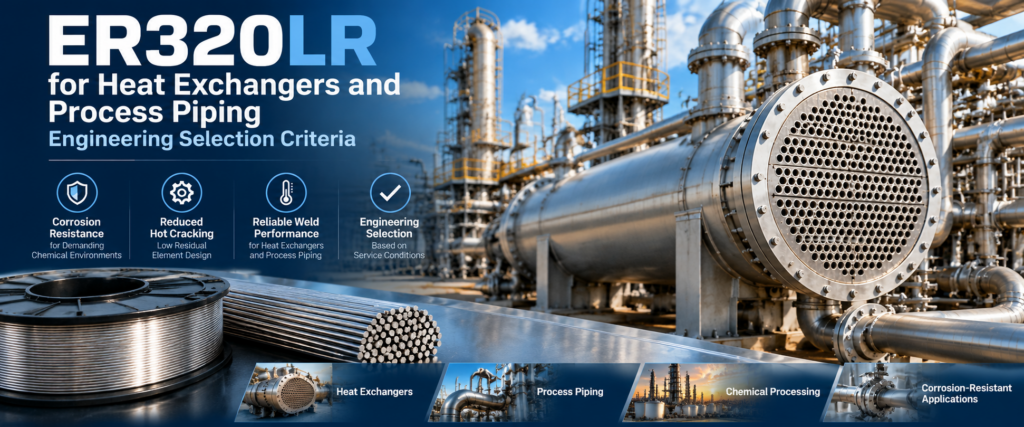
ER320LR for Heat Exchangers and Process Piping: Engineering Selection Criteria
Heat exchangers and process piping are essential components in chemical processing, petrochemical production, pharmaceutical manufacturing, and other industries that handle corrosive fluids. These systems must maintain reliable performance under demanding operating conditions, including elevated temperatures, pressure fluctuations, and exposure to aggressive chemical environments.ER320LR
Selecting the correct welding filler metal is critical to maintaining joint integrity and minimizing corrosion-related failures. ER320LR is a specialized austenitic stainless steel filler metal designed for applications requiring resistance to severe corrosion and improved control of weld metal hot cracking and microfissuring.
With its controlled residual element content and alloy composition containing chromium, nickel, molybdenum, copper, and niobium, ER320LR is commonly considered for welding Alloy 20-type materials and related corrosion-resistant components.
However, its suitability depends on the process fluid, operating temperature, base metal, welding procedure, and required service life. This article examines the engineering criteria for selecting ER320LR in heat exchangers and process piping, with a focus on corrosion performance, weldability, material compatibility, and quality assurance.
1. Understanding ER320LR Filler Metal
ER320LR is an austenitic stainless steel welding filler metal classified under AWS A5.9. The designation LR refers to low residuals, reflecting tighter control of elements associated with hot cracking and microfissuring in fully austenitic weld metal.
Compared with conventional ER320, ER320LR has lower specified maximum levels of carbon, silicon, phosphorus, and sulfur, together with narrower control of manganese and niobium content.
These compositional controls help reduce cracking susceptibility while maintaining the corrosion resistance required for demanding chemical service.
Key Alloying Elements and Their Functions
| Element | Engineering significance |
|---|---|
| Chromium (Cr) | Supports corrosion resistance through the formation of a protective passive film. |
| Nickel (Ni) | Stabilizes the austenitic structure and contributes to ductility and corrosion performance. |
| Molybdenum (Mo) | Improves resistance to localized corrosion in suitable chemical environments. |
| Copper (Cu) | Contributes to corrosion resistance in certain acidic environments, particularly sulfuric acid service. |
| Niobium (Nb) | Helps stabilize the alloy against undesirable chromium carbide precipitation under appropriate conditions. |
| Carbon (C) | Controlled at a low level to limit undesirable effects on weld metal properties. |
| Silicon (Si) | Restricted to help control weld metal cracking susceptibility. |
| Phosphorus (P) and sulfur (S) | Controlled because excessive levels can contribute to solidification cracking and microfissuring. |
| Manganese (Mn) | Controlled within a specified range to support consistent weld metal behavior. |
Typical ER320LR chemistry includes approximately 19–21% chromium, 32–36% nickel, 2–3% molybdenum, and 3–4% copper by weight. Actual composition limits must be verified against the applicable classification and certified consumable documentation.
The defining advantage of ER320LR is not simply its alloy content. Its controlled chemistry is designed to balance corrosion performance with improved resistance to cracking during weld solidification.
2. Why ER320LR Is Considered for Heat Exchangers
Heat exchangers frequently operate in environments where corrosion resistance, thermal performance, and weld integrity must be maintained simultaneously.
Depending on the application, equipment may encounter acidic process streams, contaminated cooling media, chloride-bearing solutions, or combinations of elevated temperature and aggressive chemistry.
ER320LR may be appropriate for heat exchangers manufactured from compatible Alloy 20-type materials when the filler metal and qualified welding procedure meet the required service conditions.
2.1 Corrosion Resistance in Acidic Environments
Sulfuric acid service is an important consideration when selecting Alloy 20-type materials and their matching filler metals.
The chromium, nickel, molybdenum, and copper content of the deposited weld metal contributes to its corrosion behavior. Nevertheless, the actual corrosion rate depends on acid concentration, temperature, dissolved contaminants, flow conditions, and the presence of other chemical species.
A filler metal that performs satisfactorily in one sulfuric acid application may not provide equivalent performance in another.
Before selecting ER320LR, engineers should establish the complete process chemistry and verify that the proposed weld metal is compatible with the expected operating environment.
2.2 Tube-to-Tubesheet and Related Welded Joints
Heat exchanger construction involves several types of welded joints, including tube-to-tubesheet connections, channel assemblies, nozzles, and shell components.
These joints may experience differential thermal expansion, mechanical loading, pressure-related stresses, and localized corrosion.
The suitability of ER320LR depends on the base metal grades, joint design, welding process, accessibility, and the mechanical and corrosion requirements of the finished assembly.
For tube-to-tubesheet welding, engineers must also consider whether the consumable form and deposition process are suitable for the joint geometry and required weld configuration. Qualification should represent the actual production joint as closely as practicable.
2.3 Thermal Cycling and Long-Term Integrity
Heat exchangers frequently undergo startup, shutdown, cleaning, and changes in process temperature.
Repeated thermal cycles can introduce stresses at welds, especially where components have different thermal expansion characteristics or where geometric discontinuities concentrate stress.
Although ER320LR is designed to reduce weld metal cracking susceptibility, filler metal selection alone cannot eliminate these risks.
Appropriate joint design, controlled welding conditions, inspection, and operating procedures remain necessary to maintain long-term reliability.
3. ER320LR for Corrosion-Resistant Process Piping
Process piping systems transport chemicals between reactors, storage vessels, heat exchangers, pumps, and other equipment. Welded joints are potential locations for leakage and localized corrosion if material compatibility or fabrication quality is inadequate.
ER320LR can be considered for piping manufactured from compatible Alloy 20-type materials, particularly where corrosion resistance in acidic chemical environments is a principal design requirement.
3.1 Base Metal Compatibility
The first step in selecting ER320LR is identifying the exact base metal.
Matching the filler metal to a base alloy of similar composition generally helps preserve the intended metallurgical and corrosion characteristics of the joint.
However, dissimilar-metal joints require a separate assessment. Differences in alloy chemistry, dilution, thermal expansion, strength, and corrosion potential can affect joint performance.
ER320LR should not automatically be substituted for a different stainless steel or nickel-based filler metal without reviewing the relevant design requirements and qualifying the proposed combination.
3.2 Process Fluid and Corrosion Mechanisms
The operating fluid determines which corrosion mechanisms must be considered.
Depending on the application, these may include:
General corrosion caused by acidic or chemically aggressive media.
Pitting and crevice corrosion in susceptible environments.
Intergranular corrosion associated with unfavorable metallurgical conditions.
Erosion-corrosion in systems with high fluid velocities or entrained solids.
Stress corrosion cracking under specific combinations of material, environment, and tensile stress.
The presence of copper and molybdenum in ER320LR contributes to its corrosion-resistant alloy design, but it does not guarantee resistance to every corrosion mechanism.
Engineers should evaluate the deposited weld metal and the base metal under representative operating conditions. Where necessary, corrosion testing should account for temperature, fluid concentration, contaminants, and flow conditions.
3.3 Pressure and Temperature Requirements
Process piping may operate across a wide range of pressures and temperatures. The selected filler metal must provide suitable mechanical properties for the intended design and service conditions.
Important considerations include tensile strength, ductility, weld joint efficiency, thermal expansion, fatigue loading, and the effects of temperature on material properties.
The governing piping code and project specification determine the applicable acceptance criteria. These requirements should be established before finalizing the filler metal selection.
4. How ER320LR Helps Control Hot Cracking and Microfissuring
Hot cracking and microfissuring are important concerns in fully austenitic weld metals.
These defects can develop during weld solidification or subsequent high-temperature stages when local strain interacts with vulnerable grain boundaries and segregated constituents.
ER320LR addresses this issue through tighter control of several alloying and residual elements.
4.1 Low Residual Element Content
Phosphorus and sulfur can contribute to low-melting constituents or segregation during solidification. Silicon and carbon also influence weld metal solidification behavior and microstructure.
By restricting the maximum levels of these elements, ER320LR is designed to reduce the likelihood of hot cracking and microfissuring.
This compositional approach is particularly valuable when fabricating corrosion-resistant components where weld integrity and chemical compatibility must be maintained together.
4.2 Controlled Manganese and Niobium
Manganese and niobium are controlled within narrower ranges than in conventional ER320 classifications.
These controls help maintain a more consistent weld metal composition and reduce the variability that can affect solidification behavior.
Niobium also plays a role in carbon stabilization. However, its effect depends on the complete alloy chemistry and thermal history rather than on its concentration alone.
4.3 Welding Conditions Still Matter
The low-residual design of ER320LR does not make the weld immune to cracking.
Joint restraint, heat input, bead sequence, travel speed, weld geometry, and dilution can influence the final result.
For critical heat exchanger and piping applications, engineers should establish a qualified welding procedure and verify that the selected process produces sound weld metal under representative fabrication conditions.
5. Selecting the Appropriate Welding Process
ER320LR is available in solid filler metal forms suitable for applicable gas tungsten arc welding (GTAW) and gas metal arc welding (GMAW) procedures. Other process applications require specific evaluation.
The process should be selected according to joint geometry, material thickness, production requirements, positional access, and the required weld quality.
5.1 Gas Tungsten Arc Welding
GTAW provides precise control of heat input and filler metal deposition, making it useful for root passes, thin sections, and joints requiring careful control of weld pool behavior.
It may be appropriate for smaller-diameter process piping, selected tube connections, and precision fabrication where access and productivity requirements permit.
Shielding gas, filler rod diameter, current, travel speed, and joint preparation should follow the qualified procedure.
5.2 Gas Metal Arc Welding
GMAW can support efficient production for piping, vessel components, and larger fabrication assemblies.
Successful application requires suitable wire feeding, shielding gas selection, transfer mode, and control of deposition conditions.
The selected settings should produce the required fusion, bead shape, and weld metal properties without introducing unacceptable porosity, lack of fusion, or cracking.
5.3 Submerged Arc Welding Considerations
Submerged arc welding requires particular caution when working with ER320LR.
Although this filler metal classification has been used successfully for certain overlay applications, it may be susceptible to cracking when used to join base metals by the submerged arc process.
Engineers should therefore distinguish between overlay or cladding applications and full joint welding. Process suitability must be established through technical evaluation and appropriate procedure qualification rather than assumed from the filler metal classification.
6. ER320LR vs. ER320: Engineering Differences
ER320LR and ER320 have similar basic alloy designs, but their compositional controls differ.
| Selection factor | ER320LR | ER320 |
|---|---|---|
| Carbon content | Lower specified maximum | Higher permitted maximum |
| Silicon content | Lower specified maximum | Higher permitted maximum |
| Phosphorus and sulfur | Tighter residual limits | Less restrictive limits |
| Manganese and niobium | Controlled within narrower ranges | Broader compositional ranges |
| Hot cracking considerations | Designed to reduce hot cracking and microfissuring susceptibility | Greater attention may be needed to cracking susceptibility, depending on chemistry and procedure |
| Typical application | Corrosion-resistant fabrication requiring low-residual weld metal | Compatible alloy applications where its chemistry and qualified performance are acceptable |
ER320LR is often selected when controlling hot cracking and microfissuring is an important fabrication requirement.
However, the appropriate choice depends on the base metal, service environment, welding process, and governing specification. Neither designation should be approved solely on the basis of its name.
7. Engineering Selection Criteria: A Practical Checklist
Before approving ER320LR for heat exchangers or process piping, engineers should evaluate the following factors.
Base Metal and Joint Design
Confirm the exact base metal specification and material condition.
Identify whether the joint involves similar or dissimilar materials.
Review wall thickness, joint geometry, restraint, and accessibility.
Confirm compatibility with the proposed filler metal classification.
Corrosion and Operating Conditions
Establish process fluid composition and potential contaminants.
Define normal and maximum operating temperatures.
Evaluate acid concentration, fluid velocity, and possible deposits.
Consider startup, shutdown, cleaning, and upset conditions.
Confirm that corrosion resistance is supported by relevant data.
Mechanical and Fabrication Requirements
Verify required tensile properties and ductility.
Evaluate fatigue loading, thermal cycling, and stress concentrations.
Establish acceptable weld quality and inspection criteria.
Review the effects of dilution and welding thermal cycles.
Confirm the suitability of the selected welding process.
Qualification and Documentation
Review certified filler metal chemistry and traceability.
Qualify the welding procedure according to the applicable code.
Perform required mechanical tests and nondestructive examination.
Conduct corrosion testing when required by the application.
Maintain records of consumable batches, welding parameters, inspection results, and repairs.
A documented selection process reduces the risk of choosing a consumable that meets nominal chemistry requirements but does not satisfy the actual operating conditions.
8. Common Mistakes in ER320LR Selection
Assuming ER320LR Is Suitable for Every Acidic Environment
Corrosion resistance depends on the complete process environment. Acid concentration, temperature, contaminants, and fluid velocity can significantly affect material performance.
Ignoring Dissimilar-Metal Compatibility
A filler metal designed for Alloy 20-type materials may not be suitable for every stainless steel or nickel alloy combination. Dissimilar joints require specific engineering evaluation.
Treating Low Residual Content as a Guarantee Against Cracking
ER320LR is designed to reduce cracking susceptibility, not eliminate every possible cracking mechanism. Welding conditions and joint restraint remain important.
Selecting a Welding Process Without Qualification
A process that works well for one joint configuration may not be appropriate for another. This is particularly important when evaluating submerged arc welding for joining applications.
Relying Only on Nominal Filler Metal Chemistry
The deposited weld metal can differ from the original filler metal because of dilution and welding conditions. Qualification testing should verify the properties of the actual joint.
Frequently Asked Questions
What is ER320LR welding wire used for?
ER320LR is primarily used to weld compatible corrosion-resistant alloys, particularly Alloy 20-type materials, in applications requiring resistance to aggressive chemical environments and improved control of weld metal hot cracking and microfissuring.
Is ER320LR suitable for heat exchangers?
It may be suitable for heat exchangers manufactured from compatible base materials when the corrosion environment, joint design, mechanical properties, and qualified welding procedure support its use.
Can ER320LR be used for process piping?
Yes, ER320LR can be considered for compatible process piping applications, especially where resistance to certain acidic environments is important. The final selection must account for process fluid chemistry, temperature, pressure, and the applicable piping code.
Why is ER320LR preferred over ER320 in some applications?
ER320LR has tighter limits on carbon, silicon, phosphorus, and sulfur, along with narrower manganese and niobium ranges. These controls are intended to reduce hot cracking and microfissuring susceptibility while maintaining corrosion resistance.
Does ER320LR eliminate hot cracking?
No. Its controlled chemistry helps reduce susceptibility, but cracking can still occur under unfavorable welding conditions. Joint design, heat input, restraint, dilution, and procedure qualification remain important.
What should be verified before purchasing ER320LR?
Confirm the classification, certified chemical composition, available mechanical test data, consumable form, compatibility with the base material, intended welding process, and project-specific qualification requirements.
Conclusion
ER320LR is a specialized low-residual austenitic stainless steel filler metal designed for corrosion-resistant fabrication where weld metal integrity and cracking control are important.
For heat exchangers and process piping, its principal engineering advantages include controlled alloy chemistry, resistance to certain aggressive chemical environments, and reduced susceptibility to hot cracking and microfissuring compared with less tightly controlled fully austenitic weld metal compositions.
Nevertheless, successful application depends on matching the filler metal to the base material, process chemistry, operating conditions, and fabrication requirements.
By evaluating corrosion mechanisms, joint compatibility, welding process limitations, and qualification data, engineers can make a more reliable selection and support the long-term integrity of heat exchangers and process piping systems.