

Hydrogen-Assisted Cracking in ER410 Welds: Mechanisms and Prevention Strategies
Hydrogen-assisted cracking in ER410 welds is a significant concern when joining martensitic stainless steel components. Although ER410 welding wire is designed to provide a weld deposit with a chemical composition similar to Type 410 stainless steel, its hardening characteristics can increase susceptibility to cracking during cooling and after welding.
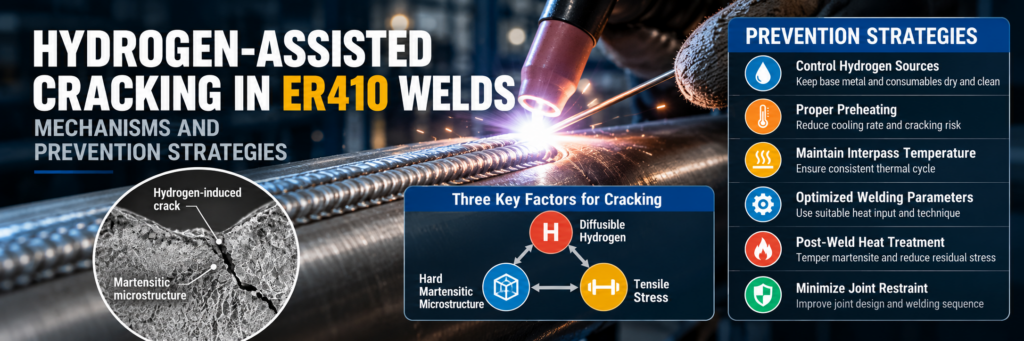
The combination of diffusible hydrogen, a hard and brittle microstructure, and tensile stress can lead to delayed cracking in the weld metal or heat-affected zone (HAZ). These cracks may develop hours after welding, making prevention, temperature control, and appropriate inspection essential for reliable fabrication.
Understanding the mechanisms of hydrogen-assisted cracking in ER410 welds helps welding engineers develop effective procedures, improve joint integrity, and reduce costly repairs.
1. Understanding ER410 Weldability
ER410 is a martensitic stainless steel filler metal containing approximately 12% chromium. It is commonly selected for welding compatible Type 410 stainless steel components where strength, hardness, wear resistance, and corrosion resistance are important.
Unlike austenitic stainless steels, ER410 weld metal can transform into martensite during cooling. This transformation provides useful mechanical properties but also creates metallurgical challenges.
Three characteristics influence its cracking susceptibility:
High hardenability: The weld metal and heat-affected zone can form hard martensitic structures during cooling.
Limited ductility in the as-welded condition: Untempered martensite can tolerate less plastic deformation than a properly tempered structure.
Sensitivity to hydrogen and residual stress: Diffusible hydrogen and tensile stresses can promote delayed cracking in susceptible regions.
The actual risk depends on the carbon content, base metal composition, joint thickness, welding process, heat input, cooling rate, and degree of restraint.
Consequently, ER410 weldability must be evaluated as part of the complete welding procedure rather than determined solely by the filler metal designation.
2. Mechanisms of Hydrogen-Assisted Cracking in ER410 Welds
Hydrogen-assisted cracking is a form of environmentally assisted, delayed cracking that can occur when susceptible microstructures experience sufficient hydrogen concentration and tensile stress.
In ER410 welds, several interacting mechanisms contribute to crack initiation and propagation.
2.1 Formation of Hard Martensite
During welding, the base metal adjacent to the fusion zone experiences a rapid thermal cycle. Areas heated above their transformation temperatures may subsequently cool rapidly enough to form martensite.
The resulting microstructure depends on the chemical composition and cooling conditions. In higher-carbon material, untempered martensite can exhibit particularly high hardness and reduced toughness.
These characteristics make the weld metal and heat-affected zone more vulnerable to cracking when hydrogen and tensile stress are present.
The problem is especially important in thick sections, highly restrained joints, and applications involving rapid cooling.
2.2 Sources of Diffusible Hydrogen
Hydrogen can enter the weld pool through several sources, including:
Moisture or contamination on the base metal surface.
Oil, grease, paint, and other organic residues.
Moisture or contamination associated with welding consumables.
Poorly controlled shielding conditions or unsuitable welding practices.
Environmental moisture and condensation.
During welding, hydrogen-containing substances can decompose and release hydrogen into the molten metal. Some hydrogen remains dissolved in the weld deposit after solidification.
As the weld cools, hydrogen migrates through the metal and may accumulate in susceptible microstructural regions, including areas near defects, interfaces, and stress concentrations.
Reducing hydrogen input before and during welding is therefore a primary prevention measure.
2.3 Residual Stress and Joint Restraint
Welding produces localized heating followed by contraction during cooling. Because the surrounding material restricts this contraction, tensile residual stresses can develop around the weld.
External loading, rigid fixtures, thick sections, and unfavorable joint geometry may further increase local stress.
When hydrogen accumulates in a hard, brittle region under tensile stress, crack initiation becomes more likely. Hydrogen-assisted deformation and fracture processes can then promote crack propagation.
This interaction explains why hydrogen alone does not determine cracking risk. Microstructure, hydrogen concentration, and stress must be considered together.
2.4 Delayed Crack Initiation
Hydrogen-assisted cracks do not necessarily appear during welding or immediately after solidification.
Hydrogen diffusion, local stress concentration, and time-dependent fracture processes can allow cracks to develop after the component has cooled.
Typical locations include:
The heat-affected zone adjacent to the fusion boundary.
The weld metal in susceptible martensitic regions.
Weld toes and other geometric stress concentrations.
Areas affected by high restraint or local defects.
A weld that appears sound immediately after completion may therefore still contain developing cracks. Inspection timing should account for the possibility of delayed cracking.
3. Key Factors That Increase Cracking Risk
Several fabrication variables influence the probability of hydrogen-assisted cracking in ER410 welds.
3.1 Carbon Content and Hardenability
Carbon content strongly affects martensitic hardness and hardenability. Higher-carbon compositions generally require more careful control of preheat, cooling, and post-weld heat treatment.
The actual base metal and filler metal chemistry should be verified before selecting a welding procedure.
3.2 Welding Heat Input
Heat input affects the weld thermal cycle and cooling rate. Excessively rapid cooling can promote hard microstructures and limit the time available for hydrogen diffusion.
However, simply increasing heat input is not a universal solution. Excessive heat can adversely affect distortion, grain structure, toughness, and other weld properties.
The appropriate heat input should be established through a qualified welding procedure.
3.3 Joint Thickness and Restraint
Thick components and highly restrained joints can develop significant residual stresses and unfavorable cooling conditions.
Joint preparation, welding sequence, fixture design, and assembly tolerances should be reviewed to minimize unnecessary restraint while maintaining dimensional accuracy.
3.4 Welding Consumable Condition
Contaminated or improperly stored consumables can introduce additional hydrogen into the weld.
Consumables should be handled according to their applicable product requirements and the qualified welding procedure. Although ER410 wire does not require the same electrode rebaking practices as many covered electrodes, it must still be protected from moisture, oil, and surface contamination.
4. Prevention Strategies for Hydrogen-Assisted Cracking
Effective prevention requires coordinated control of hydrogen, microstructure, temperature, and stress.
4.1 Apply Appropriate Preheating
Preheating is one of the most important measures for reducing cracking susceptibility in martensitic stainless steel welds.
A suitable preheat slows the cooling rate, reduces severe thermal gradients, and provides more time for hydrogen to diffuse from susceptible regions. It also influences the transformation behavior of the weld metal and heat-affected zone.
Preheat temperatures in the range of approximately 200–300°C are commonly used as a starting point for evaluating conventional martensitic stainless steel welding procedures. This range is not a universal requirement for every ER410 application.
The final temperature must be established according to the base metal chemistry, component thickness, joint restraint, welding process, and applicable code requirements.
Preheating should be applied uniformly over an appropriate area around the joint. Temperature verification should use suitable calibrated instruments rather than relying on visual judgment.
4.2 Maintain Interpass Temperature
Interpass temperature control helps maintain a consistent thermal cycle during multipass welding.
If the joint cools excessively between passes, subsequent passes may produce unfavorable cooling rates and hard microstructures. Maintaining the specified minimum interpass temperature can reduce this variability.
At the same time, excessive interpass temperatures can affect microstructure, distortion, and mechanical properties.
The welding procedure should therefore specify both minimum and maximum interpass temperatures where applicable.
4.3 Minimize Hydrogen Input
Hydrogen control begins before the arc is initiated.
Recommended practices include:
Clean the joint surfaces to remove oil, grease, moisture, and other contaminants.
Ensure the base metal is dry before welding.
Store ER410 welding wire in clean, dry conditions.
Prevent condensation during material preparation and fabrication.
Maintain suitable shielding gas flow and protect the weld pool from atmospheric contamination.
Inspect the wire feeding system and welding equipment for contamination.
Use a welding process and consumables appropriate for the required hydrogen control.
Gas tungsten arc welding and gas metal arc welding can provide effective hydrogen control when equipment, shielding, and surface preparation are properly managed.
The objective is to minimize hydrogen entering the weld rather than relying on heat treatment to compensate for preventable contamination.
4.4 Control Cooling After Welding
Cooling conditions after welding influence martensitic transformation, hydrogen diffusion, and residual stress development.
Uncontrolled rapid cooling can increase cracking susceptibility in susceptible ER410 weldments.
Depending on the qualified procedure, controlled cooling or an appropriate post-weld thermal treatment may be necessary. The component should be protected from drafts, uneven cooling, and other conditions that create undesirable thermal gradients.
A controlled cooling strategy must be compatible with the required microstructure and subsequent heat treatment.
4.5 Perform Appropriate Post-Weld Heat Treatment
Post-weld heat treatment (PWHT) is often important for ER410 weldments because it can temper the martensitic microstructure, reduce hardness, improve toughness, and relieve part of the residual stress.
For many conventional Type 410 applications, tempering treatments are developed within a range of approximately 650–760°C. The actual temperature, holding time, heating rate, and cooling rate depend on the material specification, component thickness, required properties, and applicable construction code.
A qualified PWHT procedure should address the following:
The required heating and holding cycle.
Temperature uniformity throughout the component.
Thermocouple placement and temperature recording.
Controlled heating and cooling rates.
The required final hardness and mechanical properties.
Any restrictions associated with corrosion resistance or service conditions.
PWHT should not be selected solely on the basis of a generic temperature range. Incompatible heat treatment can produce undesirable hardness, toughness, or corrosion performance.
Where the procedure requires a specific sequence of cooling and tempering, that sequence must be followed. Delaying necessary heat treatment or allowing the component to remain in a vulnerable condition may increase the opportunity for cracking.
5. Inspection and Detection of Hydrogen-Assisted Cracking
Inspection is an essential part of preventing undetected cracking in ER410 welds.
5.1 Visual Inspection
Visual inspection can identify surface-breaking cracks, undercut, irregular weld profiles, and other visible discontinuities.
However, visual inspection alone cannot reliably exclude subsurface cracking or very fine cracks.
5.2 Magnetic Particle Testing
Because Type 410 stainless steel is normally ferromagnetic, magnetic particle testing can be suitable for detecting surface and near-surface cracks when the material condition and examination procedure permit.
Particular attention should be paid to weld toes, fusion boundaries, and other stress-concentration regions.
5.3 Liquid Penetrant Testing
Liquid penetrant testing can identify surface-breaking discontinuities. It is useful when magnetic particle testing is unsuitable or when a complementary surface examination is required.
The inspected surface must be adequately prepared, and the method cannot detect cracks that do not reach the surface.
5.4 Volumetric Examination
Radiographic or ultrasonic examination may be appropriate for detecting internal discontinuities, depending on the joint geometry, material characteristics, defect orientation, and examination procedure.
The selected method should be capable of detecting the relevant crack types rather than being chosen solely because it is available.
5.5 ER410 Delayed Inspection
Because hydrogen-assisted cracking can develop after welding, the inspection schedule should include any required delay before final examination.
The delay must be established by the applicable code, project specification, material behavior, and qualified inspection plan. A fixed waiting period should not be assumed appropriate for every ER410 weldment.
6. ER410 Practical Welding Procedure Checklist
The following checklist can help welding engineers and quality personnel reduce cracking risk.
Before welding
Verify the base metal and ER410 filler metal specifications.
Review material chemistry, thickness, joint design, and restraint.
Confirm the qualified welding procedure and preheat requirements.
Remove surface contamination and moisture.
Verify that welding consumables and shielding equipment are in suitable condition.
During welding
Maintain the specified preheat and interpass temperatures.
Control heat input, travel speed, and welding parameters.
Protect the weld pool from atmospheric contamination.
Avoid unnecessary joint restraint and abrupt thermal changes.
Record essential process parameters as required.
After welding
Follow the specified cooling and PWHT sequence.
Verify heat-treatment temperatures and holding times.
Perform hardness testing where required.
Conduct the specified surface and volumetric examinations.
Account for delayed cracking in the inspection schedule.
Document the results for quality assurance and traceability.
A systematic approach helps identify process deviations before they develop into expensive fabrication failures.
7. ER410 Common Mistakes to Avoid
Several practices can undermine hydrogen cracking prevention.
Relying on filler metal selection alone: Matching ER410 filler metal to Type 410 base metal does not eliminate hydrogen-assisted cracking susceptibility.
Using preheat without temperature verification: Uneven or insufficient preheating may fail to provide the intended thermal conditions.
Ignoring consumable cleanliness: Even a suitable welding process can introduce hydrogen if the wire or joint surfaces are contaminated.
Applying an unqualified PWHT cycle: Excessive or insufficient heat treatment may compromise the required mechanical properties.
Inspecting only immediately after welding: Delayed cracking may remain undetected if the inspection plan does not consider crack initiation time.
Treating every Type 410 application identically: Different carbon contents, component thicknesses, service conditions, and joint designs can require different welding controls.
Avoiding these mistakes improves process consistency and supports more reliable weld quality.
8. Frequently Asked Questions
What causes hydrogen-assisted cracking in ER410 welds?
Hydrogen-assisted cracking generally results from the interaction of diffusible hydrogen, a susceptible hard microstructure, and tensile stress. Rapid cooling, martensite formation, contamination, and high joint restraint can increase the risk.
Is preheating necessary when welding ER410?
Preheating is commonly required or recommended for conventional martensitic stainless steel welding, particularly when carbon content, thickness, or restraint increases cracking susceptibility. The required temperature must be established by a qualified welding procedure.
Can ER410 welds crack after welding is completed?
Yes. Hydrogen-assisted cracking can develop after the weld has cooled because hydrogen continues to redistribute within the material and cracking processes may be time-dependent.
Does post-weld heat treatment eliminate hydrogen cracking?
Appropriate PWHT can reduce cracking susceptibility by tempering martensite and reducing residual stress. However, it cannot guarantee that cracks will not form, especially if hydrogen contamination, unsuitable cooling conditions, or severe restraint are not controlled.
How can hydrogen be minimized during ER410 welding?
Use clean, dry joint surfaces, properly stored welding wire, suitable shielding conditions, controlled welding parameters, and a qualified thermal management procedure.
What inspection methods are suitable for ER410 welds?
Visual inspection, magnetic particle testing, liquid penetrant testing, and suitable volumetric examination methods may be used depending on the defect type, component geometry, and applicable requirements. Delayed inspection should be incorporated when required.
ER410 Conclusion
Hydrogen-assisted cracking in ER410 welds is primarily a metallurgical and process-control challenge. The susceptibility of martensitic weld metal and heat-affected zones, combined with diffusible hydrogen and tensile stress, can lead to delayed cracking and reduced component reliability.
The most effective prevention strategy combines appropriate preheating, interpass temperature control, hydrogen minimization, controlled cooling, qualified post-weld heat treatment, and suitable inspection.
By considering material chemistry, joint design, welding parameters, and heat-treatment requirements together, fabricators can reduce cracking risk and improve the integrity of ER410 welded components. Consistent procedure qualification and documented quality control remain essential for achieving reliable results.