

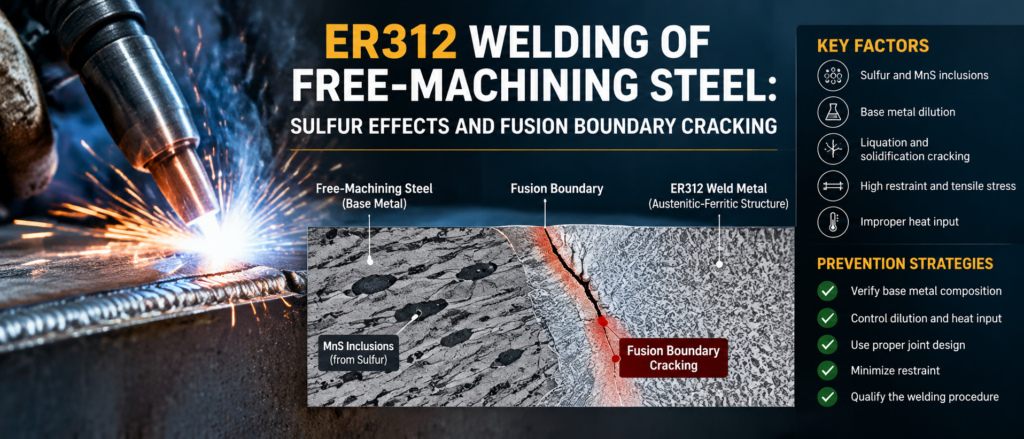
ER312 Welding of Free-Machining Steel: Sulfur Effects and Fusion Boundary Cracking
ER312 welding of free-machining steel presents unique metallurgical challenges because sulfur, an element intentionally added to improve machinability, can increase the risk of cracking during welding. Although ER312 stainless steel filler metal is often selected for joining dissimilar metals and repairing difficult-to-weld steels, its performance depends heavily on the base metal composition, dilution rate, welding parameters, and joint conditions.
Free-machining steels are designed to produce short chips, reduce cutting forces, and improve machining productivity. These benefits are commonly achieved through sulfur additions that promote the formation of manganese sulfide inclusions. During welding, however, the same inclusions and sulfur-related metallurgical effects can contribute to localized cracking, particularly near the fusion boundary.
Understanding sulfur behavior, weld pool solidification, and fusion boundary cracking is essential for developing reliable ER312 welding procedures. This article examines the underlying mechanisms, key risk factors, and practical strategies for improving weld integrity.
1. Understanding Free-Machining Steel and ER312 Filler Metal
1.1 Characteristics of Free-Machining Steel
Free-machining steels contain alloying additions that improve cutting performance. Sulfur is one of the most common additions because it promotes the formation of manganese sulfide (MnS) inclusions.
These inclusions can reduce friction during machining, promote chip breaking, and improve tool life under appropriate cutting conditions.
However, sulfur also affects high-temperature deformation and solidification behavior. Depending on the steel composition and thermal cycle, sulfur-rich regions can become susceptible to localized melting or cracking during welding.
Important characteristics of free-machining steel include:
Elevated sulfur content compared with conventional grades of similar steel.
MnS inclusions distributed throughout the base metal.
Potentially reduced weldability near the fusion boundary.
Sensitivity to local chemical composition changes during melting.
Possible differences in cracking behavior depending on carbon content and other alloying elements.
Not all free-machining steels have the same composition. Sulfur content, manganese-to-sulfur balance, lead or other additions, and the underlying steel grade must be considered before welding.
1.2 Why ER312 Is Considered for Difficult-to-Weld Steels
ER312 is a high-alloy stainless steel filler metal with a nominal chromium content of approximately 29% and nickel content of approximately 9%, although actual deposited weld metal composition depends on the consumable specification and dilution.
Its weld metal typically develops a mixed austenitic-ferritic microstructure. This structure can provide useful resistance to certain forms of solidification cracking and makes ER312 a candidate for selected dissimilar-metal joints and repair applications.
Potential advantages include:
High alloy content that can help accommodate some dilution effects.
A weld metal microstructure suitable for selected dissimilar-metal applications.
Good strength and useful wear-related properties in appropriate conditions.
Applicability to certain difficult-to-weld or hardenable steel repair procedures.
Nevertheless, ER312 does not eliminate the metallurgical risks associated with sulfur-rich base metals. Its suitability must be evaluated for the specific steel grade, service conditions, joint geometry, and required mechanical properties.
2. How Sulfur Affects Weldability
Sulfur influences weldability through several interconnected mechanisms. Its effect is not limited to the formation of visible inclusions; it can also change the behavior of material near the fusion boundary during the welding thermal cycle.
2.1 Formation of Manganese Sulfide Inclusions
In many free-machining steels, manganese combines with sulfur to form MnS inclusions.
These inclusions are beneficial during machining because they influence chip formation and tool-workpiece interactions. During welding, however, their behavior depends on whether they remain solid, dissolve, or interact with the surrounding molten metal.
Near the fusion boundary, the base metal experiences rapid heating followed by melting or partial melting. Local variations in sulfur concentration can produce regions with different melting behavior and mechanical properties.
The resulting microstructural heterogeneity may contribute to crack initiation when combined with tensile stress and unfavorable thermal conditions.
2.2 Sulfur Segregation During Solidification
Sulfur can partition into the remaining liquid during solidification rather than distributing uniformly throughout the weld metal.
As solidification progresses, sulfur may become concentrated in interdendritic regions or other last-to-solidify areas. If low-melting constituents form, these regions can remain weak while surrounding material contracts during cooling.
This phenomenon is especially relevant when base metal dilution introduces sulfur into the ER312 weld pool.
The actual extent of segregation depends on the chemical composition, dilution rate, weld pool geometry, solidification conditions, and interactions with other alloying elements.
2.3 Reduced High-Temperature Ductility
Sulfur-rich regions may exhibit reduced ductility at elevated temperatures. When the surrounding weld metal and heat-affected zone contract during cooling, these regions may be unable to accommodate the imposed strain.
If the local strain exceeds the material’s capacity to deform without fracture, cracking can initiate.
The risk becomes more significant when several factors occur together:
High local sulfur concentration.
Unfavorable solidification or partial-melting conditions.
High restraint and tensile stress.
Rapid thermal cycling.
Localized strain concentration near the fusion boundary.
This interaction explains why sulfur content alone cannot fully predict cracking. The thermal cycle, local chemistry, and mechanical constraint are equally important.
3. Fusion Boundary Cracking: Mechanisms and Locations
Fusion boundary cracking refers to cracking that develops at or near the interface between the weld metal and the base metal. In sulfur-containing steels, several related mechanisms must be distinguished.
3.1 Liquation Cracking in the Heat-Affected Zone
Liquation cracking can occur when local constituents near the fusion boundary partially melt during welding.
The affected region may contain inclusions, segregated elements, or local chemical compositions that reduce the temperature at which liquid forms. During subsequent cooling, tensile strain can open cracks along these weakened regions.
In free-machining steel, sulfur-related constituents may contribute to local liquation under suitable thermal conditions.
Liquation cracking is particularly associated with the partially melted region of the heat-affected zone, where the material experiences high temperatures without necessarily undergoing complete melting.
3.2 Solidification Cracking in the Weld Metal
Solidification cracking develops within the weld metal during the final stages of solidification.
As the weld pool solidifies, the remaining liquid may become enriched in elements that segregate to interdendritic regions. If the residual liquid cannot accommodate the tensile strain generated by contraction, cracks may form along solidification boundaries.
Sulfur introduced from the base metal can alter the weld pool chemistry and increase cracking susceptibility under unfavorable conditions.
ER312’s alloy composition and solidification structure may help resist certain cracking mechanisms, but the protection is not absolute. Excessive dilution or unfavorable contaminant levels can undermine the intended weld metal properties.
3.3 Cracking Along the Fusion Line
Cracks near the fusion line may develop because of local melting, chemical gradients, microstructural differences, and high thermal strain.
A steep composition gradient can exist between the ER312 weld metal and the free-machining steel. The resulting interface may contain regions with different transformation behavior, hardness, and high-temperature ductility.
The fusion line can therefore become a preferred location for cracking when the thermal cycle and local chemistry create a sufficiently weak region.
Metallographic examination is often necessary to determine whether a crack originates in the weld metal, the partially melted heat-affected zone, or the adjacent base metal.
3.4 The Role of Welding Restraint
Welding creates localized expansion and contraction. Rigid fixtures, thick components, short weld lengths, and complex joint geometries can increase restraint.
When restraint limits contraction, tensile stresses may develop near the fusion boundary while the material is still at elevated temperatures.
If sulfur-related weakening or local liquation has reduced the material’s resistance to deformation, these stresses may promote crack initiation and propagation.
Reducing unnecessary restraint and selecting an appropriate welding sequence can therefore be important parts of crack prevention.
4. Key Factors That Increase Cracking Susceptibility
4.1 High Base Metal Dilution
Dilution describes the proportion of melted base metal incorporated into the weld deposit.
When ER312 is deposited on sulfur-rich free-machining steel, excessive dilution can introduce more sulfur and other base metal elements into the weld pool. This may change the weld metal’s solidification behavior and chemical balance.
Dilution is affected by current, voltage, travel speed, electrode angle, joint preparation, and welding process.
A procedure should aim to achieve sufficient fusion without unnecessarily increasing the amount of base metal incorporated into the deposit.
4.2 Incorrect Heat Input
Heat input influences the size and shape of the weld pool, the extent of base metal melting, and the cooling cycle.
Excessive heat input may increase base metal melting and dilution, while insufficient heat input can result in incomplete fusion or poor bead geometry.
Neither extreme is desirable. The goal is to maintain stable fusion and a controlled thermal cycle within the qualified welding procedure.
4.3 Poor Joint Preparation
Contamination, uneven joint surfaces, excessive gaps, and unsuitable groove geometry can make the welding process less stable.
Surface contaminants can introduce additional impurities, while inconsistent joint geometry can lead to variable penetration and dilution.
Thorough cleaning and controlled joint preparation help reduce these avoidable sources of variability.
4.4 Unfavorable Weld Bead Geometry
Deep, narrow weld pools and abrupt changes in weld profile can affect solidification patterns and local strain distribution.
Depending on the welding conditions, unfavorable bead geometry may increase the likelihood of interdendritic cracking or concentrate stress near the fusion boundary.
Weld bead shape should be controlled through suitable welding parameters, torch or electrode manipulation, and joint design.
5. Prevention Strategies for ER312 Welding of Free-Machining Steel
Reliable crack prevention requires coordinated control of base metal chemistry, dilution, heat input, restraint, and inspection.
5.1 Verify the Base Metal Composition
Before welding, identify the exact free-machining steel grade and review its chemical composition.
Important information includes:
Sulfur and manganese content.
Carbon content and hardenability.
Other alloying or machinability-enhancing additions.
Component thickness and prior heat treatment.
Service temperature and mechanical loading.
The steel designation alone may not provide enough information to assess welding risks. Where uncertainty exists, material analysis and engineering review should be considered.
5.2 ER312 Control Dilution Through Welding Parameters
Dilution control is one of the most important variables when applying ER312 to sulfur-containing steel.
Practical measures include:
Selecting suitable current and voltage settings.
Controlling travel speed and electrode manipulation.
Using a joint design that permits reliable fusion without excessive penetration.
Avoiding unnecessary remelting of previously deposited material.
Evaluating bead sequence and pass placement.
Verifying the resulting weld profile and fusion characteristics.
Where cracking risk is high, procedure qualification should assess whether the selected parameters produce acceptable weld integrity and chemistry.
A buffer layer may be considered for certain repair or dissimilar-metal applications, but it should not be assumed to eliminate sulfur-related cracking. Its effectiveness depends on the layer’s composition, thickness, dilution, and the thermal cycle of subsequent passes.
5.3 Optimize Heat Input and Interpass Temperature
Heat input and interpass temperature should be controlled to produce stable fusion and avoid unnecessary thermal exposure.
A suitable procedure should specify welding parameters, temperature limits, and any restrictions on the sequence of passes.
Preheating may be necessary for some base metals because of their carbon content, hardenability, thickness, or restraint. However, preheating alone does not prevent sulfur-related liquation or solidification cracking.
The correct thermal strategy must account for both the base metal’s transformation behavior and the weld metal’s solidification characteristics.
5.4 ER312 Minimize Joint Restraint
Where practical, reduce unnecessary mechanical restraint and avoid assembly conditions that impose excessive contraction stress.
Useful measures may include:
Reviewing fixture rigidity and clamping locations.
Improving joint fit-up.
Selecting a suitable welding sequence.
Avoiding abrupt changes in weld size and geometry.
Controlling distortion without imposing excessive constraint.
The goal is to allow appropriate contraction while preserving dimensional requirements and structural integrity.
5.5 Evaluate the Need for Buffer Layers
For some high-risk applications, an intermediate deposit may be used to modify the chemistry at the interface or reduce the influence of direct base metal dilution in subsequent weld passes.
However, a buffer layer is not a universal solution. If the first layer itself experiences excessive dilution or liquation cracking, the original problem may remain.
The choice of buffer material, deposition sequence, and layer thickness should be validated for the actual steel grade and service requirements.
5.6 Qualify the Welding Procedure
A qualified welding procedure provides a structured method for confirming that the chosen process can produce acceptable results.
For ER312 welding of free-machining steel, qualification may need to address:
Base metal identity and chemical composition.
Filler metal classification.
Welding process and essential parameters.
Heat input and interpass temperature.
Joint design and restraint.
Relevant mechanical testing.
Metallographic evaluation when cracking mechanisms are uncertain.
Applicable acceptance criteria.
The extent of qualification should reflect the risk level, component function, and governing construction requirements.
6. Inspection and Failure Analysis
Inspection should identify cracks early and help establish their underlying cause.
6.1 Visual Inspection
Visual inspection can reveal surface-breaking cracks, undercut, irregular bead profiles, and other visible discontinuities.
However, many fusion boundary cracks are too small or too deeply located to be identified visually.
6.2 Liquid Penetrant Testing
Liquid penetrant testing can identify surface-breaking cracks on properly prepared, nonporous surfaces.
It is useful for examining weld toes and accessible fusion boundary regions but cannot detect discontinuities that do not extend to the surface.
6.3 Magnetic Particle Testing
Magnetic particle testing may be appropriate when the base metal is ferromagnetic and the examination procedure is suitable for the component.
Because ER312 weld metal and the base metal may have different magnetic properties, examination procedures should account for the actual materials and geometry.
6.4 Metallographic Examination
Metallography can help determine the location and morphology of cracking.
A cross-section through the affected region may reveal whether the crack is associated with the weld metal, partially melted heat-affected zone, or base metal.
Microscopy can also identify inclusions, local melting features, and microstructural changes that support a particular failure mechanism.
6.5 Chemical Analysis
Chemical analysis of the base metal and weld deposit can help establish whether sulfur, dilution, or other compositional factors contributed to cracking.
Results should be interpreted alongside the welding parameters, joint geometry, fracture location, and metallographic evidence.
A complete failure analysis should avoid attributing every fusion boundary crack to sulfur without sufficient supporting evidence.
7. Common Welding Mistakes to Avoid
Several practices can increase the likelihood of cracking when ER312 is used on free-machining steel.
Assuming ER312 prevents all cracking: Its alloy composition may be beneficial for selected applications, but it cannot eliminate every sulfur-related mechanism.
Ignoring the exact steel grade: Free-machining steels vary in sulfur content, carbon content, and other alloying additions.
Allowing excessive dilution: High base metal dilution can change weld metal chemistry and solidification behavior.
Increasing heat input without evaluation: Higher heat input may increase melting and dilution rather than improve weld quality.
Relying on preheat alone: Preheat can influence cooling and transformation behavior, but it does not automatically prevent liquation or solidification cracking.
Applying an unqualified buffer layer: An intermediate deposit must be designed and validated for the specific application.
Using inspection without failure analysis: Detecting a crack is not equivalent to identifying the mechanism that caused it.
Avoiding these errors improves process consistency and supports more effective corrective action.
8. Frequently Asked Questions
Why is free-machining steel difficult to weld with ER312?
Free-machining steel often contains elevated sulfur levels that improve machining but can contribute to local melting, reduced high-temperature ductility, and cracking near the fusion boundary. ER312 may be suitable for certain applications, but the base metal chemistry and welding procedure must be evaluated.
ER312 Does sulfur always cause fusion boundary cracking?
No. Sulfur increases risk under certain metallurgical and thermal conditions, but cracking depends on local composition, temperature history, strain, restraint, and other alloying elements.
Can ER312 eliminate hot cracking in sulfur-rich steel?
No filler metal can guarantee crack-free welding under all conditions. ER312’s microstructure may provide advantages in selected applications, but excessive dilution, unfavorable solidification conditions, or base metal liquation can still cause cracking.
ER312 Is preheating effective for sulfur-related cracking?
Preheating can help manage cooling rate and may be necessary for hardenable or thick base metals. However, it does not directly eliminate sulfur segregation or guarantee prevention of fusion boundary liquation cracking.
How can dilution be reduced during ER312 welding?
Dilution can be managed by optimizing current, voltage, travel speed, electrode manipulation, joint geometry, and deposition sequence. The chosen settings must still provide complete fusion and satisfy the qualified welding procedure.
ER312 What is the most reliable way to identify the cracking mechanism?
A combination of crack location, visual and nondestructive examination, metallographic analysis, chemical analysis, and review of welding records provides a stronger basis for determining the root cause than any single inspection method.
ER312 Conclusion
ER312 welding of free-machining steel requires careful attention to sulfur-related metallurgical effects. Although sulfur additions improve machining performance, they can contribute to localized melting, segregation, reduced high-temperature ductility, and cracking near the fusion boundary under unfavorable welding conditions.
Successful prevention depends on understanding the base metal composition, controlling dilution, optimizing heat input, managing joint restraint, and qualifying the welding procedure for the actual application.
ER312 can be a useful filler metal for selected difficult-to-weld and dissimilar-metal applications, but reliable results require more than filler metal selection alone. Combining metallurgical assessment, process control, and appropriate inspection provides a stronger foundation for reducing fusion boundary cracking and improving weld integrity.