

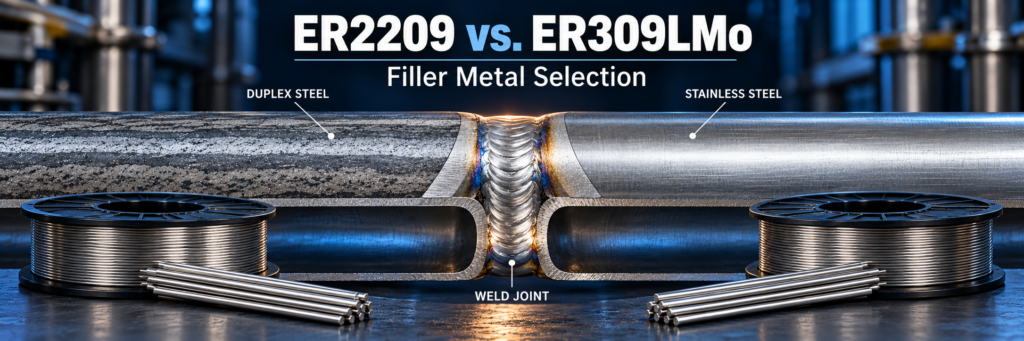
ER2209 vs. ER309LMo: Filler Metal Selection for Duplex-to-Stainless Steel Joints
Choosing between ER2209 vs. ER309LMo can be challenging when welding duplex stainless steel to an austenitic stainless steel such as 304L or 316L. Both filler metals can be considered for certain dissimilar joints, but they are designed around different metallurgical objectives.Duplex-to-Stainless Steel
ER2209 is a duplex filler metal commonly used with 2205 stainless steel. ER309LMo is a molybdenum-bearing, predominantly austenitic filler metal used in a range of dissimilar welding applications. The right choice depends on the base metals, weld dilution, required strength, corrosion exposure, and the results of welding procedure qualification.
This article compares their characteristics and explains how to approach filler metal selection for duplex-to-austenitic stainless steel joints.
Why Duplex-to-Stainless Steel Joints Need Special Attention
A duplex-to-stainless steel joint combines materials with different chemical compositions and microstructures.
Duplex stainless steels contain both ferrite and austenite. This two-phase structure contributes to their combination of strength and corrosion resistance. Austenitic stainless steels, such as 304L and 316L, have a predominantly austenitic structure and generally lower yield strength than standard duplex grades.
During welding, the filler metal mixes with both base metals. As a result, the final weld composition is different from the composition of the wire alone.
The welding engineer must therefore consider more than whether the filler metal is compatible with each base metal. The question is whether the completed joint will meet its mechanical and corrosion requirements after dilution and exposure to the welding thermal cycle.
ER2209 vs. ER309LMo: Key Differences
| Comparison | ER2209 | ER309LMo |
|---|---|---|
| Filler metal type | Duplex stainless steel | Molybdenum-bearing austenitic stainless steel |
| Typical weld structure | Ferrite and austenite | Predominantly austenite, generally with some ferrite |
| Common applications | Welding 2205 and other suitable duplex grades | Dissimilar joints and molybdenum-bearing stainless steel applications |
| Typical alloying emphasis | Chromium, nickel, molybdenum, and nitrogen | Chromium, nickel, and molybdenum |
| Main selection consideration | Maintaining suitable joint properties when joining duplex materials | Producing a suitable weld composition under the expected dilution |
| Important limitation | Austenitic base metal dilution can change the weld’s phase balance | Weld metal properties may differ significantly from those of the duplex base metal |
The final microstructure and properties of either weld depend on the actual base metals, welding process, dilution, and procedure. Neither wire should be selected solely from a comparison table.
What Is ER2209 Welding Wire?
ER2209 is a duplex stainless steel filler metal commonly used to weld 2205 duplex stainless steel, including UNS S31803 and UNS S32205.
Its composition is designed to support the formation of both ferrite and austenite in the weld metal. Compared with a typical 2205 base metal, ER2209 generally contains additional nickel to help promote austenite formation during weld cooling.
When welding 2205 to an austenitic stainless steel, ER2209 may be considered when the design calls for a duplex-type filler. However, the austenitic side contributes alloying elements to the weld pool. This dilution can change the weld’s phase balance and properties, particularly in the root pass or other highly diluted regions.
For that reason, the use of ER2209 in a dissimilar joint should be supported by a welding procedure that demonstrates the required results.
What Is ER309LMo Welding Wire?
ER309LMo is a low-carbon, molybdenum-bearing stainless steel filler metal. It is commonly associated with dissimilar welding applications, including joints involving molybdenum-bearing stainless steels and carbon or low-alloy steels.
Its relatively high chromium and nickel contents help produce a suitable stainless weld deposit under certain dilution conditions. The addition of molybdenum is relevant when a joint requires greater corrosion performance than a comparable molybdenum-free filler may provide.
ER309LMo may also be considered for some duplex-to-austenitic stainless steel joints. Its weld metal is generally predominantly austenitic, rather than designed to reproduce the duplex structure of ER2209. This difference matters when the joint must meet demanding strength or corrosion requirements.
Molybdenum content alone does not establish the corrosion resistance of a completed weld. Dilution, local chemistry, surface condition, fabrication quality, and the service environment all affect performance.
Duplex-to-Stainless Steel :How Dilution Changes the Filler Metal Decision
Dilution is the proportion of melted base metal that becomes part of the weld deposit. In a duplex-to-austenitic stainless steel joint, the weld pool may contain contributions from:
- The duplex base metal
- The austenitic base metal
- The filler wire
- Previous weld passes, in a multipass joint
The amount contributed by each material is not necessarily equal. Joint geometry, penetration, torch position, welding process, and travel speed can all affect dilution.
For example, a weld with ER2209 that receives substantial dilution from 316L may develop a different phase balance from an ER2209 weld made between two pieces of 2205. Similarly, the final deposit made with ER309LMo may differ from its undiluted weld metal, especially near the fusion boundaries.
Why the root pass deserves particular attention
The root pass may have a high proportion of base metal relative to filler metal. It is also often exposed directly to the process fluid in pipework.
A procedure should therefore address both:
- The chemistry and quality of the root weld.
- The surface condition on the process side, including oxidation and heat tint.
A visually acceptable root is useful, but appearance alone does not establish its corrosion resistance or mechanical performance.
ER2209 vs. ER309LMo: Strength and Corrosion Considerations
Strength
Standard duplex stainless steels such as 2205 generally have higher yield strength than common austenitic grades such as 304L and 316L.
An ER2209 deposit is intended to produce duplex weld metal, while an ER309LMo deposit is generally predominantly austenitic. This distinction can affect how each filler performs in a particular joint.
However, the strength of a dissimilar joint cannot be determined from the filler classification alone. The actual failure location may depend on the weaker base metal, weld geometry, dilution, and test configuration.
If strength is a controlling requirement, use procedure qualification tests and the applicable design rules to establish whether the joint is acceptable.
Duplex-to-Stainless Steel :ER2209 Corrosion resistance
Corrosion performance depends on the entire exposed joint: the weld metal, fusion boundaries, heat-affected zones, and adjacent base metals.
For chloride-containing service, review the operating temperature, chloride concentration, pH, oxygen availability, and likelihood of crevice formation. A filler metal with a desirable nominal composition does not guarantee that every part of a dissimilar joint will resist the intended environment.
Where required by the project specification, corrosion testing should evaluate a representative welded joint. Surface cleaning, removal of unacceptable heat tint, and the specified post-weld treatment also matter.
When Should You Consider ER2209?
ER2209 is a candidate when:
- One base metal is a standard duplex grade such as 2205.
- The design calls for a duplex-type filler metal.
- The required joint properties justify maintaining a duplex weld metal approach.
- The welding procedure can control and assess the effects of dilution.
- Qualification testing confirms that the joint meets the project requirements.
For example, when joining 2205 to 316L in a process system, ER2209 may be evaluated if the designer wants to retain a duplex-type deposit. The resulting weld still needs to be assessed for the actual service conditions; the 316L side and the dissimilar weld interface remain part of the corrosion system.
When Should You Consider ER309LMo?
ER309LMo is a candidate when:
- An austenitic filler metal is permitted by the design and applicable specification.
- The joint involves dissimilar materials and dilution is an important selection factor.
- A molybdenum-bearing filler is appropriate for the intended service.
- The required mechanical and corrosion properties can be demonstrated with the selected filler.
ER309LMo may offer a practical approach for some dissimilar joints, but it should not automatically be treated as an equivalent replacement for ER2209. Its different weld metal structure and chemistry can lead to different joint properties.
Duplex-to-Stainless Steel : Welding Procedure Considerations
Control heat input and interpass temperature
The duplex side of the joint remains sensitive to the welding thermal cycle regardless of which filler wire is used.
Excessively rapid cooling can limit austenite formation in the duplex heat-affected zone. Excessive time at elevated temperatures can increase the risk of undesirable microstructural changes. Use heat input and interpass temperature limits established for the actual material, thickness, process, and qualified procedure.
Duplex-to-Stainless Steel : Select shielding and backing gases for the procedure
Shielding gas affects arc behavior, weld quality, oxidation, and potentially weld metal chemistry. Backing gas is particularly important when the root will be exposed to a corrosive medium.
Gas selection should account for the welding process, filler metal, joint configuration, and qualified procedure. Avoid assuming that a gas mixture suitable for one process or filler is automatically suitable for another.
Duplex-to-Stainless Steel :Keep the weld area clean
Remove oil, moisture, paint, and other contaminants before welding. Use clean tools suitable for stainless steel fabrication and protect the root from unnecessary oxidation.
After welding, assess the surface against the project’s acceptance criteria. Where required, remove heat tint and carry out cleaning or passivation in accordance with the applicable procedure.
How to Select Between ER2209 and ER309LMo
Use the following sequence to narrow down the choice:
- Identify both base metals. Confirm the exact grades and product forms rather than using only “duplex” and “stainless steel.”
- Define the service environment. Record temperature, pressure, process fluid, chloride exposure, and potential crevice conditions.
- Establish the required joint properties. Include strength, toughness, corrosion resistance, and any project-specific acceptance criteria.
- Assess dilution. Review joint preparation, root access, welding process, and expected penetration.
- Check the applicable specification. Determine whether the project permits ER2209, ER309LMo, or another filler metal.
- Qualify the welding procedure. Test a representative joint using the specified process, materials, and parameters.
Depending on the application, qualification may include visual inspection, mechanical testing, ferrite assessment, metallographic examination, or corrosion testing. The required tests and acceptance limits should come from the applicable code and project specification.
Choosing the Right Filler Metal
ER2209 and ER309LMo offer different approaches to welding duplex stainless steel to austenitic stainless steel. ER2209 provides a duplex filler option, while ER309LMo provides a molybdenum-bearing austenitic option for suitable dissimilar joints.
The best choice is the one that produces a qualified joint for the actual materials and service conditions. Start with the joint requirements, evaluate dilution and the duplex heat-affected zone, and confirm performance through the appropriate welding procedure qualification.