

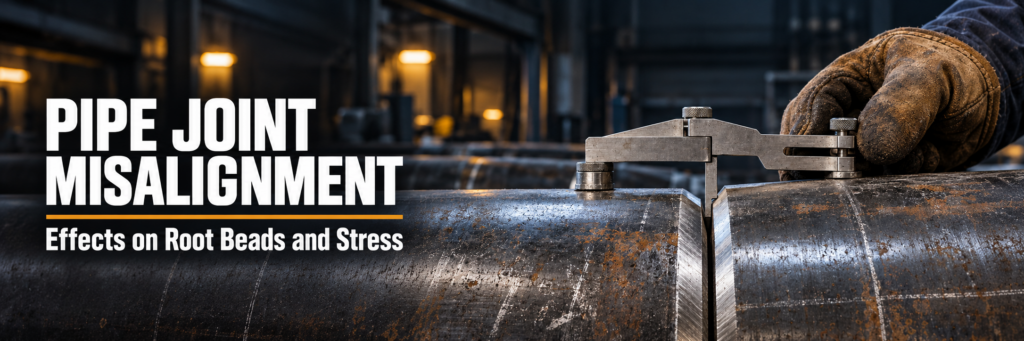
How Pipe Joint Misalignment Affects Root Bead Formation and Joint Stress
Pipe joint misalignment creates more than an uneven internal surface. It changes the geometry the welder must fuse and the path that loads follow through the completed joint. Even when the external weld looks uniform, an internal offset can leave an irregular root profile or increase local stress.
Understanding these effects helps fabricators address fit-up problems before they become welding defects, inspection failures, or service concerns.
What Is Pipe Joint Misalignment?
Pipe joint misalignment occurs when the adjoining pipe ends do not meet in the intended position. Two forms are particularly relevant to circumferential butt welds:
Internal offset, or hi-lo: The internal surfaces form a step across the joint.
Angular misalignment: The pipe centerlines meet at an unintended angle.
A changing root opening may accompany either condition, but root gap and misalignment are separate measurements. A joint can have the specified gap while still having excessive internal offset.
Common contributors include pipe ovality, differences in wall thickness, inaccurate end preparation, and inadequate support during assembly.
How Misalignment Affects Root Bead Formation
The root pass must establish fusion between both pipe ends while producing the required internal profile. Misalignment makes that task less consistent around the circumference.
Uneven Access to the Root Faces
With internal hi-lo, one root edge projects farther into the bore. The arc and weld pool no longer encounter a symmetrical joint.
During welding from one side, this geometry can make fusion at the root or sidewall more difficult. The risk depends on the offset, joint preparation, process, and welding technique.
Inconsistent Root Profile
As the joint geometry changes, a technique that works in one section may produce a different result elsewhere. The internal bead may become uneven in width, reinforcement, or transition into the surrounding pipe.
An irregular profile does not automatically mean the joint is unacceptable. It does mean the root needs assessment against the specified requirements.
A Smaller Working Range for the Welder
Misalignment can reduce the margin between achieving adequate fusion and losing control of the weld pool. Trying to compensate by increasing current or slowing travel may introduce additional problems elsewhere.
Correcting fit-up before welding is generally more dependable than expecting parameter adjustments to overcome an unsuitable joint.
How Pipe Joint Misalignment Increases Joint Stress
Misalignment affects the completed connection even when fusion is sound. Its structural effect comes from the joint geometry and loading conditions.
Local Stress Concentration
A step or abrupt transition can concentrate stress near the weld root. The local stress may exceed the nominal stress calculated for the pipe away from the joint.
The size of this increase depends on factors such as offset relative to wall thickness, root shape, and applied loading. There is no single stress multiplier that applies to every misaligned pipe weld.
Additional Bending Under Axial Load
In an aligned joint, axial load follows a relatively direct path through the pipe walls. An offset makes that path eccentric and can introduce local bending.
Angular misalignment can also generate additional bending as the joint carries load. Consequently, a connection assessed only using nominal axial stress may need further consideration of its actual geometry.
Greater Fatigue Sensitivity
Under repeated loading, increased local stress ranges can make the root region more susceptible to fatigue cracking.
This matters in piping exposed to pressure cycles, vibration, or repeated mechanical movement. Misalignment does not guarantee failure, but it is a relevant input when assessing fatigue performance.
Root Geometry, Residual Stress, and Service Stress
These effects should be distinguished during troubleshooting:
| Factor | What it describes |
|---|---|
| Root geometry | The internal bead shape and its transition into the pipe |
| Welding residual stress | Stress remaining after welding and cooling |
| Service stress | Stress caused by operating loads |
| Misalignment effect | Additional local stress associated with the offset or angular geometry |
A smooth-looking bead does not demonstrate low residual stress. Likewise, complete fusion does not eliminate the structural effect of an offset.
How to Reduce Pipe Joint Misalignment
Measure Before Tacking
Check the internal offset, root opening, bevel, and root face before welding. Take measurements at several positions around the circumference; a single reading can miss localized hi-lo.
pipe joint misalignment Check Ovality and Wall Thickness
External alignment alone may not establish internal alignment. Where pipe dimensions vary, compare the bore surfaces directly using suitable inspection tools.
If rotating one pipe improves the match, confirm that the resulting fit-up meets the project requirements around the entire joint.
pipe joint misalignment Support the Pipe Properly
Use suitable supports and alignment equipment to maintain position during tacking and welding. Recheck the joint after tacking, since movement can change the original fit-up.
Avoid forcing an assembly into position without an approved method.
pipe joint misalignment Follow the Approved Joint Design
Where adjoining wall thicknesses differ, use the specified transition detail. Any machining, tapering, or local material removal must preserve the required wall thickness and follow the approved preparation requirements.
pipe joint misalignment Verify the Root Before Continuing
Where access and the inspection plan permit, examine the root before depositing further passes. Early detection makes it easier to identify whether the problem originated in fit-up or welding.
What Is the Acceptable Misalignment for Pipe Welding?
There is no universal allowable offset for every pipe joint.
Acceptance depends on the governing construction code, project specification, material, wall thickness, and service requirements. Use the applicable limits rather than an informal rule borrowed from a different application.
Fit-up acceptance and weld acceptance also require separate checks. An acceptable offset does not excuse incomplete fusion, and a sound weld does not automatically make excessive misalignment acceptable.