

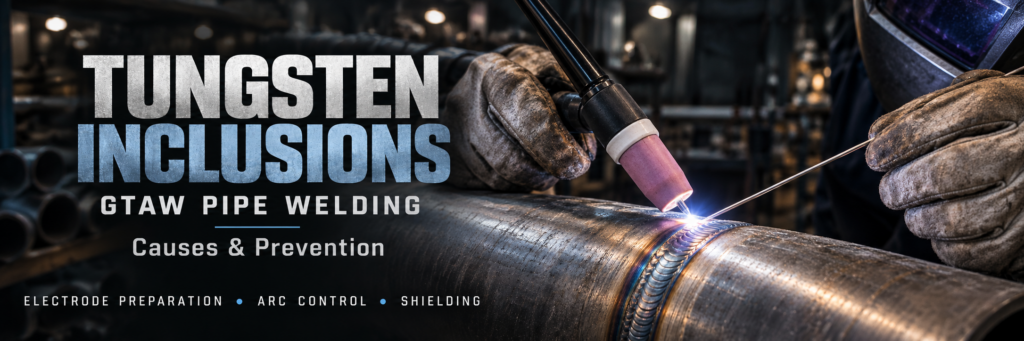
Tungsten Inclusions in GTAW Pipe Welding: Causes and Prevention
Tungsten inclusions in GTAW pipe welding occur when particles from the tungsten electrode become trapped in the weld metal. They can result from accidental contact with the molten pool, contact between the filler rod and electrode, or deterioration of an overloaded electrode.
A smooth weld surface does not rule out an internal inclusion. Preventing this discontinuity requires control of electrode condition, welding parameters, and torch handling—especially during root passes and difficult positional work.
What Are Tungsten Inclusions?
Gas tungsten arc welding, also called TIG welding, uses a nonconsumable tungsten electrode to establish the arc. The electrode is intended to carry current without becoming part of the weld deposit.
When part of the electrode breaks off, erodes, or transfers into the molten metal, it can remain embedded after solidification. The resulting inclusion is metallic and differs from porosity, which consists of gas cavities.
Tungsten inclusions also differ from slag inclusions. Although GTAW normally uses no flux, it can still introduce solid particles through electrode damage or contamination.
Main Causes of Tungsten Inclusions in GTAW
1. Dipping the Electrode Into the Weld Pool
Accidental contact between the tungsten and molten metal is a direct route to contamination and particle transfer.
In pipe welding, this can happen when the welder changes position around the circumference, loses hand support, or encounters an inconsistent root opening.
Maintaining clearance requires following the changing pool position rather than holding the torch at a fixed distance from the original pipe surface.
2. Touching the Electrode With the Filler Rod
A poorly controlled filler rod can contact the hot tungsten tip. This may contaminate the electrode, disturb the arc, and contribute to tungsten entering the weld.
The risk increases when access is restricted or the filler approach angle leaves little separation between the rod and electrode.
3. Excessive Current for the Electrode
An electrode that is too small for the operating conditions can overheat and deteriorate.
Electrode selection should consider diameter, composition, polarity, and the current waveform. For pulsed welding, checking only the displayed average current may overlook demanding peak-current conditions.
Reducing current without considering penetration and fusion is not a complete solution. The electrode and welding parameters must work together within the qualified procedure.
4. Incorrect Polarity
Polarity affects how heat is distributed between the electrode and workpiece.
For conventional GTAW of steel and stainless steel pipe, direct current electrode negative, or DCEN, is normally used. An unintended electrode-positive connection can cause excessive electrode heating and rapid deterioration.
Check the actual lead connections as well as the machine settings before starting production.
5. Poor Electrode Preparation
A damaged tip or unsuitable taper can make arc control more difficult and encourage tip breakdown.
For applications requiring a ground electrode, prepare it longitudinally using dedicated, clean grinding equipment. Match the taper and tip geometry to the electrode guidance and welding procedure.
A very sharp, fragile point is not suitable for every current level.
6. Inadequate Shielding
Insufficient shielding can allow the hot electrode to oxidize and deteriorate. Problems may arise from gas leaks, drafts, unsuitable nozzle arrangements, or inadequate post-flow.
Increasing gas flow indiscriminately is not a reliable correction. Excessive flow can create turbulence and draw surrounding air into the shielding envelope.
How to Prevent Tungsten Inclusions in Pipe Welds
Match the Electrode to the Procedure
Confirm the electrode classification, diameter, tip preparation, polarity, and operating current before welding.
Do not assume that the electrode used successfully on one pipe joint is suitable for another joint with different access, wall thickness, or welding parameters.
Tungsten inclusions in GTAW Plan Torch and Filler Access
Before striking the arc, check whether the torch and filler rod can move through the intended welding segment without collision.
For fixed-position pipe welding, reposition hand supports before reaching an uncomfortable angle. Restricted movement can turn a controlled root pass into repeated electrode contact.
Tungsten inclusions in GTAW Use a Controlled Arc Start
Use the starting method specified by the procedure. High-frequency starting can establish the arc without touching the electrode to the workpiece.
Where another starting method is required, use it correctly and avoid uncontrolled scratching across the production joint.
Tungsten inclusions in GTAW Stop When Contamination Occurs
If the tungsten touches the pool or filler rod, stop and inspect the electrode.
Remove the contaminated or damaged portion using suitable equipment, then prepare a clean tip. Simply grinding a new point onto a visibly contaminated end may leave affected material behind.
Inspect the weld location as well. Restoring the electrode does not remove particles already trapped in the deposit.
Tungsten inclusions in GTAW Maintain Shielding Through Shutdown
Check gas delivery, torch components, and protection from drafts. Maintain the specified post-flow so that the hot tungsten remains shielded while cooling.
Keep clean, prepared spare electrodes available to reduce the temptation to continue with a damaged tip.
How Are Tungsten Inclusions Detected?
Radiographic testing is commonly used to detect tungsten inclusions in pipe welds. Because tungsten strongly attenuates radiation, inclusions typically appear as light indications on conventional radiographic film. Digital display settings can reverse image polarity.
Visual inspection can reveal electrode damage or exposed particles, but it cannot reliably exclude internal inclusions.
Record the location of electrode-contact incidents. This helps connect welding observations with subsequent inspection findings.
Are Tungsten Inclusions Always Rejectable?
Acceptance depends on the applicable construction code and project specification.
Evaluation may consider indication size, shape, number, spacing, and location. An inclusion should not be accepted merely because it looks small, nor should a universal rejection threshold be assumed.
Use the specified acceptance criteria and qualified inspection personnel to determine the required action.
How to Repair a Weld Containing Tungsten
When repair is required, locate and remove the affected material under an approved repair procedure. Verify the excavation as required before rewelding.
Do not attempt to hide an inclusion beneath another pass or rely on remelting to eliminate it.
Before restarting, correct the initiating cause—whether electrode overload, poor access, unstable filler handling, or shielding failure. Complete the required examination after repair.
Tungsten inclusions in GTAW Practical Prevention Checklist
Before and during GTAW pipe welding:
Verify polarity and electrode suitability.
Prepare a clean, undamaged electrode tip.
Check shielding gas delivery and post-flow.
Establish stable torch support and filler access.
Maintain controlled electrode-to-pool clearance.
Stop immediately after electrode contamination.
Inspect suspected locations before covering them.
Consistent control at these points reduces the chances of tungsten entering the weld and helps prevent repeated excavation, rewelding, and inspection.