

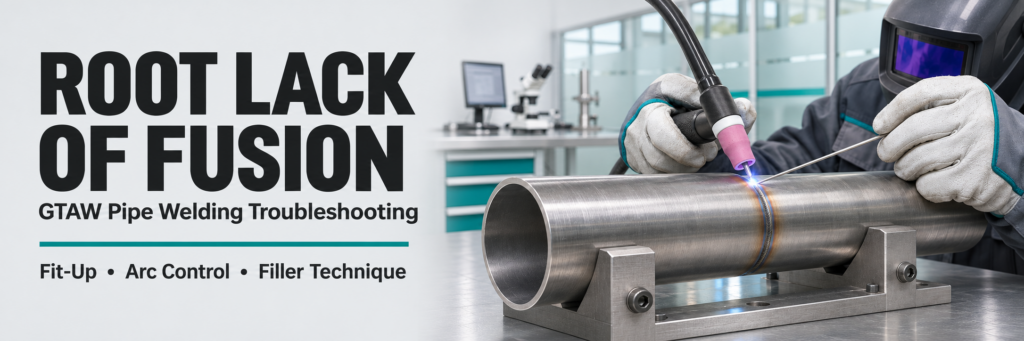
Root Lack of Fusion: GTAW Pipe Welding Fixes
Root Lack of Fusion occurs when weld metal fails to bond completely with the base metal at the root of a pipe joint. In GTAW pipe welding, the defect can remain beneath a smooth external bead, making appearance alone an unreliable acceptance check. Effective troubleshooting starts by identifying the unfused interface, checking joint preparation, and evaluating how the arc and filler interact with the root edges.
Increasing amperage may help in some cases, but it cannot correct every cause. A narrow opening, excessive root face, poor torch access, or contaminated surface may require a different corrective action.
Recognizing Root Lack of Fusion in Pipe Joints
Incomplete fusion and incomplete penetration describe different conditions, although they can occur together.
Incomplete fusion means the required metallurgical bond has not formed at an interface. Incomplete penetration means the weld has not extended to the required depth through the joint.
For example, deposited metal may bridge the root opening while leaving an unfused interface along one edge. Conversely, insufficient penetration may leave part of the joint thickness unwelded.
Neither condition should be diagnosed solely from the external bead profile. Determine the location, orientation, and extent of the indication using inspection methods appropriate to the joint.
Acceptance depends on the applicable fabrication requirements. Avoid assuming that a small indication is acceptable because the pipe passes a leak test.
Confirming Root No Fusion Through Inspection
Internal visual examination can reveal accessible root irregularities, but it cannot establish the condition of every buried interface.
Radiographic testing may detect certain indications, although sensitivity to planar imperfections depends on their orientation relative to the radiation beam. Ultrasonic methods also require suitable procedures, access, and consideration of wall thickness, geometry, and material.
For troubleshooting during procedure development, a sectioned and appropriately prepared test weld can help reveal the actual fusion boundary.
Record where the problem occurs around the pipe. Repeated indications near tacks, restarts, or particular welding positions often provide more useful clues than a general description such as “poor root quality.”
Fit-Up Causes of Root Fusion
Joint preparation determines whether the arc can reach and melt the root edges.
An excessively thick root face may demand more energy than the selected technique can deliver effectively. A root opening that is too small can restrict access and encourage the weld pool to bridge before both edges fuse.
Excessive internal misalignment creates another difficulty: one edge may receive direct arc heating while the other remains partially shielded.
Check the following before changing electrical settings:
- Root face dimensions around the circumference.
- Root opening after tacking.
- Bevel angle and available torch access.
- Internal alignment between pipe ends.
- Tack size, condition, and preparation.
- Local contamination or damaged edges.
Compare measurements with the approved welding procedure specification, or WPS. Do not widen the gap or grind away the root face without checking the permitted joint preparation.
Tack-Related
A sound tack must integrate into the root pass where it remains part of the finished weld.
Abrupt tack ends can make it difficult to establish a smooth transition. Prepare them as required by the procedure, and remove cracked or otherwise unacceptable tacks.
Inspect the fit-up again after tacking. Welding shrinkage can close an initially acceptable opening, creating different conditions as the root pass progresses.
If defects repeatedly occur at the same tack locations, investigate tack preparation and local gap closure before raising current across the entire joint.
Arc Control and Root Fusion
Adequate current matters, but the location and concentration of arc energy matter just as much.
Maintain a stable arc length appropriate to the procedure and electrode setup. An unnecessarily long arc can spread heating and reduce precise control at the root edges.
Torch angle should allow the arc to act on the intended fusion area. Excessive inclination or restricted access can direct energy toward one side of the joint.
Travel speed must allow both root edges to melt. Excessively fast movement may leave an unfused interface, while excessive dwell can produce an oversized pool, root sagging, or burn-through.
Check the complete operating condition:
| Observation | Possible contributor | Corrective check |
|---|---|---|
| One root edge remains unfused | Torch bias or internal misalignment | Verify alignment and arc placement |
| Defects appear in tight-gap sections | Local gap closure | Recheck fit-up around the circumference |
| Problems concentrate at restarts | Inadequate restart preparation | Prepare and inspect the transition |
| A broad pool forms without reliable root fusion | Poor arc access or unsuitable technique | Review arc length, angle, and joint geometry |
| Results change despite similar settings | Consumable, setup, or technique variation | Check tungsten condition and actual operating parameters |
Make parameter changes within the WPS limits. Changes outside those limits require the appropriate technical review.
Filler Technique and Root Fusion
Filler addition can conceal an unmelted root edge when deposition gets ahead of fusion.
Establish the required melting of the joint edges rather than using filler to bridge them prematurely. Follow the specified technique for rod placement, timing, and addition rate.
An oversized filler rod or excessive addition can chill the pool and obstruct visibility. Conversely, insufficient filler may create an unsuitable root profile. Select the diameter and feeding method for the joint and procedure.
Keep the filler clean and protected as required. If the tungsten contacts the pool or filler, stop and restore the electrode condition before continuing.
Also verify shielding and, where required, internal purging. Oxidation and contamination can interfere with weld quality, but increasing gas flow indiscriminately may create turbulence. Purging does not compensate for inadequate melting of the root edges.
Correcting Root Fusion Safely
Do not assume that a hot pass will reliably remelt and eliminate an existing root defect. Additional welding can bury the indication without removing it.
Use a controlled repair sequence:
- Identify and document the affected location.
- Determine the defect extent using suitable examination.
- Obtain the required repair disposition.
- Remove the affected material by an approved method.
- Verify excavation and remaining wall thickness.
- Prepare and weld using the applicable repair procedure.
- Reinspect to the specified acceptance criteria.
Where internal access is limited, or excavation would leave an unsuitable joint, cutting out and replacing the affected section may be necessary.
Correct the original cause before rewelding. Repeating the same preparation and technique can reproduce the same defect.
Preventing in Production
Use representative trials to confirm that the procedure and working conditions produce consistent root quality.
Match relevant production conditions, including material, wall thickness, joint preparation, welding position, access, and purge arrangements. Include tacks and restarts in the assessment where they are recurring problem areas.
During troubleshooting, change one variable at a time where practical. Record the original condition, adjustment, and inspection result so the team can identify what improved performance.
Before production welding, confirm that:
- Fit-up meets the specified dimensions.
- Joint surfaces and filler are clean.
- Tungsten preparation and shielding are suitable.
- The welder can access and observe the fusion area.
- Parameters remain within the approved range.
- Root inspection occurs at the required stage.
Preventing Root Lack of Fusion requires consistent preparation, controlled arc placement, appropriate filler addition, and verified inspection results. Treat each defect as evidence of a specific process problem, then confirm that the corrective action removes that cause before releasing the joint