

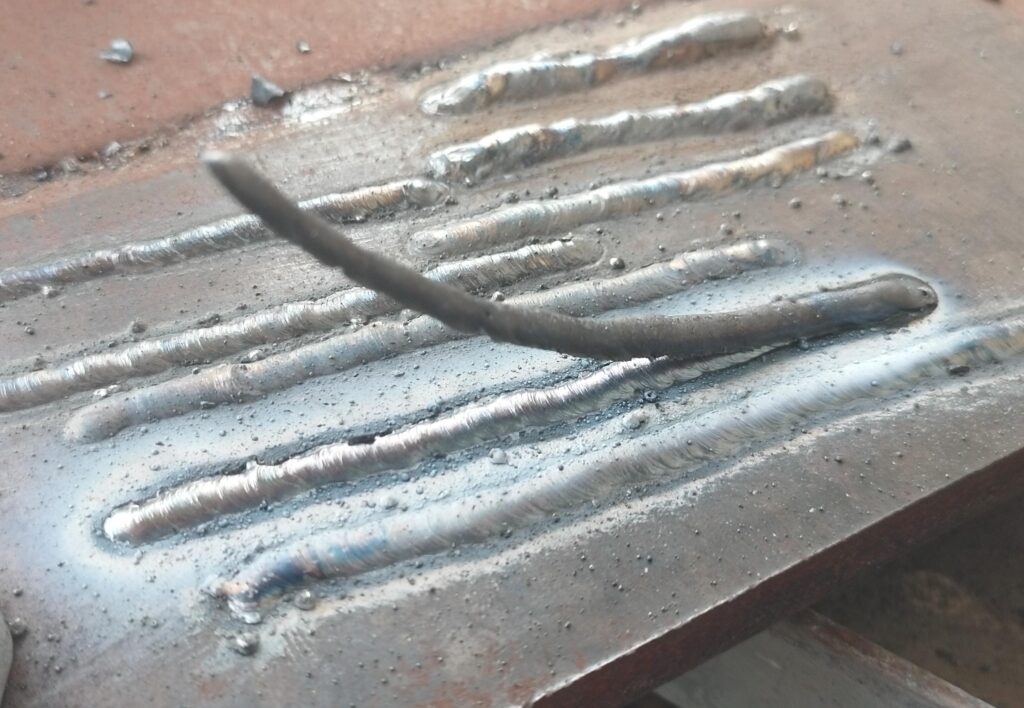
●To foster a “green welding” environment and cultivate a “green welding”-themed philosophy, our company has focused its R&D and technical personnel to independently develop a welding electrode that aligns with this theme: the AKR-13.
●The AKR-13 qualifies as AWS A5.1 E6013, but its superior welding performance surpasses 98% of similar products on the market.
●The AKR-13 produces no smoke, noise, odor, or harmful gases during welding, minimizing welder health. Furthermore, the AKR-13 exhibits exceptional arc starting and restriking capabilities, is resistant to arc interruption, and supports all-position welding, including vertical and downward welding.
●The successful development of the AKR-13 marks the beginning of our company’s journey toward “green welding”!
🌿 Green Welding: Concept and Background
Green welding originates from the “Green Manufacturing” strategy and aims to address the welding industry’s challenges of high energy consumption, low resource utilization, and high pollution. Its core goal is to achieve low emissions, low pollution, and high efficiency in the welding process through innovative materials, processes, and equipment. For example, pollution from traditional welding, such as fume, spatter, and lead/cadmium solder, is being gradually replaced by harmless technologies.
🔧 Key Technologies: From Materials to Processes
1. Green Welding Materials
● Cadmium-Free and Lead-Free Solders: Silver-copper-zinc and zinc-aluminum-based solders developed by the General Research Institute of Machinery Science and Technology replace toxic materials, offering superior performance and eliminating phosphorus fume during manufacturing.
● Preformed Solders and Composite Wires: For example, flux-cored wires reduce flux usage by 90%, significantly reducing pollution.
2. Highly Efficient and Energy-Saving Processes
● Cold Metal Transfer Technology: Adding an activator to CO₂ gas shielded welding increases penetration by over 20% while reducing spatter and fume.
● Laser-arc hybrid welding: A low-power pulsed laser induces an arc, reducing energy consumption while doubling penetration and efficiency. It is suitable for difficult-to-weld materials such as magnesium and titanium alloys.
● Friction stir welding: A solid-state joining technology that eliminates slag and exhaust gases and is widely used in lightweight aluminum alloy structures.
3. Green Laser Welding
● Green laser (532nm): Increases absorption by over 50% for highly reflective materials (such as copper and aluminum), consumes only 9%-16% of the energy of infrared lasers, and produces no spatter with a minimal heat-affected zone. This eliminates the risk of short circuits caused by metal spatter in power battery welding.
4. Automation and Digitalization
● Robotic welding and intelligent planning systems: Optimize parameters through algorithms to reduce energy consumption by 10%-30%. For example, fully automated offshore pipeline maintenance systems reduce labor and resource waste.
🚀 Challenges and Future Trends
1. Bottleneck Analysis:
● Green materials are relatively expensive, making them difficult for small and medium-sized enterprises to adopt.
● Process stability needs to be improved. For example, the penetration depth of copper welded with green lasers still needs improvement.
2. Development Directions:
● Intelligent closed-loop control: Integrating the Internet of Things (IoT) and AI for real-time parameter adjustment.
● Circular economy model: Promoting composite welding technology and promoting component recycling.
● Multi-energy field hybrid processes: Such as ultrasonic-laser hybrid technology, further reducing energy consumption and improving efficiency.
💎 Conclusion
Green welding is not only a technological innovation but also a core driver of sustainable manufacturing development. Through harmless materials, precise processes, and intelligent systems, it is liberating welding from the stereotype of high energy consumption and high pollution, becoming an indispensable green engine for high-end manufacturing. With the global move towards carbon neutrality, green welding technology is poised to play an even more critical role in aerospace, new energy, and other fields.