
AWS EM13K Submerged Arc Welding Wire: Specifications, Applications and Selection Guide
When fabricators search for EM13K, they are usually looking for a submerged arc welding wire that can deliver stable bead appearance, reliable mechanical properties and good performance on carbon steel or low-alloy steel structures. AWS EM13K, also known in some markets as H10MnSi, is a solid submerged arc welding wire commonly used with suitable SAW fluxes for automatic or semi-automatic welding.
This guide explains what EM13K is, where it is used, how to select the right diameter and flux combination, and what buyers should check before placing an order.
What Is EM13K Welding Wire?
EM13K is an AWS-classified submerged arc welding wire designed for welding mild steel and certain low-alloy steel structures. It contains controlled manganese and silicon levels, which help support deoxidation, bead formation and weld metal consistency during submerged arc welding.
In practical production, EM13K is often chosen when the welding process requires:
Stable arc performance under flux
Smooth weld bead appearance
Good slag detachability
Suitable mechanical properties for structural applications
Better resistance to porosity when the base metal surface is not perfectly clean
Because submerged arc welding is normally used for long seams, thick plates and high-productivity fabrication, EM13K is most often supplied in larger packaging such as coils, drums or reels.
EM13K and H10MnSi: Are They the Same?
In many international product catalogs, EM13K is listed together with H10MnSi. EM13K is the AWS classification, while H10MnSi is commonly used in Chinese and GB-related product naming.
Although the names are often used together, buyers should not rely only on the grade name. The final welding performance depends on the full system, including:
Wire chemistry
Flux type
Welding current and polarity
Plate thickness
Joint design
Preheating and interpass temperature
Post-weld heat treatment requirements
Testing standard requested by the project
For critical projects, always confirm the material certificate, welding procedure qualification and flux-wire classification before production.
Typical Applications of AWS EM13K SAW Wire
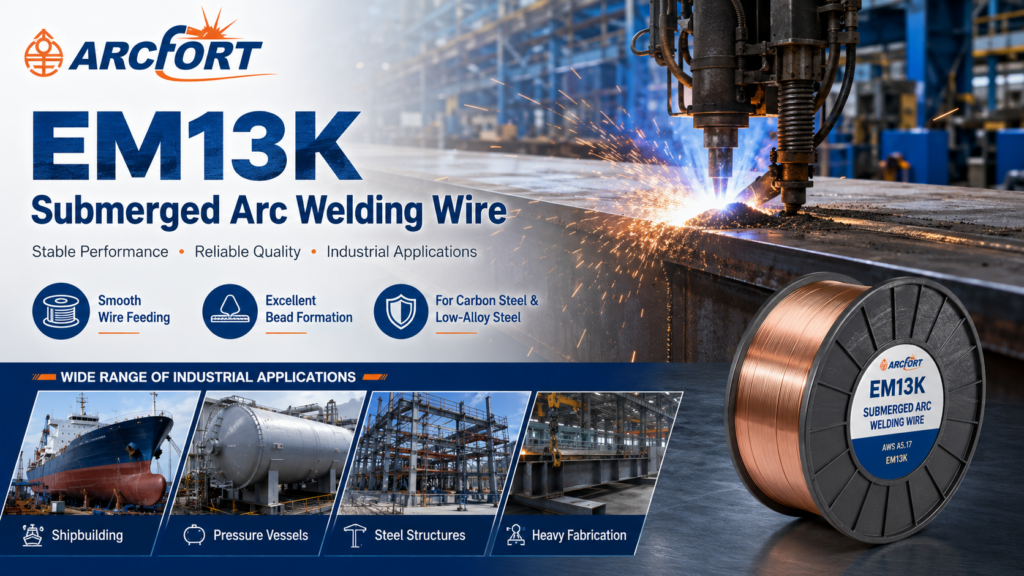
EM13K is mainly used for submerged arc welding of carbon steel and low-alloy steel structures. Common applications include:
Pressure Vessels and Boilers
EM13K can be used for longitudinal and circumferential seams where stable weld quality and consistent deposition are required. For pressure-related work, the wire and flux combination should be selected according to the required tensile strength, impact value and heat treatment condition.
Shipbuilding
Shipyards use submerged arc welding for panels, stiffeners and long straight welds. EM13K is suitable for production lines that need high deposition efficiency and repeatable weld appearance.
Bridges and Structural Fabrication
For bridge components, beams and heavy structural parts, EM13K can support efficient welding of medium-thickness and thick steel plates. The correct flux pairing is important to achieve the required mechanical properties.
Storage Tanks and Large Steel Structures
Tank fabrication often involves long weld seams and repetitive welding operations. EM13K works well in submerged arc systems where productivity and bead consistency are important.
Heavy Equipment and General Fabrication
EM13K can also be used for machinery frames, welded components, rail-related structures and other heavy fabrication jobs that require dependable carbon steel welds.
Key Features of EM13K Welding Wire
A well-manufactured EM13K submerged arc welding wire should offer the following advantages:
1. Stable Feeding Performance
Copper-coated EM13K wire is designed for smooth feeding through automatic welding equipment. Good wire surface quality helps reduce feeding interruptions and supports consistent arc behavior.
2. Good Bead Formation
The manganese and silicon balance in EM13K helps produce a clean and uniform weld bead when paired with the correct flux and parameters.
3. Suitable for High-Speed Welding
In production environments, EM13K can be used for high-speed welding of carbon steel plates, especially when the joint design and flux-wire combination are optimized.
4. Good Slag Removal
With compatible flux, the weld slag should detach easily after welding. This reduces cleaning time and improves productivity in continuous fabrication.
5. Practical Tolerance to Light Rust or Mill Scale
EM13K is often selected for applications where the base metal surface may contain slight rust or mill scale. However, this does not mean surface preparation can be ignored. Cleaner base metal still produces more reliable results.
Typical Chemical Composition
The exact chemical composition depends on the manufacturer and applicable standard. A typical EM13K wire may include controlled levels of carbon, manganese and silicon, with restricted sulfur and phosphorus.
| Element | Typical Control Purpose |
|---|---|
| Carbon | Supports strength while maintaining weldability |
| Manganese | Helps deoxidation and contributes to strength |
| Silicon | Supports deoxidation and bead appearance |
| Sulfur | Kept low to reduce weld quality risks |
| Phosphorus | Kept low to improve weld metal reliability |
| Copper | Often related to copper coating and corrosion resistance during storage |
Before purchase, buyers should request the manufacturer’s actual mill test certificate instead of relying only on a catalog range.
Available Diameters
Common EM13K submerged arc welding wire diameters include:
| Diameter | Typical Use |
|---|---|
| 2.5 mm | Medium current welding and thinner plate applications |
| 3.2 mm | General SAW fabrication and common production use |
| 4.0 mm | Higher deposition welding for thicker plates |
| 5.0 mm | Heavy fabrication and high-current applications |
The right diameter should be selected according to current range, plate thickness, joint type, welding position and deposition rate target.
Flux Matching for EM13K
EM13K must be used with a suitable submerged arc welding flux. The flux affects:
Weld metal mechanical properties
Slag detachability
Bead shape
Impact toughness
Welding speed
Resistance to porosity
Suitability for single-pass or multi-pass welding
Common flux types used with EM13K include fused or sintered fluxes designed for carbon steel submerged arc welding. For important projects, the flux-wire combination should be tested together rather than selected separately.
EM13K vs EM12K: What Is the Difference?
Both EM13K and EM12K are used in submerged arc welding, but EM13K generally has a different manganese and silicon balance. In many applications, EM13K is chosen when the welding process needs stronger deoxidizing performance, better bead control or improved tolerance to surface conditions.
However, EM13K is not automatically better for every job. EM12K may still be suitable for certain welding procedures, base metals or flux combinations. The best choice depends on the required weld deposit properties and the approved welding procedure.
How to Choose a Reliable EM13K Supplier
When sourcing AWS EM13K submerged arc welding wire, do not compare only price per ton. A reliable supplier should provide consistent quality, complete documentation and stable production capability.
Check the following before ordering:
1. Standard Compliance
Confirm whether the product conforms to AWS A5.17 EM13K, GB H10MnSi or another project-specific standard.
2. Chemical Composition Certificate
Ask for a mill test certificate showing actual chemical composition, not only a catalog page.
3. Mechanical Property Data
For structural or pressure-related work, confirm tensile strength, yield strength, elongation and impact value requirements.
4. Flux Recommendation
A good supplier should be able to recommend compatible submerged arc welding flux for your base metal and welding condition.
5. Packaging Options
Choose packaging according to your production line. Common options include coils, drums and reels. Large drums are suitable for continuous automatic welding.
6. Surface and Winding Quality
Wire surface quality, copper coating uniformity and layer winding can affect feeding stability. Poor winding may cause downtime during automatic welding.
7. Batch Consistency
For large projects, batch-to-batch consistency is important. Confirm whether the supplier can keep stable chemistry and packaging across repeated orders.
Storage and Handling Tips
To maintain EM13K wire performance, store the product in a dry and enclosed area. Keep the original package intact before use. Avoid exposure to moisture, dust, oil or corrosive environments.
Before welding, operators should check:
Wire surface condition
Flux dryness
Feeding system cleanliness
Contact tip condition
Welding current and voltage
Travel speed
Stick-out length
Workpiece cleanliness
Proper storage and setup help reduce porosity, arc instability and weld defects.
Common Questions About EM13K
Is EM13K a MIG wire?
No. It is mainly used as a submerged arc welding wire, not a standard MIG welding wire. It is designed to work under a layer of SAW flux.
Can EM13K be used for pressure vessels?
Yes, It can be used in pressure vessel fabrication when the selected flux-wire combination, welding procedure and test results meet the project standard.
What base metals can EM13K weld?
It is commonly used for mild steel and low-alloy steel structures. The exact base metal range should be confirmed by the welding procedure and project specification.
Does EM13K require clean base metal?
Light rust or mill scale may be tolerated in some conditions, but clean base metal is always recommended for better weld quality and lower defect risk.
What information should I provide when requesting a quote?
To get an accurate quotation, provide the required standard, diameter, quantity, packaging type, destination port, flux requirement and any third-party inspection needs.
Conclusion
AWS EM13K submerged arc welding wire is a practical choice for carbon steel and low-alloy steel fabrication where stable welding performance, good bead appearance and high productivity are required. It is widely used in shipbuilding, bridges, boilers, pressure vessels, storage tanks and heavy structural fabrication.
For the best results, It should not be selected by grade name alone. The wire, flux, welding procedure and base metal must be considered as a complete system. A reliable supplier should provide not only competitive pricing, but also technical support, certificates, stable packaging and consistent batch quality.