

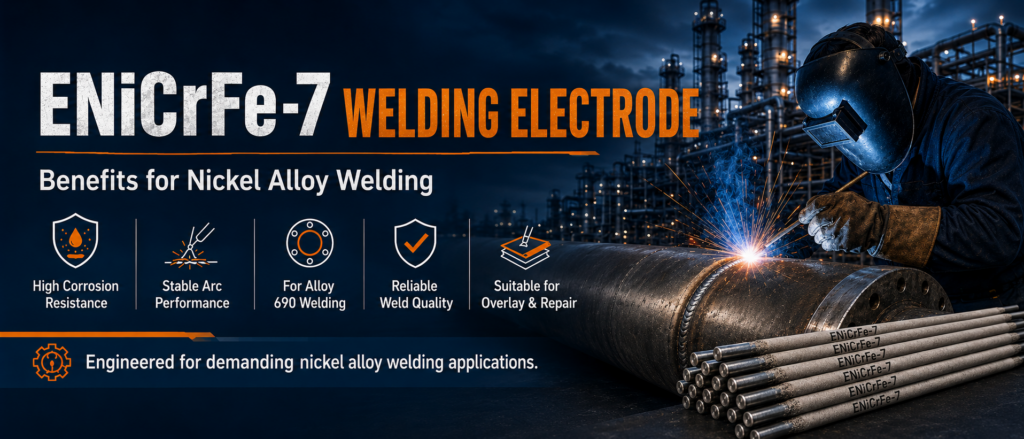
Benefits of ENiCrFe-7 for Nickel Alloy Welding
Nickel alloys are widely used in equipment that must withstand corrosion, elevated temperatures, aggressive chemicals, and demanding operating conditions. However, the performance of a nickel alloy component depends not only on the base material but also on the quality and compatibility of the welding consumable.ENiCrFe-7
ENiCrFe-7 is a nickel-chromium-iron covered electrode designed for shielded metal arc welding. It is commonly selected for welding Alloy 690-type materials and for specialized applications requiring a high-chromium, nickel-based weld deposit.
The main benefits of ENiCrFe-7 for nickel alloy welding include strong corrosion resistance, good mechanical properties, stable arc performance, controlled weld-pool behavior, and suitability for demanding fabrication and maintenance work.
What Is an ENiCrFe-7 Welding Electrode?
ENiCrFe-7 is a covered welding electrode classified under AWS A5.11 for shielded metal arc welding of nickel and nickel-alloy materials.
Its weld deposit is primarily composed of nickel, chromium, and iron, with controlled additions of elements such as manganese and niobium. The relatively high chromium content is one of the most important characteristics of this electrode.
ENiCrFe-7 is mainly associated with Alloy 690-type materials, which are selected for applications requiring resistance to oxidation, corrosive chemicals, and stress-corrosion cracking.
Depending on the qualified welding procedure, ENiCrFe-7 may be used for:
Welding Alloy 690-type base materials
Joining selected nickel-chromium-iron alloys
Repairing corrosion-resistant equipment
Producing protective weld overlays
Joining certain dissimilar-metal combinations
Maintaining chemical-processing equipment
Fabricating selected power-generation components
The electrode should always be selected according to the exact base material, operating environment, design code, and approved welding procedure.
1. High Chromium Content for Corrosion Resistance
One of the most significant benefits of ENiCrFe-7 is its high chromium content.
Chromium contributes to the formation of a stable protective oxide layer on the weld-metal surface. This passive layer helps protect the deposited metal from oxidation and corrosion in many industrial environments.
This characteristic makes ENiCrFe-7 suitable for components exposed to:
Oxidizing chemicals
High-temperature gases
Acid-processing environments
Steam and hot-water systems
Corrosive process fluids
Repeated thermal exposure
The actual corrosion performance of a completed weld depends on the service medium, temperature, concentration, contamination level, weld dilution, surface condition, and heat treatment.
For critical equipment, corrosion compatibility should be verified through engineering evaluation or application-specific testing.
2. Compatibility with Alloy 690-Type Materials
ENiCrFe-7 was developed primarily for welding high-chromium nickel alloys such as Alloy 690.
Matching the weld-metal composition to the base material helps maintain the intended corrosion resistance and metallurgical performance of the completed joint.
Using a filler metal with insufficient chromium may create a weld zone that performs differently from the surrounding base material. In severe service, this difference may become a preferred location for corrosion or premature degradation.
ENiCrFe-7 provides a nickel-chromium-iron deposit that is chemically compatible with Alloy 690-type materials, making it a logical choice for:
Joint welding
Repair welding
Attachment welding
Nozzle connections
Component replacement
Localized restoration
Corrosion-resistant surfacing
Final compatibility must still be confirmed through the applicable welding procedure specification.
3. Improved Resistance to Stress-Corrosion Cracking
Stress-corrosion cracking occurs when tensile stress, a susceptible material, and a specific corrosive environment act together.
This form of damage is particularly serious because cracks may develop with limited visible metal loss. Components can therefore appear acceptable while localized cracking is progressing.
The high-chromium nickel-based weld deposit produced by ENiCrFe-7 is designed for applications where resistance to stress-corrosion cracking is important.
This benefit can be valuable in:
High-temperature water systems
Steam-generating equipment
Chemical-processing units
Pressure-containing components
Heat-transfer equipment
Corrosion-resistant piping
Power-generation systems
Electrode selection alone cannot eliminate stress-corrosion cracking. Joint stress, residual stress, surface condition, contamination, operating temperature, fluid chemistry, and welding heat input must also be controlled.
4. Good Mechanical Strength
Nickel alloy welds often operate under a combination of pressure, temperature, vibration, thermal expansion, and mechanical loading.
ENiCrFe-7 provides a weld deposit with useful tensile strength and ductility for demanding industrial joints. When deposited correctly, the weld metal can support the structural and pressure-containing requirements of compatible nickel alloy components.
Good mechanical performance helps the completed joint resist:
Static loading
Thermal expansion
Localized stress
Equipment vibration
Pressure fluctuations
Repeated operating cycles
The required mechanical properties should be verified through the applicable classification certificate, batch test report, procedure qualification record, or project specification.
5. Good Ductility for Demanding Joints
Strength is important, but a weld that is strong without adequate ductility may be vulnerable to cracking under restraint or thermal movement.
A properly deposited ENiCrFe-7 weld can provide a useful balance between strength and elongation. This allows the weld metal to accommodate a certain amount of deformation before failure.
Ductility is especially valuable when welding:
Thick sections
Highly restrained joints
Complex equipment geometries
Components exposed to thermal cycling
Dissimilar materials with different expansion rates
Repair areas containing residual stress
Good joint design and controlled welding parameters remain essential. Even a ductile filler metal can crack when the joint is contaminated, excessively restrained, or welded with unsuitable heat input.
6. Stable Shielded Metal Arc Welding Performance
ENiCrFe-7 is supplied as a covered electrode for shielded metal arc welding, also known as SMAW.
SMAW remains an important process for nickel alloy fabrication and repair because the equipment is portable and does not require an external shielding-gas supply.
A well-manufactured ENiCrFe-7 electrode can provide:
Stable arc ignition
Consistent electrode melting
Controlled metal transfer
Manageable weld-pool fluidity
Uniform bead appearance
Reduced spatter
Reliable slag coverage
Practical slag removal
These characteristics help welders maintain better control in field and workshop conditions.
Actual welding behavior may vary according to electrode diameter, coating condition, current setting, arc length, welding position, storage condition, and operator technique.
7. Suitable for Positional Welding
Industrial equipment cannot always be positioned to make every weld in the flat position.
Maintenance and installation work may require vertical, horizontal, overhead, or restricted-access welding. ENiCrFe-7 electrodes are available for positional welding when used within the electrode manufacturer’s recommended diameter and current range.
This flexibility is valuable for:
Piping systems
Pressure vessels
Tanks
Heat exchangers
Field repairs
Equipment installed in confined spaces
Components that cannot be rotated
Smaller electrode diameters are generally easier to control in vertical and overhead positions. The exact permitted positions should be confirmed from the product data and approved welding procedure.
8. Useful for Corrosion-Resistant Weld Overlay
ENiCrFe-7 may be used to deposit a corrosion-resistant nickel alloy layer onto selected carbon steels, low-alloy steels, or stainless steels.
This process is often known as weld overlay, cladding, or surfacing.
Instead of manufacturing the entire component from an expensive nickel alloy, engineers may use a structural base material and apply a corrosion-resistant surface layer only where required.
Potential overlay applications include:
Pressure vessel surfaces
Valve components
Nozzles
Flanges
Chemical-processing equipment
Pipe interiors
Heat-transfer components
Localized corrosion-damaged areas
Overlay welding requires careful control of dilution. Excessive mixing with the base metal can reduce chromium and nickel content in the first deposited layer.
Multiple layers may therefore be required to achieve the specified surface chemistry.
9. Potential for Selected Dissimilar-Metal Welding
Industrial systems often contain combinations of nickel alloy, stainless steel, low-alloy steel, and carbon steel.
ENiCrFe-7 may be considered for selected dissimilar-metal joints because its nickel-based weld deposit can tolerate some compositional dilution and differences between base materials.
Possible applications may include:
Nickel alloy to stainless steel
Nickel alloy to low-alloy steel
Corrosion-resistant alloy attachments
Transition joints
Repair sections involving different materials
Nickel alloy overlay on steel
Dissimilar-metal welding is more complex than matching-alloy welding. Engineers must evaluate:
Base-metal chemistry
Carbon migration
Dilution
Thermal expansion differences
Post-weld heat treatment
Corrosion potential
Hardness at the fusion boundary
Operating temperature
Long-term service conditions
ENiCrFe-7 should not be used for a dissimilar-metal joint solely because it is a nickel-based electrode. The complete welding procedure must be technically reviewed and qualified.
10. Practical for Maintenance and Repair Welding
Many nickel alloy repairs occur on equipment that cannot be transported to a fabrication shop.
The portability of SMAW equipment makes ENiCrFe-7 practical for field maintenance. The process can be used with a suitable power source, electrode holder, and properly stored electrodes.
It is useful for:
Local crack repairs
Replacement sections
Worn surface restoration
Attachment repairs
Nozzle maintenance
Corrosion-damaged components
Small production quantities
Emergency shutdown work
Because SMAW does not rely on a shielding-gas cylinder, it may also be easier to use in outdoor locations where wind could disturb gas-shielded processes.
Adequate weather protection, joint cleaning, and electrode moisture control are still required.
11. Good Control in Narrow Joint Preparations
Nickel alloy components may have thick sections or narrow joint designs intended to reduce weld-metal volume.
ENiCrFe-7 electrodes with controlled arc characteristics can help welders direct the weld pool into narrow preparations and restricted joint areas.
Good gap-bridging ability and manageable slag behavior may improve welding efficiency in joints where access is limited.
For narrow joints, welders should pay close attention to:
Sidewall fusion
Slag removal
Electrode angle
Arc length
Bead placement
Restart cleaning
Interpass temperature
Joint visibility
Poor technique can cause slag inclusions or lack of fusion, especially along the sidewalls of a narrow groove.
12. Reduced Post-Weld Cleaning
A controlled slag system can make slag removal easier after each pass.
Easy slag removal is not only a productivity advantage. It also helps welders inspect the deposited bead and prepare the surface for the next layer.
Complete interpass cleaning reduces the risk of:
Slag inclusions
Lack of fusion
Irregular bead overlap
Hidden surface defects
Contamination between passes
Every pass should be cleaned according to the qualified procedure. Special attention should be given to bead edges, crater areas, and arc-restart locations.
Typical Applications of ENiCrFe-7
Because of its high-chromium nickel-based weld deposit, ENiCrFe-7 may be used in several demanding industries.
Chemical Processing
Chemical plants use nickel alloys in equipment exposed to aggressive acids, oxidizing media, and corrosive process streams.
Potential applications include:
Reactors
Process vessels
Piping
Valves
Pumps
Heat exchangers
Storage equipment
Corrosion-resistant linings
Power Generation
ENiCrFe-7 may be selected for specialized components used in steam systems, high-temperature water environments, and corrosion-sensitive equipment.
The welding procedure must meet the applicable construction code and quality requirements.
Nuclear-Related Equipment
Alloy 690-type materials are used in certain nuclear-related components because of their corrosion resistance in high-temperature water environments.
Welding consumables for these applications require strict control of chemistry, traceability, mechanical properties, welding procedures, and inspection.
Heat Exchangers
Heat exchangers may be exposed to corrosive fluids on one or both sides of the heat-transfer surface.
ENiCrFe-7 may be considered for compatible nickel alloy tubes, tube sheets, nozzles, and repair areas.
Petrochemical Equipment
Petrochemical facilities contain corrosive process media, elevated temperatures, and pressure-containing systems.
Possible ENiCrFe-7 applications include nickel alloy equipment, protective overlays, repair welding, and selected transition joints.
Recommended Welding Practices
The performance of ENiCrFe-7 depends on correct welding technique and preparation.
Identify the Base Material
Confirm the exact alloy before selecting the electrode. Material certificates, equipment records, or positive material identification may be required.
Clean the Joint Thoroughly
Remove all oil, grease, moisture, paint, oxide scale, sulfur-containing contamination, and cutting residue.
Nickel alloy welds can be sensitive to surface contamination.
Keep Electrodes Dry
Covered electrodes should be stored in dry conditions. Rebaking should only be performed according to the product instructions.
Incorrect heating can damage the coating, while moisture can contribute to porosity and unstable welding performance.
Use the Recommended Polarity
ENiCrFe-7 electrodes are commonly used with direct current electrode positive. However, the product data sheet and welding procedure should always be followed.
Maintain a Short Arc
A short arc helps maintain shielding, reduce oxidation, control spatter, and produce a more uniform weld bead.
Use Controlled Stringer Beads
Stringer beads generally provide better control of heat input and weld-pool behavior than wide weaving.
Weaving should remain within the limits of the approved welding procedure.
Control Interpass Temperature
Excessive interpass temperature can affect weld-metal properties, increase distortion, and make the weld pool more difficult to control.
Allow the joint to cool when necessary.
ENiCrFe-7 Clean Between Passes
Remove slag and surface oxides completely before depositing the next bead.
Dedicated stainless steel tools may be used to reduce contamination from carbon steel.
Fill the Final Crater
Unfilled weld craters may develop shrinkage cracks. Fill the crater properly before breaking the arc.
ENiCrFe-7 Common Welding Problems and Prevention
Porosity
Porosity may result from moisture, contamination, excessive arc length, or damaged electrode coating.
Prevent it by keeping electrodes dry, cleaning the joint, and maintaining a controlled arc.
ENiCrFe-7 Slag Inclusions
Slag inclusions may occur when the previous layer is not completely cleaned or when bead placement creates trapped slag.
Clean every pass and use an electrode angle that allows the slag to remain behind the weld pool.
Lack of Fusion
Lack of fusion may result from low current, excessive travel speed, poor electrode manipulation, or restricted access.
Ensure that the arc reaches both sides of the joint and that the current is suitable for the electrode diameter.
Crater Cracking
Crater cracks form when the weld is stopped without adequately filling the final pool.
Reduce travel speed near the end and fill the crater before stopping the arc.
Excessive Heat Input
High heat input can increase distortion and reduce control over the molten metal.
Use the specified current, travel speed, bead size, and interpass temperature.
How to Select High-Quality ENiCrFe-7 Electrodes
For critical nickel alloy welding, electrode consistency is more important than selecting the lowest purchase price.
Consider the following factors:
ENiCrFe-7 Classification Compliance
Verify that the electrode meets the required ENiCrFe-7 classification.
ENiCrFe-7 Chemical Composition
Review the deposited weld-metal chemistry, especially nickel, chromium, iron, manganese, niobium, carbon, sulfur, and phosphorus.
ENiCrFe-7 Mechanical Properties
Confirm tensile strength and elongation values according to the project requirements.
ENiCrFe-7 Batch Traceability
Each package should clearly identify the classification, diameter, batch number, and manufacturing information.
ENiCrFe-7 Packaging
Moisture-resistant packaging helps protect the electrode coating during storage and international transportation.
ENiCrFe-7 Arc Performance
Consistent arc ignition, smooth melting, controlled slag, and uniform bead appearance can reduce welding defects and improve productivity.
ENiCrFe-7 Quality Documentation
For critical projects, request the required product certificate, batch test report, inspection record, and traceability information.
ENiCrFe-7 Conclusion
The benefits of ENiCrFe-7 for nickel alloy welding come from its high-chromium, nickel-based weld deposit and practical shielded metal arc welding performance.
When correctly selected, ENiCrFe-7 can provide strong corrosion resistance, good mechanical properties, useful ductility, stable arc behavior, positional welding capability, and reliable performance on Alloy 690-type materials.
It can also support selected overlay, maintenance, repair, and dissimilar-metal applications when used under an approved welding procedure.
To achieve dependable results, fabricators should combine the correct electrode with accurate material identification, thorough joint cleaning, controlled heat input, dry electrode storage, qualified welders, and appropriate inspection.
For critical nickel alloy equipment, consistent quality, complete batch traceability, and reliable technical documentation should always take priority over the lowest electrode price.