

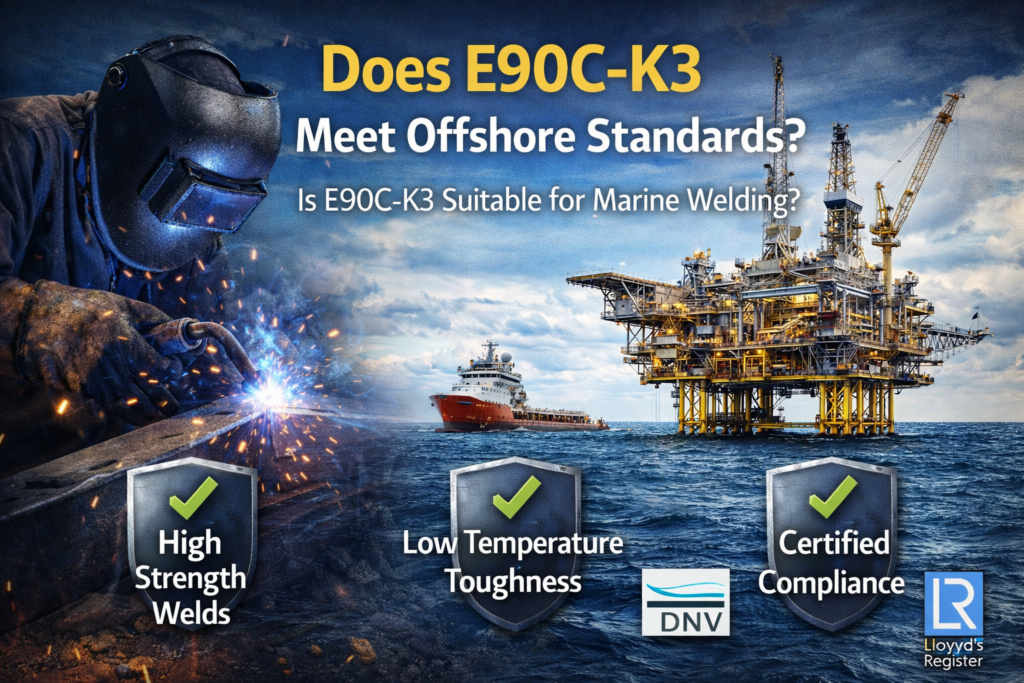
Does E90C-K3 Meet Offshore Standards?
Offshore welding applications demand extreme reliability. From oil platforms to marine structures, weld metal must withstand saltwater corrosion, dynamic loading, and low-temperature environments.E90C-K3.
So the key question is:
Does E90C-K3 truly meet offshore standards?
This guide explains mechanical properties, classification requirements, and practical suitability for offshore fabrication.
1. E90C-K3 What Offshore Welding Standards Require
Offshore structural welding typically requires compliance with standards such as:
American Welding Society structural classifications
DNV offshore approval
Lloyd’s Register certification
EN ISO standards for European projects
Key performance requirements include:
Minimum 90 ksi tensile strength
Excellent low-temperature impact toughness
Controlled diffusible hydrogen
Stable mechanical performance under dynamic loading
2. Mechanical Properties of E90C-K3
E90C-K3 is a metal-cored wire designed for high-strength low-alloy steel welding.
Typical properties:
Tensile Strength: ≥ 620 MPa
Yield Strength: High structural grade
Impact Toughness: Suitable for low-temperature service
Excellent arc stability and high deposition rate
The “K3” designation generally indicates a nickel-alloyed weld metal, improving toughness and crack resistance — critical for offshore environments.
3. E90C-K3 Impact Toughness in Low Temperatures
Offshore structures are often exposed to:
North Sea climates
Arctic wind loads
Marine cyclic stress
Nickel-enhanced weld metal in it improves:
Charpy V-notch impact performance
Crack arrest capability
Fatigue resistance
This makes it suitable for structural offshore components when properly qualified under project-specific procedures.
4. E90C-K3 Compliance and Certification
Whether it “meets offshore standards” depends on certification level.
For offshore approval, manufacturers must provide:
Mill Test Certificates (MTC)
WPQR (Welding Procedure Qualification Record)
Third-party inspection approval (DNV, LR, ABS, etc.)
CE marking for European projects
When supplied with proper certification and tested under EN ISO 17632 equivalent classifications, It can be qualified for offshore structural fabrication.
5. Practical Offshore Applications
It is commonly used in:
Offshore platform secondary structures
Crane structures
Heavy marine equipment
Shipyard structural fabrication
High-strength support frames
It is particularly suitable when high deposition efficiency and productivity are required.
6. When Is It Not Suitable?
It may not be ideal for:
Extremely low-temperature Arctic primary load-bearing structures without special approval
Corrosion-critical zones requiring stainless or duplex alloys
Subsea pressure containment without specific certification
Final suitability depends on project specifications and third-party approval.
Conclusion: Can E90C-K3 Be Used Offshore?
Yes — E90C-K3 can meet offshore standards when:
Properly certified
Tested under required impact temperature conditions
Approved by relevant classification societies
For structural offshore fabrication requiring high strength and productivity, E90C-K3 is a competitive and cost-effective solution.