

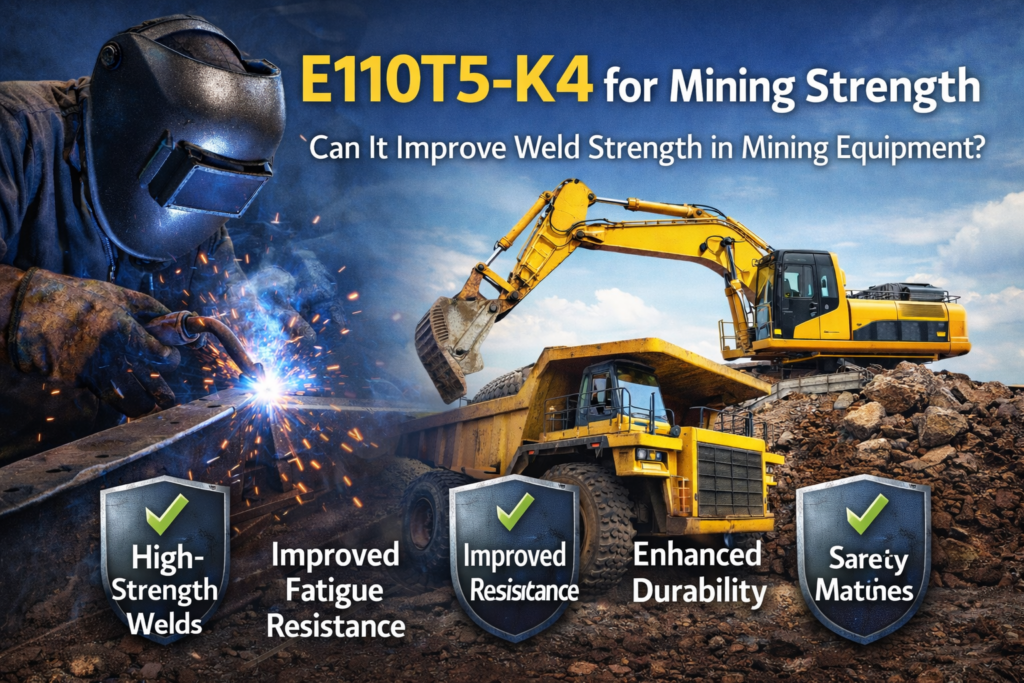
Can E110T5-K4 Improve Weld Strength in Mining Equipment?
Mining equipment operates in one of the harshest industrial environments on earth. From haul trucks and excavator booms to crusher frames and dragline components, welded joints are constantly exposed to:E110T5-K4
Extreme static loads
High cyclic fatigue stress
Abrasion and impact shock
Temperature variations
Remote-site maintenance challenges
In such demanding conditions, weld metal strength is not just a technical parameter — it directly determines equipment lifespan, downtime cost, and safety performance.
So, can E110T5-K4 significantly improve weld strength in mining equipment?
The answer depends on strength matching, alloy design, and application control. Let’s break it down.
1️⃣ Understanding E110T5-K4 Classification
Under standards published by the American Welding Society, E110T5-K4 belongs to the 110 ksi class of flux-cored arc welding (FCAW) wires.
Classification breakdown:
E – Electrode
110 – Minimum tensile strength of 110 ksi (≈760 MPa)
T5 – Flux-cored wire, designed for CO₂ or mixed shielding gas
K4 – Alloy designation for high-strength applications
This places it well above conventional 70 ksi or 80 ksi consumables commonly used in general fabrication.
2️⃣ E110T5-K4 Why Weld Strength Matters in Mining Equipment
Mining machinery components often use high-strength low-alloy (HSLA) steels such as:
Boom arms
Bucket assemblies
Undercarriage frames
Chassis support beams
If the filler metal has lower strength than the base metal, several issues can occur:
Plastic deformation at weld joints
Early fatigue crack initiation
Structural overstress concentration
Reduced load-bearing capacity
Using a 110 ksi class wire like E110T5-K4 ensures proper strength matching or overmatching when welding high-strength steel grades.
3️⃣ E110T5-K4 Mechanical Performance Advantages
✔ High Tensile and Yield Strength
Typical mechanical properties include:
Tensile Strength ≥ 760 MPa
Yield Strength ≥ 680 MPa
This makes it suitable for welding steels in the 690 MPa class and above.
Higher yield strength helps:
Resist permanent deformation
Maintain dimensional stability
Improve structural reliability
✔ Improved Fatigue Resistance
Mining equipment does not fail under static load alone. It fails due to repeated cyclic stress.
High-strength weld metal with refined microstructure helps:
Delay crack propagation
Reduce fatigue sensitivity
Improve long-term structural integrity
Proper weld metal strength reduces localized stress concentration at weld toes.
4️⃣ E110T5-K4 Alloy System Benefits in Harsh Conditions
E110T5-K4 typically contains controlled levels of:
Nickel (Ni) – enhances toughness
Manganese (Mn) – increases strength
Silicon (Si) – improves weld bead quality
This alloy combination supports:
Better impact resistance
Resistance to brittle fracture
Stable performance in outdoor mining environments
Impact performance is especially important when equipment operates in colder regions.
5️⃣ E110T5-K4 Productivity and Welding Efficiency
Mining equipment fabrication often involves:
Thick plates
Multi-pass welding
Position welding on large assemblies
E110T5-K4 offers:
Stable arc characteristics
Good slag detachability
Consistent deposition rates
Suitable all-position capability
This reduces:
Repair rates
Grinding time
Production delays
In mining equipment manufacturing, efficiency is as important as strength.
6️⃣ Hydrogen Control and Crack Prevention
High-strength steels are more sensitive to hydrogen-induced cracking.
E110T5-K4 is engineered for controlled hydrogen levels when used with proper welding procedures.
This helps:
Reduce delayed cracking
Improve weld reliability
Lower post-weld repair costs
In remote mining sites, reducing repair frequency directly lowers operational downtime.
7️⃣ When Should You Use E110T5-K4 in Mining Equipment?
It is recommended when:
✔ Welding high-strength structural components
✔ Fabricating load-bearing mining frames
✔ Manufacturing heavy excavators or haul trucks
✔ Repairing high-stress structural joints
✔ Strength matching is critical
It may not be necessary for:
✖ Low-strength mild steel repairs
✖ Non-load-bearing attachments
Correct filler metal selection must always match base material grade and engineering design.
8️⃣ Does It Truly Improve Weld Strength?
Yes — when used appropriately.
E110T5-K4 improves weld strength by:
Providing high tensile capacity
Matching high-strength base metals
Enhancing fatigue performance
Reducing structural deformation
Supporting crack resistance
However, weld performance also depends on:
Proper joint design
Controlled preheat and interpass temperature
Qualified welding procedures
Skilled welding operation
A high-strength wire alone cannot compensate for poor welding practice.
Final Verdict
For mining equipment manufacturers seeking improved structural performance, E110T5-K4 is a strategic choice in high-strength welding applications.
When combined with proper welding procedure control, it can:
Extend equipment service life
Improve load-bearing safety
Reduce maintenance frequency
Enhance overall fabrication reliability
In high-stress mining environments, weld strength is not optional — it is essential.