

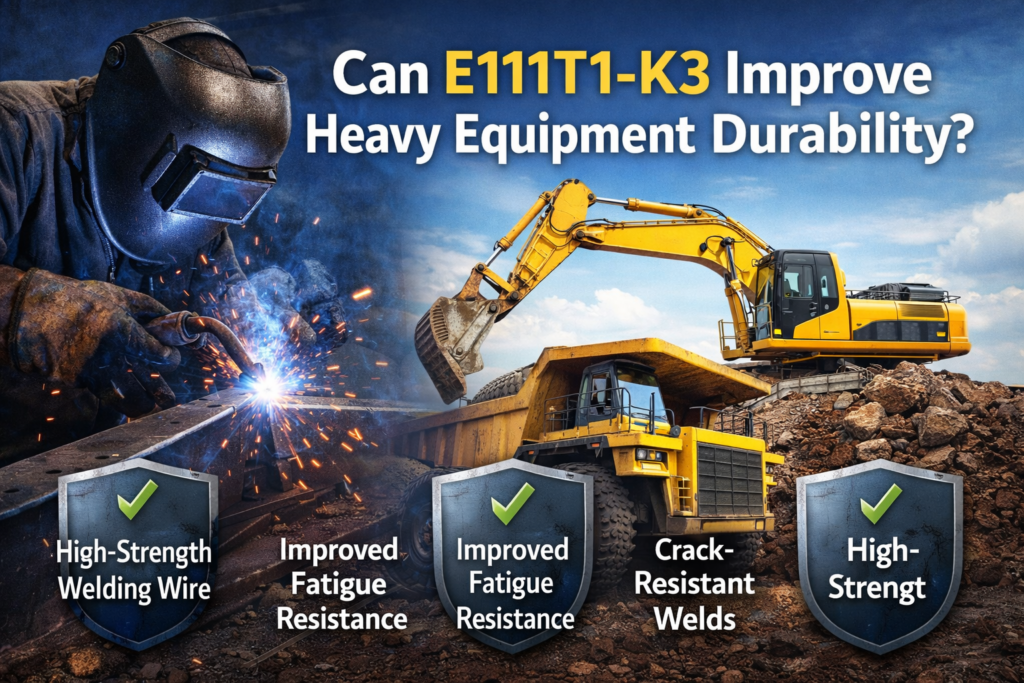
E111T1-K3 for Heavy Equipment Durability
Heavy equipment manufacturers face constant challenges: extreme loads, vibration fatigue, impact stress, and harsh working environments. Whether used in mining, construction, offshore lifting, or agricultural machinery, structural weld integrity directly determines equipment lifespan.E111T1-K3.
Can E111T1-K3 truly improve heavy equipment durability?
The answer lies in its strength class, alloy design, and low-temperature toughness performance.
1️⃣ Understanding E111T1-K3 Classification
E111T1-K3 is a 110 ksi class gas-shielded flux cored wire designed for high-strength structural steels.
Breakdown:
E – Electrode
111 – 110 ksi minimum tensile strength
T1 – Rutile type, all-position FCAW
K3 – Alloy designation (Ni-Cr-Mo system)
This classification follows standards published by American Welding Society under AWS A5.29.
Its mechanical properties typically include:
Tensile strength: ≥ 760 MPa
Yield strength: ≥ 680 MPa
Excellent impact toughness at low temperatures
Controlled diffusible hydrogen levels
For heavy-duty fabrication, these values are critical.
2️⃣ E111T1-K3 Why Durability Fails in Heavy Equipment
Heavy machinery welds commonly fail due to:
Fatigue cracking
Undermatching filler metal strength
Hydrogen-induced cracking
Poor impact toughness
Stress concentration at weld toes
When filler metal strength does not match or exceed base metal strength, early crack initiation becomes likely.
This is where E111T1-K3 becomes a strategic solution.
3️⃣ E111T1-K3 High Strength Matching for Structural Integrity
Modern heavy equipment increasingly uses high-strength steels (S690, S700, quenched & tempered grades).
Using lower-strength consumables (such as 70 ksi or 80 ksi class wires) creates:
Strength mismatch
Plastic deformation zones
Reduced fatigue life
E111T1-K3 provides proper overmatching, ensuring:
Load-bearing reliability
Reduced structural distortion
Better static and dynamic strength performance
4️⃣ Impact Toughness in Harsh Environments
Mining trucks, offshore cranes, and construction excavators often operate in:
Sub-zero climates
High shock load conditions
Cyclic stress environments
It offers strong low-temperature impact properties, helping prevent brittle fracture.
In European markets, impact performance is particularly important under standards developed by CEN.
5️⃣ Hydrogen Control and Crack Prevention
Heavy plate welding increases hydrogen cracking risk due to:
High restraint
Thick sections
Multi-pass welding
E111T1-K3 typically offers low diffusible hydrogen classification (H4 or similar), reducing:
Cold cracking
Delayed cracking
Repair rates
Lower repair rates directly increase equipment production efficiency.
6️⃣ Fatigue Resistance in Dynamic Applications
Equipment such as:
Excavator booms
Crane structures
Loader arms
Dump truck frames
are exposed to constant cyclic loads.
The combination of:
High tensile strength
Refined weld metal microstructure
Good slag detachability (reducing weld defects)
improves fatigue life significantly.
Durability is not just about static strength — it’s about long-term cyclic resistance.
7️⃣ Productivity Advantages in Fabrication
Beyond mechanical properties, E111T1-K3 also improves production efficiency:
Smooth arc stability
All-position capability
High deposition rate
Minimal spatter
For heavy equipment OEMs, this means:
Faster welding cycles
Reduced grinding time
Lower labor cost per joint
Durability and productivity can go hand in hand.
8️⃣ When Should You Choose E111T1-K3?
E111T1-K3 is recommended when:
✔ Welding high-strength structural steel
✔ Fabricating mining or construction equipment
✔ Working in low-temperature environments
✔ Seeking EN or AWS compliant solutions
✔ Requiring improved fatigue performance
It may not be necessary for mild steel fabrication, but for 690 MPa+ structural components, it becomes a highly strategic consumable choice.
Conclusion: Does E111T1-K3 Improve Durability?
Yes — when properly matched to high-strength steel applications.
E111T1-K3 enhances:
Structural load capacity
Fatigue resistance
Crack prevention
Low-temperature performance
Production efficiency
For heavy equipment manufacturers aiming to extend service life and reduce warranty risks, E111T1-K3 is not just a filler metal — it is a durability solution.