

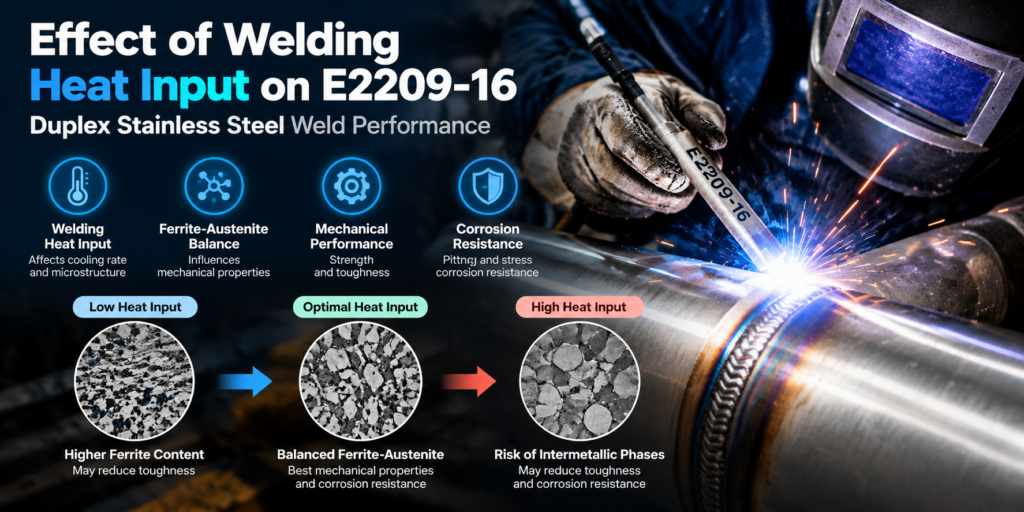
Effect of Welding Heat Input on E2209-16 Duplex Stainless Steel Weld Performance
Introduction
E2209-16 duplex stainless steel electrodes are widely used for welding duplex stainless steels due to their excellent combination of strength, toughness, and corrosion resistance. The weld performance of E2209-16 depends not only on electrode composition but also on welding parameters, especially welding heat input.
During duplex stainless steel welding, heat input directly influences cooling rate, phase transformation behavior, ferrite-austenite balance, and the final mechanical and corrosion properties of the weld metal. Proper control of heat input is therefore essential to achieve stable weld quality and maintain the advantages of duplex stainless steel.
Understanding the relationship between welding heat input and E2209-16 weld performance helps engineers optimize welding procedures for applications requiring high reliability and corrosion resistance.
What Is Welding Heat Input in E2209-16 Welding?
Welding heat input represents the amount of thermal energy introduced into the weld area during welding. It is commonly affected by:
- Welding current
- Arc voltage
- Welding speed
- Welding efficiency
- Electrode diameter and welding technique
A higher heat input means more energy is transferred into the base metal and weld pool, while a lower heat input results in faster cooling after welding.
For E2209-16 duplex stainless steel electrodes, controlling heat input is particularly important because the duplex microstructure requires an appropriate balance between:
- Ferrite (α phase)
- Austenite (γ phase)
The correct phase balance provides excellent mechanical strength and corrosion resistance.
Influence of Heat Input on E2209-16 Weld Microstructure
1. Effect on Ferrite-Austenite Balance
The duplex structure of E2209-16 weld metal is designed to achieve an optimized ferrite and austenite ratio. However, welding heat input can significantly affect phase transformation.
Low Heat Input
When heat input is too low:
- Cooling occurs rapidly
- Austenite formation may be insufficient
- Excessive ferrite content can remain in the weld metal
High ferrite levels may reduce:
- Impact toughness
- Ductility
- Resistance to certain corrosion conditions
Although ferrite contributes to strength and stress corrosion cracking resistance, excessive ferrite can negatively affect weld performance.
High Heat Input
When heat input increases:
- Cooling becomes slower
- More time is available for austenite formation
- The weld structure may become more balanced
However, excessive heat input may create other problems:
- Enlarged heat-affected zone (HAZ)
- Reduced cooling control
- Possible precipitation of harmful intermetallic phases
Therefore, an appropriate heat input range is necessary to maintain optimal weld properties.
Effect of Heat Input on Mechanical Properties
Tensile Strength and Weld Integrity
E2209-16 electrodes are designed to produce weld deposits with high tensile strength suitable for duplex stainless steel applications.
Controlled heat input helps maintain:
- Uniform weld structure
- Strong metallurgical bonding
- Stable mechanical performance
Excessive heat input may cause grain coarsening, which can reduce toughness and negatively influence mechanical reliability.
Impact Toughness
Impact toughness is strongly related to weld microstructure.
A properly controlled heat input promotes:
- Balanced ferrite and austenite formation
- Fine grain structure
- Improved low-temperature toughness
If cooling is too rapid due to low heat input, excessive ferrite may reduce toughness. Conversely, overheating may promote undesirable phase changes.
E2209-16 Influence of Heat Input on Corrosion Resistance
One of the most important advantages of E2209-16 welding electrodes is excellent corrosion resistance.
The corrosion performance of duplex stainless steel welds depends on:
- Chromium distribution
- Molybdenum content
- Nitrogen retention
- Ferrite-austenite balance
Improper heat input can disturb the microstructure and reduce resistance against:
- Pitting corrosion
- Crevice corrosion
- Stress corrosion cracking
A controlled welding thermal cycle allows the weld metal to maintain the corrosion-resistant characteristics expected from duplex stainless steel.
E2209-16 Heat Input and Intermetallic Phase Formation
Duplex stainless steels are sensitive to harmful intermetallic phases, especially when exposed to certain temperature ranges for excessive time.
High heat input conditions may increase the risk of:
- Sigma phase formation
- Reduced toughness
- Lower corrosion resistance
Proper welding procedures for E2209-16 should avoid excessive thermal exposure by controlling:
- Welding current
- Interpass temperature
- Cooling conditions
Recommended Welding Considerations for E2209-16 Electrodes
To achieve reliable weld performance, several factors should be carefully controlled:
1. Maintain Proper Heat Input Range
Avoid extremely low or high heat input conditions. The goal is to achieve:
- Stable cooling rate
- Balanced ferrite and austenite phases
- Excellent corrosion resistance
2. Control Interpass Temperature
High interpass temperature can increase thermal accumulation and affect duplex phase stability.
Proper temperature management helps prevent:
- Excessive ferrite formation
- Intermetallic precipitation
- Reduced toughness
3. Optimize Welding Parameters
Important welding parameters include:
- Current selection
- Arc length control
- Travel speed
- Electrode angle
A stable welding process ensures consistent E2209-16 weld quality.
Applications Requiring Optimized E2209-16 Welding Performance
Because of its excellent corrosion resistance and mechanical properties, E2209-16 welding electrodes are commonly applied in:
- Chemical processing equipment
- Offshore structures
- Pressure vessels
- Heat exchangers
- Pipeline systems
- Marine engineering applications
In these environments, weld reliability is critical because failures caused by corrosion or cracking can lead to significant maintenance costs.
E2209-16 Conclusion
Welding heat input plays a critical role in determining the performance of E2209-16 duplex stainless steel welds. Proper control of heat input ensures an optimized ferrite-austenite balance, improved mechanical properties, and excellent corrosion resistance.
Too little heat input may result in excessive ferrite, while excessive heat input can increase the risk of microstructural degradation. By carefully controlling welding parameters and thermal cycles, engineers can achieve high-quality E2209-16 weld joints suitable for demanding industrial applications.
For duplex stainless steel welding, understanding the relationship between heat input, microstructure, and weld performance is essential for producing durable and corrosion-resistant welded structures.