

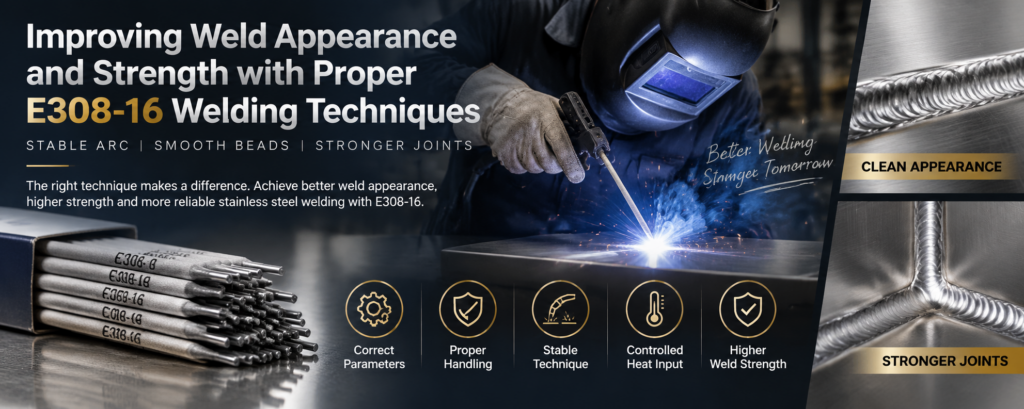
Improving Weld Appearance and Strength with Proper E308-16 Welding Techniques
High-quality stainless steel welding requires more than selecting the right electrode. The welding process, operating parameters, and technique all play important roles in determining weld appearance, mechanical strength, and long-term reliability.E308-16
E308-16 welding electrodes are widely used for joining austenitic stainless steels, especially materials with similar chromium-nickel compositions. However, achieving smooth weld beads, stable arc performance, and strong joints depends on understanding how to properly control the welding process.
This article explores the key techniques that help improve weld quality when using E308-16 electrodes.
Understanding the Characteristics of E308-16 Welding Electrodes
E308-16 electrodes are designed for stainless steel welding applications where good corrosion resistance, stable arc behavior, and reliable mechanical properties are required.
The electrode coating provides several important functions during welding:
Stabilizing the welding arc
Protecting the molten weld pool
Controlling slag formation
Improving weld bead appearance
Supporting smooth metal transfer
Because of these characteristics, E308-16 electrodes are commonly selected for applications involving stainless steel fabrication, equipment manufacturing, and general maintenance welding.
However, the final weld quality depends greatly on how the electrode is used.
1. Selecting the Correct Welding Parameters
Proper welding parameters are one of the most important factors affecting E308-16 weld quality.
Key parameters include:
Welding Current
Current selection directly influences penetration, arc stability, and heat input.
Excessive current may cause overheating, excessive penetration, distortion, or surface oxidation.
Insufficient current may result in poor fusion and unstable arc performance.
Choosing an appropriate current range based on electrode diameter, material thickness, and welding position helps achieve a balanced weld profile.
Arc Length Control
Maintaining a consistent arc length is essential for producing uniform weld beads.
A long arc may increase spatter, reduce shielding effectiveness, and create irregular weld appearance.
A shorter and stable arc generally helps improve:
Weld bead consistency
Arc concentration
Surface quality
2. Maintaining Proper Electrode Handling and Storage
Moisture control is critical for stainless steel welding.
Improperly stored electrodes may absorb moisture from the environment, which can negatively affect welding performance.
Potential issues include:
Increased porosity risk
Unstable arc behavior
Poor weld surface quality
Reduced mechanical performance
Proper storage conditions help maintain electrode performance and reduce welding defects.
Before welding, operators should also ensure that electrodes are clean and free from contamination.
3. Controlling Welding Technique for Better Weld Appearance
The welding technique directly influences the final appearance of the weld.
Several practices can improve weld bead quality:
Maintaining Consistent Travel Speed
Travel speed affects weld width, penetration, and heat input.
Moving too quickly may create narrow beads and insufficient fusion.
Moving too slowly may cause excessive buildup and unnecessary heat accumulation.
A consistent travel speed helps create uniform and visually attractive weld profiles.
Using Proper Electrode Angle
The electrode angle affects molten metal control and slag movement.
Maintaining an appropriate angle helps:
Improve weld pool control
Reduce slag entrapment
Produce smoother bead formation
4. Managing Heat Input During Stainless Steel Welding
Heat control is especially important when welding stainless steel.
Excessive heat input may lead to:
Surface discoloration
Distortion
Changes in corrosion resistance
Unwanted metallurgical effects
To manage heat input effectively, welders can:
Use appropriate current settings
Control welding speed
Apply intermittent welding techniques when necessary
Allow sufficient cooling between passes
Balanced heat management improves both weld appearance and structural performance.
5. Improving Weld Strength Through Proper Joint Preparation
A strong weld begins with proper preparation before welding.
Important preparation steps include:
Cleaning the Base Material
Removing oil, dirt, moisture, and surface contaminants helps prevent welding defects.
Selecting the Correct Joint Design
Joint geometry influences:
Penetration depth
Stress distribution
Weld strength
Proper joint preparation allows the E308-16 electrode to perform effectively and ensures better fusion between materials.
Common E308-16 Welding Problems and Solutions
E308-16 Uneven Weld Beads
Possible causes:
Inconsistent travel speed
Incorrect electrode angle
Unstable arc length
Solutions:
Maintain steady movement
Adjust welding technique
Optimize welding parameters
E308-16 Excessive Spatter
Possible causes:
Incorrect current setting
Poor arc control
Improper electrode handling
Solutions:
Adjust current levels
Maintain stable arc conditions
Improve operator technique
E308-16 Porosity in Welds
Possible causes:
Moisture contamination
Poor surface preparation
Unstable shielding conditions
Solutions:
Keep electrodes properly stored
Clean the welding area
Improve welding practices
Best Practices for Achieving High-Quality E308-16 Welds
To maximize weld performance, welding professionals should focus on the following:
Select suitable electrode diameter and welding parameters.
Maintain clean base materials before welding.
Control arc length and electrode angle.
Manage heat input during welding.
Apply consistent welding techniques.
Inspect weld appearance and quality after completion.
These practices help achieve stronger joints, improved surface appearance, and more reliable stainless steel welding performance.
E308-16 Conclusion
Improving weld appearance and strength with E308-16 electrodes requires a combination of proper parameter selection, good preparation, and skilled welding techniques.
Although E308-16 electrodes provide excellent arc stability and stainless steel welding capability, their full potential can only be achieved through controlled welding processes.
By optimizing current settings, managing heat input, and applying consistent operating methods, welders can produce cleaner weld profiles with improved strength and long-term reliability.
For stainless steel welding applications, attention to every process detail is the foundation of consistent and high-quality results.