

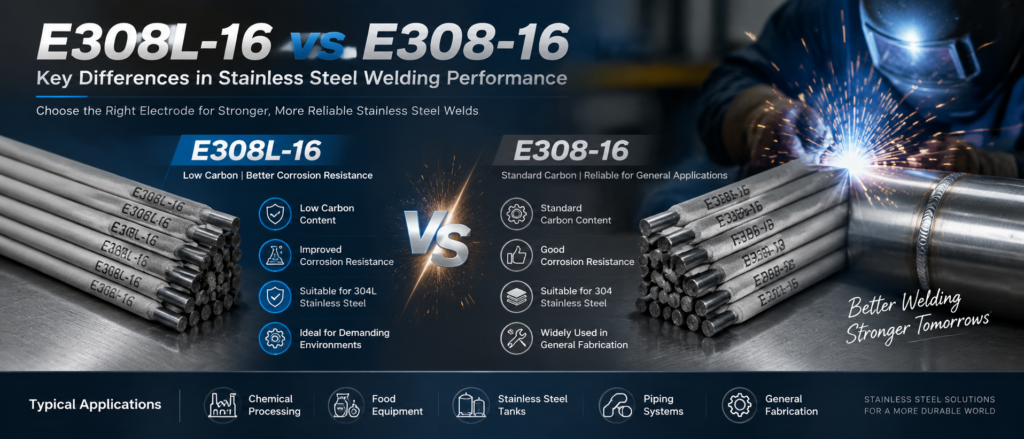
E308L-16 vs E308-16: Key Differences in Stainless Steel Welding Performance
Understanding the Difference Between E308L-16 and E308-16
Selecting the correct stainless steel welding electrode is critical for achieving reliable weld strength, corrosion resistance, and long-term service performance. Among austenitic stainless steel electrodes, E308L-16 and E308-16 are two widely used options for welding chromium-nickel stainless steels, especially materials related to the 304 stainless steel family.
Although they share similar alloy systems and welding characteristics, the main difference between E308L-16 and E308-16 lies in carbon content control. This difference directly affects corrosion resistance, welding applications, and suitability for demanding environments.
Understanding these differences helps engineers and fabricators select the appropriate electrode for stainless steel structures, processing equipment, pipelines, and general fabrication projects.
1. Overview of E308-16 Stainless Steel Welding Electrode
E308-16 is an austenitic stainless steel electrode designed for welding stainless steel grades with similar chromium-nickel compositions. It provides stable arc performance, good weld appearance, and reliable mechanical properties.
The electrode is commonly selected for applications involving:
304 stainless steel fabrication
Stainless steel equipment manufacturing
General corrosion-resistant structures
Industrial maintenance welding
The weld metal produced by E308-16 offers a balanced combination of strength, ductility, and corrosion resistance, making it suitable for many conventional stainless steel welding applications.
However, because E308-16 contains a relatively higher carbon level compared with its low-carbon counterpart, additional attention may be required when welding components exposed to prolonged high-temperature service.
2. What Makes E308L-16 Different?
The “L” in E308L-16 represents low carbon content. The reduced carbon level is designed to minimize chromium carbide precipitation during welding and heat exposure.
During stainless steel welding, carbon can combine with chromium at elevated temperatures, forming chromium carbides near grain boundaries. This process may reduce available chromium and decrease resistance to intergranular corrosion.
E308L 16 reduces this risk through improved carbon control, making it particularly suitable for applications where corrosion resistance after welding is important.
Key advantages of E308L-16 include:
Lower risk of intergranular corrosion
Improved corrosion resistance after welding
Better performance in welded stainless steel assemblies
Suitable for 304L stainless steel applications
3. E308L-16 vs E308-16: Chemical Composition Difference
The primary distinction between E308L 16 and E308-16 is carbon content.
| Feature | E308-16 | E308L-16 |
|---|---|---|
| Carbon level | Standard carbon content | Lower carbon content |
| Chromium-nickel system | Similar | Similar |
| Corrosion resistance | Good | Improved after welding |
| Carbide precipitation risk | Higher | Lower |
| Typical base materials | 304 stainless steel | 304L stainless steel |
| Welding environment | General applications | Corrosion-sensitive applications |
The lower carbon design of E308L-16 provides an advantage when welded components must maintain corrosion resistance during long-term operation.
4. Welding Performance Comparison
4.1 Arc Stability and Weld Appearance
Both E308-16 and E308L-16 provide good arc stability and smooth weld formation.
Their -16 coating classification provides:
Stable welding arc
Good slag removal characteristics
Suitable bead appearance
Reliable operation with common welding equipment
The choice between them is usually not based on basic welding operation but on the required service performance of the finished weld.
4.2 Corrosion Resistance After Welding
Corrosion resistance is one of the most important differences between these two electrodes.
E308L-16 offers improved resistance in applications where welded joints may experience:
Moisture exposure
Chemical environments
Heat cycles
Long-term service conditions
The reduced carbon content helps maintain chromium availability around grain boundaries, reducing the possibility of corrosion-related problems.
For stainless steel equipment requiring enhanced durability, E308L-16 is often preferred.
4.3 Mechanical Properties and Weld Strength
Both electrodes provide excellent mechanical performance for austenitic stainless steel welding.
Their weld deposits typically offer:
Good tensile strength
High toughness
Good crack resistance
Stable weld structure
In most normal fabrication conditions, the strength difference between E308-16 and E308L-16 is not the primary selection factor. The decision is more related to corrosion requirements and operating environment.
5. When Should You Choose E308L-16 Instead of E308-16?
E308L-16 is generally preferred for applications requiring improved corrosion resistance and long-term reliability.
Typical applications include:
Food Processing Equipment
Food processing equipment often requires excellent hygiene performance and resistance to cleaning chemicals. E308L-16 helps maintain stainless steel corrosion resistance after welding.
Chemical Processing Systems
Chemical environments can accelerate corrosion at welded areas. The low-carbon structure of E308L-16 provides additional protection against welding-related corrosion issues.
Stainless Steel Tanks and Piping
For welded tanks, pipes, and pressure-containing components, maintaining corrosion resistance throughout the weld zone is essential.
304L Stainless Steel Fabrication
E308L 16 is commonly matched with 304L stainless steel because both materials share similar low-carbon characteristics.
6. When Is E308-16 Still a Suitable Choice?
E308-16 remains a practical solution for many general stainless steel welding applications.
It can be suitable when:
The service temperature is moderate
Corrosion requirements are not extremely demanding
Welding productivity is the main consideration
The base material does not require low-carbon matching
For standard stainless steel fabrication projects, E308-16 continues to provide reliable welding performance.
7. How to Select Between E308L-16 and E308-16
The correct electrode selection should consider:
Base Material
Match the electrode with the stainless steel grade being welded.
304 stainless steel → E308-16 may be suitable
304L stainless steel → E308L-16 is generally preferred
Operating Environment
Consider:
Chemical exposure
Temperature changes
Moisture conditions
Required service life
More aggressive environments usually favor E308L-16.
Welding Quality Requirements
Projects requiring maximum corrosion resistance and long-term reliability should prioritize low-carbon electrode options.
8. Welding Tips for Better E308L-16 and E308-16 Performance
Regardless of electrode selection, proper welding practices are essential.
Recommended practices include:
E308L-16 Maintain Proper Electrode Storage
Moisture absorption can affect arc stability and weld quality. Electrodes should be stored under controlled conditions.
E308L-16 Control Heat Input
Excessive heat input may influence stainless steel microstructure and corrosion performance.
E308L-16 Clean Base Material Before Welding
Oil, oxide layers, and contaminants can increase weld defects and reduce corrosion resistance.
E308L-16 Use Appropriate Welding Parameters
Correct current, travel speed, and welding position help achieve consistent weld quality.
Conclusion: E308L-16 or E308-16 — Which One Is Better?
E308L-16 and E308-16 are both reliable stainless steel welding electrodes, but they are designed for different performance requirements.
The key difference is carbon control. E308L-16 provides improved resistance against chromium carbide precipitation and is better suited for applications where corrosion resistance after welding is critical. E308-16 remains a dependable choice for general stainless steel fabrication where standard performance is sufficient.
For modern stainless steel welding projects requiring durability, corrosion resistance, and long-term reliability, understanding the difference between E308L-16 and E308-16 helps engineers make more effective material selections.