

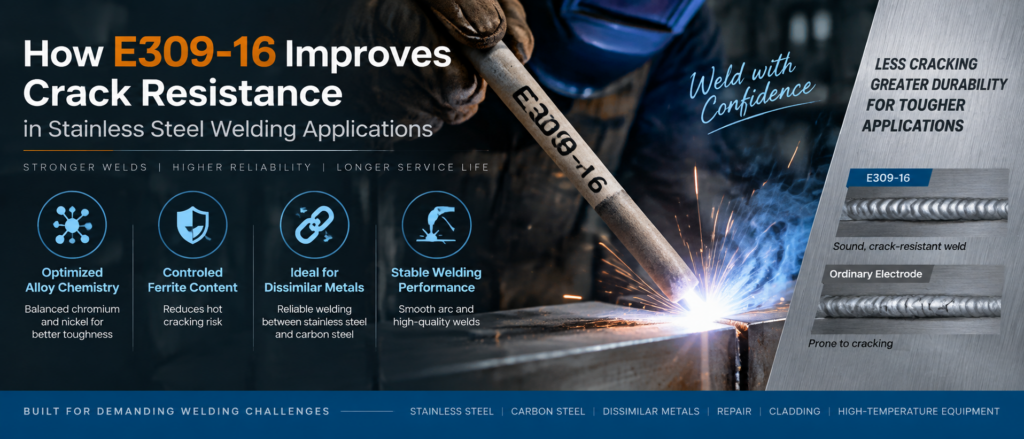
How E309-16 Improves Crack Resistance in Stainless Steel Welding Applications
Introduction: Why Crack Resistance Matters in Stainless Steel Welding
Cracking is one of the most critical challenges in stainless steel welding. Although stainless steels are widely used because of their corrosion resistance, strength, and durability, improper filler metal selection can lead to weld defects such as hot cracking, solidification cracking, and reduced joint reliability.E309-16
For applications involving stainless steel, carbon steel, or dissimilar metal combinations, selecting an appropriate welding electrode is essential. E309-16 stainless steel welding electrode is widely recognized for its ability to provide stable weld deposits, improved crack resistance, and reliable performance in demanding welding environments.
The superior crack resistance of E309-16 comes from its carefully balanced chemical composition, controlled ferrite formation, and ability to accommodate differences between base metals.
What Is E309-16 Stainless Steel Welding Electrode?
E309-16 is an austenitic stainless steel electrode designed primarily for welding applications where enhanced corrosion resistance and crack resistance are required.
The electrode typically contains higher levels of chromium and nickel compared with conventional stainless steel welding electrodes. This alloy balance provides:
Excellent weld metal toughness
Improved resistance to hot cracking
Good oxidation resistance
Stable arc characteristics
Compatibility with stainless steel and carbon steel combinations
Because of these characteristics, E309-16 is commonly selected for applications such as:
Stainless steel to carbon steel welding
Stainless steel cladding
Repair welding
High-temperature equipment fabrication
Dissimilar metal joining
Why Do Stainless Steel Welds Experience Cracking?
Understanding the causes of cracking helps explain why E309-16 performs effectively.
1. Solidification Cracking
During welding, molten metal rapidly cools and transforms into a solid structure. If the weld metal composition is not properly balanced, low-melting compounds can form along grain boundaries, increasing the possibility of cracks.
A weld metal with an appropriate ferrite level can reduce this risk by improving resistance against liquid metal separation during solidification.
2. Differences Between Base Metals
Dissimilar metal welding creates additional challenges because different materials may have:
Different thermal expansion rates
Different chemical compositions
Different metallurgical structures
For example, joining stainless steel with carbon steel can create stress concentrations during cooling.
E309-16 is specifically designed to handle these differences by providing a more flexible and compatible weld structure.
3. Thermal Stress During Cooling
Welding introduces intense localized heat. As the weld cools, contraction forces generate internal stresses.
If the weld metal lacks sufficient toughness or ductility, these stresses can result in cracking.
A properly designed E309-16 weld deposit provides better resistance against these thermal stresses.
How E309-16 Improves Crack Resistance
1. Balanced Chromium and Nickel Content
The chemical composition of E309-16 plays a key role in preventing weld cracking.
Chromium Contribution
Chromium improves:
Corrosion resistance
High-temperature oxidation resistance
Weld stability
A higher chromium content helps maintain the protective characteristics of stainless steel weld metal.
Nickel Contribution
Nickel stabilizes the austenitic structure and improves:
Weld ductility
Toughness
Resistance to thermal stress
The combination of chromium and nickel creates a weld deposit capable of tolerating welding-induced stresses.
2. Controlled Ferrite Content Reduces Hot Cracking Risk
One of the most important factors affecting stainless steel weld cracking is ferrite control.
During stainless steel welding, a completely austenitic weld structure may be more sensitive to hot cracking. A controlled amount of ferrite can improve resistance by:
Reducing impurity segregation
Increasing solidification stability
Improving resistance to cracking during cooling
E309 16 is designed to provide a balanced microstructure containing both austenite and controlled ferrite.
This metallurgical balance helps reduce the likelihood of solidification cracks.
3. Better Performance in Dissimilar Metal Welding
One of the major advantages of E309 16 is its suitability for joining different metals.
Common examples include:
Stainless steel to carbon steel
Stainless steel to low-alloy steel
Stainless steel repair applications
When two different metals are welded together, the weld area experiences complex stress conditions.
E309-16 provides a transition layer between different materials, helping reduce:
Thermal mismatch stress
Metallurgical incompatibility
Crack formation at the fusion boundary
4. Stable Arc and Smooth Weld Appearance
Crack resistance is not only determined by chemistry but also by welding performance.
E309-16 electrodes provide:
Stable arc characteristics
Good slag removal
Smooth bead appearance
Consistent penetration
A stable welding process helps reduce defects caused by:
Irregular heat input
Poor fusion
Unstable weld pool behavior
E309-16 vs Standard Stainless Steel Electrodes for Crack Resistance
| Factor | E309-16 Advantage |
|---|---|
| Dissimilar metal welding | Excellent compatibility |
| Hot cracking resistance | Improved through ferrite control |
| Thermal stress tolerance | Higher weld ductility |
| Stainless steel repair | Reliable performance |
| Carbon steel joining | Suitable transition layer |
| High-temperature applications | Better oxidation resistance |
Compared with general stainless steel electrodes, E309-16 provides a more suitable composition for challenging welding conditions.
Applications Where E309-16 Helps Prevent Welding Cracks
Stainless Steel to Carbon Steel Welding
This is one of the most common applications.
E309-16 helps create a reliable connection between materials with different metallurgical characteristics.
Stainless Steel Cladding
In corrosion-resistant overlay applications, crack-free weld deposits are essential.
E309-16 provides:
Good corrosion resistance
Strong bonding performance
Reduced cracking tendency
E309-16 High-Temperature Equipment
Industrial equipment exposed to elevated temperatures requires welds that maintain stability during thermal cycling.
E309-16 is suitable for applications including:
Heat exchangers
Processing equipment
Furnace components
High-temperature piping systems
Best Practices for Maximizing E309-16 Crack Resistance
Even with a suitable electrode, welding procedures strongly influence final weld quality.
1. E309-16 Proper Surface Preparation
Before welding:
Remove oil and contaminants
Clean oxide layers
Ensure proper joint preparation
Contamination can increase defect formation.
2. E309-16 Control Heat Input
Excessive heat input may increase:
Grain growth
Residual stress
Distortion
Maintaining appropriate welding parameters helps achieve a stronger weld structure.
3. E309-16 Maintain Proper Electrode Storage
Moisture absorption can affect welding quality.
Proper storage helps maintain:
Stable arc performance
Lower defect risk
Consistent weld properties
Conclusion: Why E309-16 Is a Reliable Choice for Crack-Resistant Welding
E309-16 improves crack resistance in stainless steel welding through a combination of optimized alloy chemistry, controlled ferrite formation, excellent ductility, and strong performance in dissimilar metal applications.
Its ability to handle thermal stress and metallurgical differences makes it a preferred choice for challenging welding conditions where weld reliability is critical.
For engineers, fabricators, and welding professionals, selecting E309-16 can significantly improve weld quality, reduce cracking risks, and extend the service life of welded structures.