

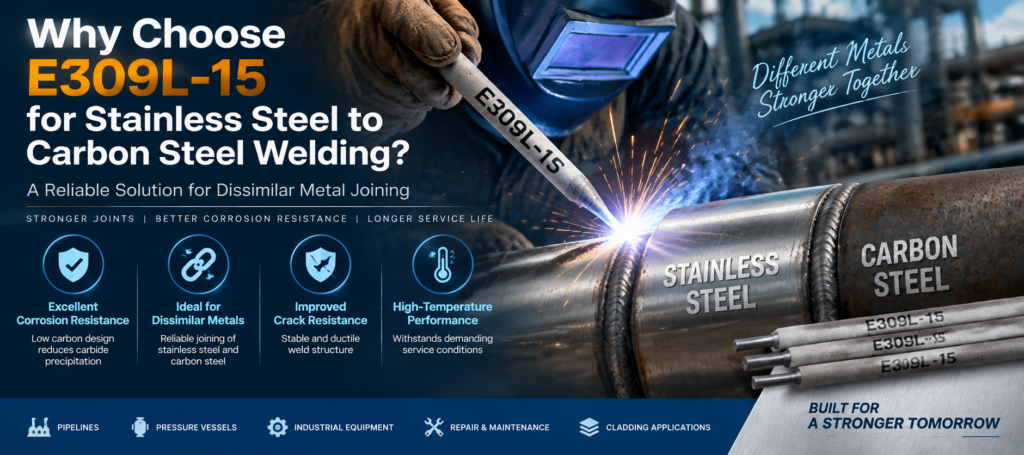
Why Choose E309L-15 for Stainless Steel to Carbon Steel Welding?
Introduction: The Challenge of Stainless Steel to Carbon Steel Welding
Joining stainless steel to carbon steel is one of the most common yet technically challenging welding applications in industrial manufacturing. These two materials have different chemical compositions, thermal expansion characteristics, and metallurgical behaviors, which can create difficulties during welding.E309L-15
Without proper filler metal selection, stainless steel to carbon steel welding may experience problems such as:
Weld cracking
Reduced corrosion resistance
Brittle intermetallic formation
Residual stress after cooling
Poor long-term joint reliability
E309L 15 stainless steel welding electrode is specifically designed to overcome these challenges. With its low carbon content, balanced chromium-nickel composition, and excellent compatibility with dissimilar metals, E309L-15 provides reliable weld performance for demanding applications.
What Is E309L-15 Welding Electrode?
E309L 15 is an austenitic stainless steel electrode commonly used for welding stainless steel to carbon steel and other dissimilar metal combinations.
The electrode belongs to the low-carbon stainless steel welding family. Its composition is optimized to provide:
Improved resistance to intergranular corrosion
Stable weld structure
Good crack resistance
High-temperature oxidation resistance
Strong bonding between different base metals
Compared with conventional stainless steel electrodes, E309L-15 offers better performance when welding materials with significantly different properties.
Why Is Stainless Steel to Carbon Steel Welding Challenging?
1. Different Chemical Compositions
Stainless steel typically contains higher levels of chromium and nickel, while carbon steel has a different alloy structure with higher carbon content.
When these materials are welded together, uncontrolled dilution between the base metals can affect weld quality.
Potential issues include:
Changes in weld microstructure
Reduced corrosion resistance
Increased cracking tendency
E309L-15 provides a suitable transition layer between stainless steel and carbon steel, helping maintain a stable weld structure.
2. Different Thermal Expansion Rates
During welding, materials experience rapid heating and cooling.
Because stainless steel and carbon steel expand and contract differently, the weld area can experience significant thermal stress.
If the filler metal cannot absorb these stresses, cracks may develop.
E309L-15 produces a tough and ductile weld deposit that can better accommodate thermal cycling.
3. Carbon Migration Risk
When stainless steel is exposed to welding heat, carbon movement can occur near the fusion zone.
Excess carbon may react with chromium and form chromium carbides, reducing corrosion resistance.
This phenomenon is known as sensitization.
The low carbon content of E309L-15 helps reduce chromium carbide precipitation and improves resistance to corrosion-related problems.
Key Advantages of E309L-15 in Dissimilar Metal Welding
1. Low Carbon Design Improves Corrosion Resistance
One of the most important features of E309L-15 is its low carbon content.
Lower carbon levels help:
Minimize chromium carbide formation
Maintain chromium availability
Improve resistance to intergranular corrosion
This makes E309L-15 suitable for applications where corrosion resistance is critical.
2. Excellent Compatibility Between Stainless Steel and Carbon Steel
E309L-15 is designed to create a reliable weld between different metal types.
It provides:
Good metallurgical compatibility
Strong fusion performance
Stable weld properties
Typical applications include:
Stainless steel pipes connected to carbon steel systems
Pressure equipment fabrication
Industrial processing equipment
Repair welding projects
3. Improved Crack Resistance
Cracking is a major concern in dissimilar metal welding.
E309L-15 improves crack resistance through:
Balanced chromium and nickel content
Controlled austenitic structure
Appropriate ferrite formation
These characteristics help the weld withstand:
Cooling stresses
Thermal expansion differences
Mechanical loading
4. Reliable Performance Under High Temperatures
Many industrial applications involve elevated temperatures.
E309L-15 provides good resistance against:
High-temperature oxidation
Thermal cycling
Structural degradation
This makes it suitable for welding applications involving heat exposure and demanding operating conditions.
E309L-15 vs General Stainless Steel Electrodes
| Performance Factor | E309L-15 Advantage |
|---|---|
| Stainless steel to carbon steel welding | Excellent compatibility |
| Corrosion resistance | Improved through low carbon design |
| Crack resistance | Enhanced weld stability |
| Thermal stress tolerance | High ductility |
| High-temperature applications | Reliable performance |
| Repair welding | Suitable for demanding conditions |
For dissimilar metal welding, selecting a filler metal specifically designed for the application is essential. E309L-15 provides a balanced solution between strength, corrosion resistance, and weld reliability.
Common Applications of E309L-15 Welding Electrode
Stainless Steel and Carbon Steel Pipe Welding
Pipeline systems often combine stainless steel components with carbon steel sections.
E309L-15 helps create durable joints while maintaining corrosion resistance.
Pressure Vessel Manufacturing
Pressure equipment requires welds with excellent mechanical stability.
E309L-15 is suitable for applications where reliability and service life are critical.
Stainless Steel Cladding
In corrosion-resistant overlay applications, E309L-15 provides:
Strong bonding
Good surface quality
Reduced cracking risk
E309L-15 Equipment Repair and Maintenance
Industrial equipment may contain mixed materials due to previous repairs or design requirements.
E309L 15 offers flexibility for repair welding situations involving stainless steel and carbon steel components.
Best Welding Practices When Using E309L-15
1. E309L-15 Proper Surface Preparation
Before welding:
Remove oil, rust, and contaminants
Clean the joint area thoroughly
Prepare the correct welding groove
Clean surfaces help improve fusion quality and reduce weld defects.
2. E309L-15 Control Heat Input
Excessive heat input may increase:
Distortion
Residual stress
Grain growth
Maintaining suitable welding parameters helps achieve consistent weld performance.
3. E309L-15 Use Proper Welding Techniques
Recommended practices include:
Maintaining stable arc length
Controlling travel speed
Avoiding excessive weaving
Allowing proper cooling between passes
These steps help maximize the benefits of E309L 15.
Conclusion: Why E309L-15 Is an Ideal Choice for Stainless Steel to Carbon Steel Welding
E309L 15 is a reliable solution for stainless steel to carbon steel welding because it addresses the major challenges of dissimilar metal joining.
Its low carbon composition, excellent corrosion resistance, balanced alloy structure, and strong crack resistance make it suitable for demanding industrial applications.
For engineers and welding professionals, choosing E309L 15 helps achieve stronger joints, improved durability, and long-term welding reliability in complex stainless steel and carbon steel assemblies.