

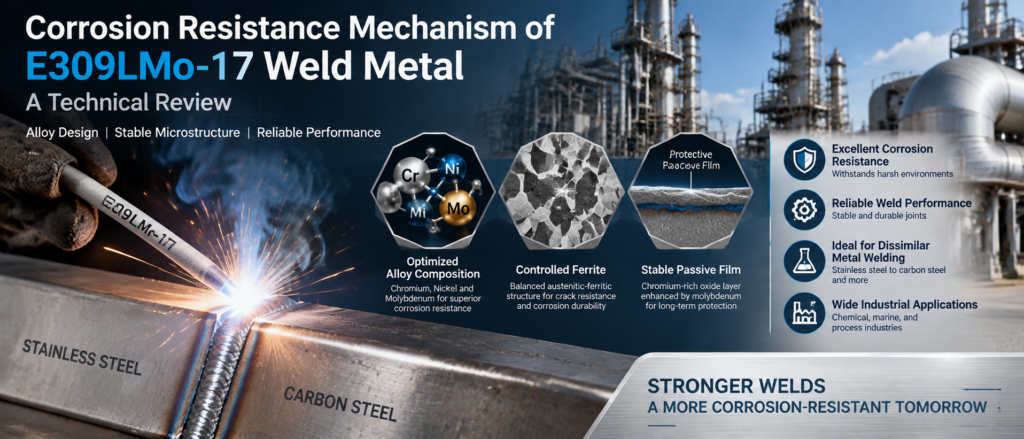
Corrosion Resistance Mechanism of E309LMo-17 Weld Metal: A Technical Review
Introduction
E309LMo-17 is a specialized stainless steel electrode widely used for welding applications where corrosion resistance, metallurgical stability, and reliable weld performance are required. Its weld metal is designed with controlled chromium, nickel, and molybdenum contents to provide enhanced resistance against aggressive environments, especially in dissimilar metal welding conditions.
Understanding the corrosion resistance mechanism of E309LMo-17 weld metal requires analyzing its chemical composition, microstructure evolution, ferrite balance, and protective oxide formation. These factors collectively determine the durability and service performance of welded components exposed to corrosive conditions.
Chemical Composition and Its Role in Corrosion Resistance
The corrosion resistance of E309LMo-17 weld metal primarily originates from its carefully balanced alloying elements.
Chromium: Formation of Passive Protection Layer
Chromium is the fundamental element responsible for stainless steel corrosion resistance. During welding, chromium in the weld metal reacts with oxygen to form a thin and stable chromium-rich oxide film on the surface.
This passive layer acts as a protective barrier that reduces further oxidation and prevents aggressive ions from directly attacking the underlying metal. Maintaining sufficient chromium content is essential for achieving long-term resistance in humid, chemical, and high-temperature environments.
Nickel: Improving Structural Stability
Nickel contributes to the stability of the austenitic phase in E309LMo-17 weld metal. A stable austenitic structure improves toughness, ductility, and resistance to stress-related corrosion damage.
The presence of nickel also helps maintain weld metal integrity during thermal cycling, reducing the risk of microstructural instability caused by welding heat input.
Molybdenum: Enhancing Localized Corrosion Resistance
Molybdenum is a key alloying element that improves resistance against localized corrosion, particularly pitting and crevice corrosion.
In chloride-containing environments, molybdenum strengthens the passive film and reduces the likelihood of localized breakdown. This makes E309LMo-17 weld metal suitable for applications where conventional chromium-nickel stainless weld metals may experience reduced corrosion performance.
Ferrite Control and Corrosion Performance
The microstructure of E309LMo-17 weld metal typically consists of an austenitic matrix with a controlled amount of delta ferrite.
Proper ferrite control plays an important role in both corrosion resistance and weld reliability.
Preventing Hot Cracking During Welding
A controlled ferrite level improves resistance to hot cracking by reducing the formation of low-melting-point compounds during solidification.
During welding, the presence of a suitable ferrite phase helps absorb impurities and improves weld metal solidification behavior.
Maintaining Corrosion Resistance Balance
Although ferrite improves weld stability, excessive ferrite may reduce certain corrosion properties and affect mechanical performance. Therefore, optimized ferrite content is necessary to achieve a balance between crack resistance and corrosion durability.
The metallurgical design of E309LMo-17 focuses on maintaining this balance through controlled alloy composition and solidification behavior.
Microstructure Evolution During Welding
The corrosion resistance of E309LMo-17 weld metal is closely related to its solidification process.
During cooling, the weld pool undergoes phase transformation, where alloy elements redistribute between austenite and ferrite phases. A stable microstructure helps prevent the formation of chromium-depleted regions, which can negatively affect corrosion resistance.
Proper control of welding parameters, including heat input, cooling rate, and interpass temperature, influences the final weld structure.
A refined and balanced microstructure provides:
Improved passive film stability
Reduced susceptibility to localized corrosion
Better resistance to thermal degradation
Enhanced long-term weld reliability
Passive Film Stability and Corrosion Protection Mechanism
The corrosion protection mechanism of E309LMo-17 weld metal depends heavily on the stability of its passive oxide layer.
When exposed to corrosive environments, chromium oxide forms rapidly on the weld surface. This protective film limits electron transfer reactions and slows down metal dissolution.
Molybdenum further improves passive film performance by reducing the sensitivity of the surface to chloride-induced breakdown.
The combined effect of chromium, nickel, and molybdenum creates a stable corrosion-resistant surface capable of maintaining protection under demanding service conditions.
Corrosion Resistance in Dissimilar Metal Welding
One of the important applications of E309LMo-17 electrodes is joining stainless steel with carbon steel or other alloy systems.
Dissimilar metal joints often experience differences in chemical composition, thermal expansion, and corrosion behavior. The weld metal must provide a stable transition zone between different base materials.
E309LMo-17 offers advantages in these applications because its alloy design provides:
High chromium content for corrosion protection
Molybdenum-enhanced resistance to localized attack
Stable austenitic-ferritic microstructure
Reliable metallurgical compatibility
These characteristics help improve the service life of welded structures exposed to corrosive environments.
Factors Affecting Corrosion Resistance of E309LMo-17 Weld Metal
Although alloy composition is critical, several welding factors can influence final corrosion performance.
E309LMo-17 Welding Heat Input
Excessive heat input may alter phase balance and promote undesirable microstructural changes. Optimized heat input helps maintain the designed corrosion-resistant structure.
E309LMo-17 Surface Cleanliness
Contaminants such as oil, oxides, and foreign particles can damage passive film formation. Proper surface preparation is essential for achieving maximum corrosion resistance.
E309LMo-17 Post-Weld Treatment
Appropriate post-weld procedures can improve surface stability and reduce residual stress, contributing to better corrosion performance.
E309LMo-17 Applications of E309LMo-17 Weld Metal
Due to its corrosion-resistant characteristics, E309LMo-17 weld metal is commonly selected for demanding industrial welding applications, including:
Stainless steel fabrication
Dissimilar metal joints
Chemical processing equipment
Pressure-containing components
Corrosive service environments
Its combination of alloy stability and weld reliability makes it suitable for applications requiring both mechanical performance and corrosion protection.
E309LMo-17 Conclusion
The corrosion resistance mechanism of E309LMo-17 weld metal is determined by the interaction between alloy composition, microstructure control, ferrite balance, and passive film stability.
Chromium provides the primary corrosion protection through oxide layer formation, nickel stabilizes the austenitic structure, and molybdenum improves resistance against localized corrosion. Together, these elements create a weld metal structure capable of maintaining reliable performance in challenging environments.
Through optimized metallurgical design, E309LMo-17 provides a balanced solution for applications requiring durable corrosion resistance, especially in dissimilar stainless steel welding conditions.