

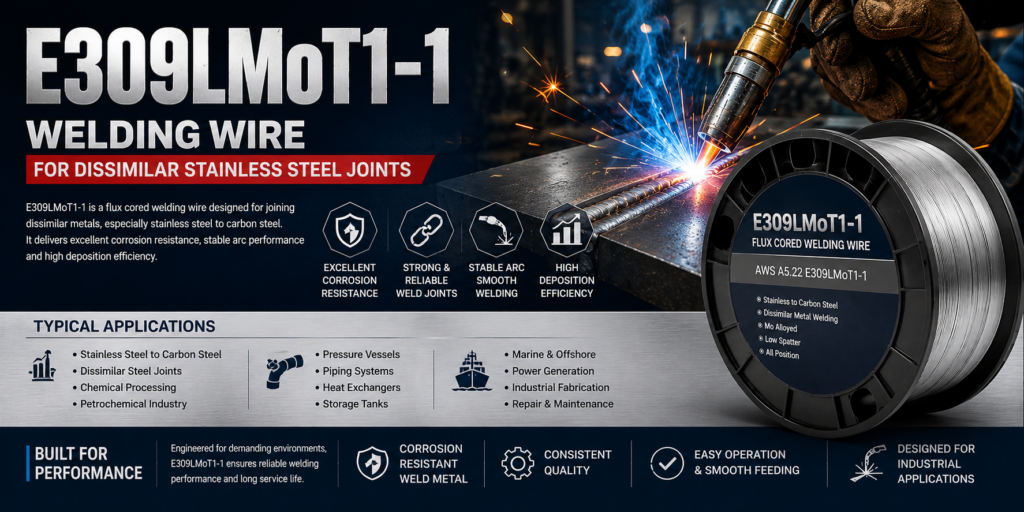
E309LMoT1-1 Welding Wire for Dissimilar Stainless Steel Joints
What Is E309LMoT1-1 Welding Wire?
E309LMoT1-1 is a stainless steel flux cored welding wire designed for demanding stainless steel fabrication and dissimilar metal welding applications. Its alloy system provides a weld deposit with relatively high chromium and nickel content, while molybdenum helps improve corrosion resistance and performance in aggressive service environments.
One of the major advantages of E309LMoT1-1 welding wire is its suitability for joining stainless steel to carbon steel or low-alloy steel. These dissimilar joints are widely used in chemical processing equipment, pressure vessels, piping systems, energy facilities, marine structures, and industrial fabrication.
Compared with conventional solid welding wire, flux cored wire can provide high deposition efficiency, good arc stability, smooth bead appearance, and easier welding in different positions when appropriate welding parameters are used.
Why E309LMoT1-1 Is Suitable for Dissimilar Stainless Steel Joints
Welding dissimilar steels presents challenges that are different from welding two pieces of the same material. Stainless steel and carbon steel have different chemical compositions, thermal expansion characteristics, mechanical properties, and corrosion behavior.
During welding, the base metals mix with the filler metal in the molten weld pool. This process is known as dilution. Excessive dilution from the carbon steel side can reduce the alloy content of the weld deposit and affect corrosion resistance, cracking resistance, and weld microstructure.
E309LMoT1-1 welding wire is formulated with an alloy composition that helps compensate for this dilution.
The relatively high chromium and nickel levels help maintain a stable austenitic weld structure, while molybdenum contributes additional resistance to localized corrosion. This makes E309LMoT1-1 especially useful where dissimilar joints must combine structural strength with corrosion resistance.
Key Benefits of E309LMoT1-1 Flux Cored Wire
Excellent Dissimilar Metal Welding Performance
E309LMoT1-1 is particularly useful for joining stainless steels to carbon steels and certain low-alloy steels. Its alloy design helps maintain desirable weld metal properties even when dilution occurs from different base materials.
Improved Corrosion Resistance
The molybdenum content in the weld metal improves resistance to localized corrosion, especially in applications exposed to moisture, chlorides, chemicals, or other corrosive conditions.
For this reason, E309LMoT1-1 can be considered when standard 309L-type weld deposits do not provide sufficient corrosion performance for the intended environment.
Low Carbon Content
The “L” designation indicates a low-carbon composition. Lower carbon content helps reduce the risk of chromium carbide precipitation in the heat-affected zone and weld metal.
This is important for stainless steel joints because excessive carbide precipitation can reduce corrosion resistance, particularly near grain boundaries.
Stable Arc Characteristics
A well-formulated E309LMoT1-1 flux cored wire can provide stable arc behavior, controlled metal transfer, and consistent weld penetration.
Stable welding characteristics are particularly important for production environments where repeatability and operator efficiency directly influence manufacturing quality.
High Deposition Efficiency
Flux cored arc welding is widely selected for applications that require higher productivity. Compared with some manual welding processes, continuous wire feeding can increase deposition rates and reduce interruptions associated with electrode replacement.
This makes E309LMoT1-1 suitable for medium- and heavy-duty stainless steel fabrication.
Good Bead Appearance
When the correct welding parameters and shielding gas are used, E309LMoT1-1 can produce smooth weld beads with good profile and consistent surface appearance.
Good slag detachability can also reduce post-weld cleaning requirements and improve production efficiency.
Typical Applications of E309LMoT1-1 Welding Wire
E309LMoT1-1 welding wire can be used across a wide range of industries where stainless steel must be joined to other steel grades.
Typical applications include:
Stainless steel to carbon steel joints
Stainless steel to low-alloy steel welding
Chemical processing equipment
Petrochemical equipment
Pressure vessels
Industrial piping systems
Heat-resistant structures
Offshore and marine fabrication
Power generation equipment
Storage tanks
Process equipment
Corrosion-resistant overlays and cladding
Repair and maintenance welding
Heavy industrial fabrication
The final filler metal selection should always consider the exact base metals, operating temperature, corrosion environment, design code, and mechanical property requirements.
E309LMoT1-1 for Stainless Steel to Carbon Steel Welding
Joining stainless steel to carbon steel is one of the most common applications for 309-series stainless filler metals.
The main difficulty is that carbon steel contributes iron and carbon to the molten weld pool, while stainless steel contributes chromium, nickel, and other alloying elements. This changes the final weld metal chemistry.
A suitable filler metal therefore needs enough alloying content to tolerate dilution without producing an undesirable weld structure.
E309LMoT1-1 provides an alloy-rich weld deposit that helps maintain corrosion resistance and favorable metallurgical characteristics after dilution. The addition of molybdenum further expands its potential use in corrosive service conditions.
For critical applications, the welding procedure should be qualified according to the applicable fabrication standard before production welding begins.
The Role of Molybdenum in E309LMoT1-1
The “Mo” in E309LMoT1-1 refers to molybdenum alloying.
Molybdenum is commonly used in stainless steel metallurgy to improve resistance to localized corrosion, particularly pitting and crevice corrosion. This becomes important when welded equipment operates in environments containing chlorides or other aggressive substances.
Molybdenum can therefore provide an important performance advantage when the welded joint requires greater corrosion resistance than a conventional 309L-type weld deposit.
However, filler metal selection should not be based on molybdenum content alone. Engineers should evaluate the entire service environment, including temperature, chemical concentration, stress, exposure time, and base metal composition.
Understanding the E309LMoT1-1 Classification
The E309LMoT1-1 designation provides useful information about the intended characteristics of the welding consumable.
In general:
E indicates an electrode classification.
309L identifies the stainless steel weld metal family with low carbon content.
Mo indicates the addition of molybdenum.
T identifies a tubular or flux cored electrode.
1 relates to welding position capability within the applicable classification system.
The final -1 identifies the shielding gas-related classification requirements specified for the consumable.
Exact chemical composition, mechanical properties, shielding gas requirements, and operating ranges should always be confirmed from the product specification and the applicable welding standard.
Recommended Shielding Gas for E309LMoT1-1
Gas-shielded stainless steel flux cored wires require appropriate shielding to protect the molten weld pool from atmospheric contamination.
The shielding gas influences:
Arc stability
Metal transfer
Penetration
Spatter level
Weld bead profile
Oxidation
Mechanical properties
Overall weld quality
The shielding gas specified for the particular E309LMoT1-1 product should therefore be followed rather than selecting gas solely according to general stainless steel welding practice.
Incorrect shielding gas can change arc behavior and may result in excessive oxidation, unstable transfer, poor bead shape, or unacceptable weld properties.
Welding Parameters for E309LMoT1-1
Correct welding parameters are essential for producing reliable dissimilar stainless steel joints.
Important variables include:
Welding Current
Current affects deposition rate, penetration, and heat input. Excessive current may increase spatter, distortion, dilution, and overheating, while insufficient current can produce poor fusion or unstable metal transfer.
Arc Voltage
Voltage strongly influences arc length and weld bead profile. Excessively high voltage may create a wide, flat bead and increase the risk of welding defects. Low voltage may produce an unstable arc and an overly convex weld profile.
Wire Feed Speed
Wire feed speed is closely related to welding current. It should be adjusted within the recommended operating range to maintain consistent arc behavior and deposition.
Travel Speed
Travel speed influences heat input and bead geometry. Moving too quickly can result in insufficient fusion, undercut, or inadequate penetration. Moving too slowly can increase heat input, distortion, and weld bead size.
Electrode Extension
Maintaining a consistent contact-tip-to-work distance helps stabilize current characteristics and deposition performance.
Operators should follow a qualified welding procedure specification rather than relying on a single parameter setting for every application.
Controlling Heat Input During Dissimilar Steel Welding
Heat input is particularly important when welding stainless steel.
Excessive heat can increase distortion, enlarge the heat-affected zone, increase oxidation, and negatively affect corrosion performance. It can also increase dilution from the carbon steel side.
Good practice generally involves maintaining controlled heat input, appropriate travel speed, and suitable interpass temperature.
For multi-pass welds, allowing the joint to cool appropriately between passes may help control thermal accumulation.
Surface Preparation Before Welding
Good joint preparation is essential when using E309LMoT1-1 welding wire.
Before welding, remove contaminants such as:
Oil
Grease
Paint
Moisture
Rust
Heavy oxide
Dirt
Cutting residue
Contamination can lead to porosity, inclusions, unstable arc behavior, and reduced corrosion resistance.
Tools used to clean stainless steel surfaces should also be controlled to avoid contamination from carbon steel particles.
How to Reduce Dilution in Dissimilar Steel Joints
Dilution management is a critical part of stainless-to-carbon-steel welding.
Excessive dilution can reduce chromium, nickel, and molybdenum concentration in the final weld deposit. This may alter weld microstructure and reduce corrosion resistance.
Several welding practices can help manage dilution:
Use appropriate welding current and voltage.
Avoid unnecessarily high heat input.
Maintain proper electrode positioning.
Control penetration into the carbon steel base metal.
Follow the specified joint design.
Use multiple controlled passes when required.
Apply a qualified welding procedure for critical joints.
For overlay and cladding applications, dilution control becomes even more important because the chemical composition of the final surface layer determines much of its corrosion performance.
Common Welding Problems and Solutions
Porosity
Porosity can result from contamination, moisture, inadequate shielding gas coverage, gas leaks, or excessive drafts.
The joint should be cleaned thoroughly, and the shielding gas system should be checked before welding.
Excessive Spatter
Spatter may be caused by unsuitable voltage, incorrect wire feed speed, excessive electrode extension, or unstable shielding.
Optimizing the welding parameters usually improves metal transfer and reduces spatter.
Lack of Fusion
Insufficient fusion can occur when heat input is too low, travel speed is too high, or the welding angle is incorrect.
Proper joint preparation and parameter control are necessary to achieve complete fusion.
Slag Inclusion
Slag must be removed properly between welding passes. Poor cleaning, incorrect bead placement, or unsuitable welding technique can trap slag inside the weld.
Excessive Oxidation
Poor shielding gas coverage or excessive heat input can produce heavy surface oxidation.
Gas flow, torch position, gas nozzle condition, and welding parameters should be inspected if excessive discoloration occurs.
E309LMoT1-1 vs. E309LT1-1
Both E309LMoT1-1 and E309LT1-1 belong to the 309L stainless steel flux cored wire family and can be suitable for many dissimilar steel welding applications.
The primary distinction is the molybdenum addition in E309LMoT1-1.
E309LT1-1 is commonly selected for general stainless-to-carbon-steel welding and other dissimilar joints where its corrosion characteristics satisfy the service requirements.
E309LMoT1-1 may be preferred when the application requires additional resistance to localized corrosion or when molybdenum-containing weld metal is beneficial for compatibility with the service environment.
The choice should be based on base metal chemistry, operating conditions, corrosion requirements, engineering specifications, and applicable welding codes.
E309LMoT1-1 for Corrosion-Resistant Cladding
E309LMoT1-1 can also be considered for certain cladding and overlay applications.
In these applications, a corrosion-resistant weld layer is deposited onto a lower-alloy substrate. This approach can provide corrosion resistance at the exposed surface while using a more economical structural material underneath.
Dilution must be carefully controlled because excessive mixing with the substrate can reduce the alloy concentration in the deposited layer.
Multiple layers may be required depending on the required final weld chemistry and corrosion resistance.
Storage and Handling of Flux Cored Welding Wire
Proper storage helps maintain consistent welding performance.
E309LMoT1-1 welding wire should be kept in a clean, dry environment and protected from moisture, condensation, dust, and chemical contamination.
Once packaging is opened, the wire should be handled carefully to prevent surface damage and moisture exposure.
Consumables showing evidence of contamination, corrosion, or physical damage should be evaluated before use.
Correct storage is particularly important in applications where porosity control and weld metal integrity are critical.
How to Select E309LMoT1-1 Welding Wire
Before choosing an E309LMoT1-1 welding consumable, evaluate the complete welding application.
Key factors include:
Base metal grades
Joint configuration
Material thickness
Welding position
Required mechanical properties
Corrosion environment
Service temperature
Required shielding gas
Welding equipment
Applicable welding standard
Required productivity
Post-weld inspection requirements
For critical structures, filler metal selection should be verified through engineering review and welding procedure qualification.
Advantages for Industrial Fabrication
E309LMoT1-1 combines the productivity advantages of flux cored arc welding with an alloy composition designed for demanding stainless steel joints.
Its key advantages include:
Reliable stainless-to-carbon-steel joining
Good tolerance to dissimilar metal dilution
Molybdenum-enhanced corrosion resistance
Low-carbon weld metal
High deposition capability
Stable welding performance
Good bead profile
Suitability for industrial fabrication
Potential use in corrosion-resistant overlay applications
These characteristics make it a practical consumable for fabrication shops working with mixed steel structures and corrosion-resistant equipment.
Conclusion
E309LMoT1-1 welding wire for dissimilar stainless steel joints is a practical solution for fabricators that need to join stainless steel with carbon steel or selected low-alloy steels while maintaining strong weld integrity and corrosion resistance.
Its high-alloy 309L-type weld deposit helps compensate for dilution during dissimilar metal welding, while the addition of molybdenum improves resistance to localized corrosion. Combined with the productivity advantages of flux cored arc welding, E309LMoT1-1 is well suited to demanding applications in chemical processing, pressure equipment, piping, marine fabrication, energy systems, and heavy industrial construction.
For the best welding results, operators should carefully control joint preparation, heat input, shielding gas, wire feed speed, voltage, travel speed, and interpass conditions. Critical applications should always use a qualified welding procedure based on the specific base metals and service requirements.