

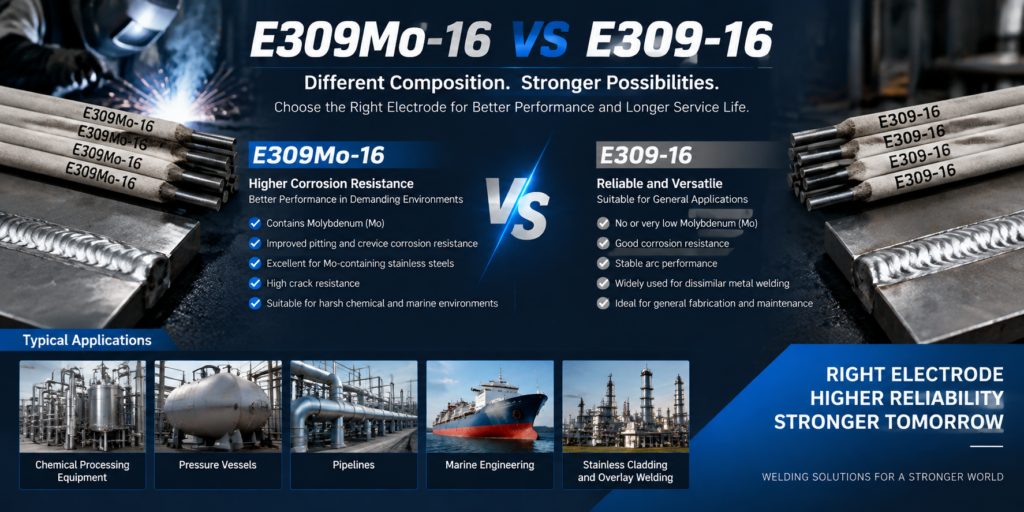
E309Mo-16 vs E309-16: Key Differences in Welding Performance and Applications
Introduction
Selecting the right stainless steel welding electrode is critical for achieving strong, durable, and corrosion-resistant welds. Among commonly used austenitic stainless steel electrodes, E309Mo-16 and E309-16 are widely recognized for their excellent performance in dissimilar metal welding and stainless steel fabrication.
Although both electrodes share a similar chromium-nickel alloy foundation, the addition of molybdenum in E309Mo-16 creates important differences in corrosion resistance, welding performance, and application suitability. Understanding these differences helps engineers choose the most suitable electrode for demanding welding environments.
E309-16 is commonly used for joining stainless steel to carbon steel and for stainless steel cladding applications, while E309Mo 16 is designed for more challenging conditions where molybdenum-containing stainless steels and higher corrosion resistance are required.
1. Overview of E309-16 and E309Mo-16 Electrodes
What Is E309-16?
E309-16 is an austenitic stainless steel electrode containing a high chromium and nickel alloy system, typically around 23% chromium and 13% nickel in the deposited weld metal.
Its balanced alloy composition provides:
Good weldability
Excellent resistance to oxidation
Stable arc performance
Good tolerance to dilution from carbon steel
E309-16 is frequently selected for:
Stainless steel to carbon steel welding
Stainless steel cladding
Repair welding of stainless components
Joining different grades of steel
What Is E309Mo-16?
E309Mo 16 is a modified version of E309-16 with the addition of molybdenum (Mo). The increased molybdenum content improves resistance to localized corrosion and enhances performance in more aggressive service environments.
Typical advantages include:
Higher corrosion resistance
Improved resistance to pitting and crevice corrosion
Better performance when welding Mo-containing stainless steels
Enhanced crack resistance in difficult dissimilar welding conditions
E309Mo 16 is commonly used for welding molybdenum-containing stainless steels, stainless clad steels, and corrosion-resistant overlay applications.
2. Chemical Composition Differences Between E309Mo-16 and E309-16
The main difference between these two electrodes is the presence of molybdenum.
| Element | E309-16 | E309Mo-16 |
|---|---|---|
| Chromium (Cr) | High Cr content | Similar Cr content |
| Nickel (Ni) | High Ni content | Similar Ni content |
| Molybdenum (Mo) | Very low or none | Approximately 2–3% Mo |
| Corrosion resistance | Good | Higher |
| Application range | General dissimilar welding | More demanding corrosion environments |
The molybdenum addition strengthens the weld metal’s ability to withstand chloride-containing environments and improves resistance against localized corrosion attack.
3. Welding Performance Comparison
3.1 Crack Resistance
Dissimilar metal welding often involves differences in thermal expansion, chemical composition, and dilution levels. These factors can increase the risk of weld cracking.
Both E309-16 and E309Mo 16 provide good crack resistance due to their austenitic stainless weld structure.
However, E309Mo 16 provides improved performance in high-dilution and more complex welding conditions because of its higher alloy content.
Advantages of E309Mo 16 include:
Better tolerance to base metal dilution
Improved weld toughness
Reduced risk of hot cracking
3.2 Corrosion Resistance
Corrosion resistance is one of the most significant differences between E309Mo 16 and E309-16.
E309-16 performs well in general stainless steel applications, while E309Mo-16 offers additional protection in environments involving:
Chloride exposure
Chemical processing conditions
Acid-containing environments
Marine-related applications
The molybdenum element improves resistance against pitting corrosion, making E309Mo-16 more suitable for severe corrosion conditions.
3.3 High-Temperature Performance
Both electrodes provide good oxidation resistance and maintain reliable weld performance at elevated temperatures.
However, E309Mo-16 offers improved stability when used with molybdenum-containing stainless steels or applications requiring enhanced corrosion protection at high temperatures.
4. Application Differences
Common Applications of E309-16
E309-16 is widely used for:
Stainless Steel to Carbon Steel Welding
The electrode can accommodate differences between stainless steel and carbon steel, making it suitable for:
Structural components
Fabrication equipment
Industrial machinery
Stainless Steel Cladding
E309-16 is often used as a buffer layer before applying stainless steel overlays.
General Stainless Steel Repair
Its stable arc and reliable weld appearance make it suitable for maintenance welding.
Common Applications of E309Mo-16
E309Mo-16 is preferred for more demanding applications:
Welding 316-Type Stainless Steel to Carbon Steel
The additional molybdenum content makes it better matched for Mo-containing stainless steels.
Stainless Steel Clad Steel Welding
It is commonly selected for welding the stainless side of clad materials.
E309Mo-16 Corrosion-Resistant Overlay Welding
Applications include:
Chemical processing equipment
Pressure vessels
Heat-resistant industrial components
Corrosive service environments
5. E309Mo-16 vs E309-16: Which Electrode Should You Choose?
The correct choice depends on the service environment and base materials.
| Requirement | Recommended Electrode |
|---|---|
| General stainless steel to carbon steel welding | E309-16 |
| Stainless steel cladding | E309-16 / E309Mo-16 |
| Welding 316 or Mo-containing stainless steel | E309Mo-16 |
| Higher corrosion resistance required | E309Mo-16 |
| Severe chemical environments | E309Mo-16 |
| General fabrication projects | E309-16 |
6. Welding Considerations for Better Results
Regardless of electrode selection, proper welding practices are essential.
E309Mo-16 Electrode Storage
Moisture absorption can affect weld quality. Electrodes should be stored in dry conditions and properly reconditioned when necessary.
E309Mo-16 Surface Preparation
Before welding:
Remove oil and contaminants
Clean rust and oxide layers
Ensure proper joint preparation
E309Mo-16 Heat Input Control
Excessive heat input may increase:
Distortion
Dilution
Metallurgical changes
Optimizing welding current and travel speed helps achieve consistent weld quality.
E309Mo-16 Conclusion
Both E309-16 and E309Mo-16 stainless steel electrodes provide excellent solutions for dissimilar metal welding and stainless steel fabrication. However, their performance differs significantly due to molybdenum addition.
E309-16 remains a reliable choice for general stainless steel welding applications, while E309Mo-16 delivers enhanced corrosion resistance, improved crack resistance, and better performance in demanding industrial environments.
For applications involving molybdenum-containing stainless steels, stainless clad materials, or aggressive corrosion conditions, E309Mo-16 is often the more suitable choice.
Understanding the differences between these electrodes allows welding engineers to improve weld reliability, extend service life, and select the optimal solution for each project.