

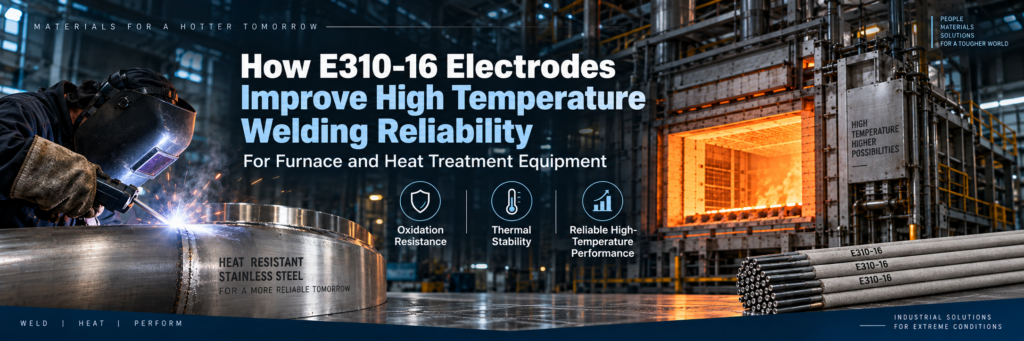
How E310-16 Electrodes Improve High Temperature Welding Reliability in Furnace and Heat Treatment Equipment
High temperature industrial equipment requires welding materials that can maintain strength, resist oxidation, and withstand continuous thermal exposure. In applications such as furnaces, heat treatment equipment, burners, and heat-resistant components, ordinary stainless steel welding electrodes may lose performance due to repeated heating cycles and extreme operating temperatures.E310-16
E310-16 electrodes are specifically designed for high-temperature stainless steel welding applications. With a high chromium-nickel alloy composition and fully austenitic weld structure, E310-16 provides excellent resistance against oxidation, scaling, and thermal degradation, making it a reliable choice for demanding heat-resistant environments.
What Is E310-16 Electrode?
E310 16 is an austenitic stainless steel welding electrode classified under AWS A5.4. It produces a high-alloy weld deposit containing approximately 25% chromium and 20% nickel, which provides excellent high-temperature stability and corrosion resistance.
The electrode is mainly used for welding heat-resistant stainless steels where the welded joint must maintain mechanical integrity under elevated temperatures. Typical applications include:
Furnace components
Heat treatment fixtures
Radiant tubes
Burner parts
High-temperature processing equipment
Heat-resistant stainless steel structures
The combination of chromium and nickel allows E310 16 weld metal to perform effectively in environments where oxidation resistance and thermal stability are critical.
Why E310-16 Improves High Temperature Welding Reliability
1. Excellent Oxidation and Scaling Resistance
One of the biggest challenges in high-temperature welding is oxidation damage. When stainless steel components operate at elevated temperatures, repeated exposure to oxygen can cause surface scaling, material loss, and reduced service life.
E310 16 electrodes contain high chromium content, which promotes the formation of a stable chromium oxide layer on the weld surface. This protective layer reduces oxidation reactions and helps maintain the integrity of welded components during long-term thermal exposure.
For furnace and heat treatment equipment, this oxidation resistance helps reduce:
Surface degradation
Weld deterioration
Frequent maintenance requirements
Unexpected equipment failure
2. Stable Performance Under Extreme Temperatures
Furnace equipment often operates under continuous high-temperature conditions. Welding materials must maintain sufficient strength and avoid structural instability during thermal cycling.
The high nickel content in E310-16 contributes to a stable austenitic microstructure, improving ductility and thermal resistance. This allows welded joints to tolerate repeated heating and cooling cycles while reducing the risk of cracking caused by thermal stress.
For applications involving prolonged exposure to high temperatures, E310 16 provides a balanced combination of:
Heat resistance
Weld metal toughness
Structural stability
Thermal fatigue resistance
3. Fully Austenitic Weld Metal for Better Thermal Durability
The microstructure of welding materials strongly influences high-temperature performance. E310-16 produces fully austenitic weld metal with high alloy content, providing reliable performance in heat-resistant applications.
Austenitic weld structures offer several advantages:
Better resistance to thermal shock
Improved ductility at elevated temperatures
Reduced risk of brittle failure
Good compatibility with heat-resistant stainless steels
These characteristics make E310-16 suitable for components exposed to continuous heating, such as furnace linings, heat shields, and thermal processing equipment.
4. Reliable Welding Performance for Heat Treatment Equipment
Heat treatment equipment frequently experiences temperature fluctuations, oxidation environments, and mechanical stress. Welding joints must maintain performance throughout the service period.
E310 16 electrodes help improve welding reliability by providing:
Smooth Arc Characteristics
The electrode design enables stable arc operation, helping welders achieve consistent weld beads and better control during fabrication.
Good Weld Appearance
A stable weld pool and easy slag removal contribute to cleaner weld surfaces and reduce post-welding finishing work.
Reduced Risk of Weld Defects
Proper welding procedures combined with E310-16 characteristics can help minimize common issues such as:
Porosity
Uneven weld formation
Thermal cracking
Premature oxidation
Applications of E310-16 Electrodes in High Temperature Industries
Furnace Manufacturing and Repair
Furnace components operate under severe thermal conditions. E310-16 is commonly selected for welding:
Furnace chambers
Burner assemblies
Heat shields
Supporting structures
Its oxidation resistance helps extend the service life of furnace parts.
E310-16 Heat Treatment Equipment
Heat treatment fixtures and components require dimensional stability during repeated heating cycles.
E310-16 is suitable for:
Heat treatment baskets
Fixtures
High-temperature supports
Thermal processing components
E310-16 High Temperature Processing Systems
Industries involving thermal processing require welding materials that can withstand continuous heat exposure.
Typical applications include:
Industrial heating equipment
High-temperature pipelines
Heat-resistant stainless steel assemblies
E310-16 Welding Considerations for Better Performance
Although E310-16 provides excellent high-temperature capability, welding quality still depends on proper process control.
Important factors include:
E310-16 Control Heat Input
Excessive heat input may increase distortion and affect weld quality. Appropriate welding current and travel speed should be selected according to material thickness and joint design.
E310-16 Maintain Clean Joint Preparation
Contaminants such as oil, moisture, and surface oxides can negatively affect weld quality. Proper cleaning before welding helps reduce defects.
E310-16 Proper Electrode Storage
Moisture absorption can influence electrode performance. Keeping electrodes dry helps maintain stable arc characteristics and weld integrity.
E310-16 vs Standard Stainless Steel Electrodes for High Temperature Applications
Compared with general-purpose stainless steel electrodes, E310-16 offers higher alloy content designed specifically for elevated temperature environments.
| Feature | E310-16 | General Stainless Electrodes |
|---|---|---|
| High temperature resistance | Excellent | Moderate |
| Oxidation resistance | High | Lower |
| Thermal cycling performance | Strong | Application dependent |
| Furnace applications | Suitable | Limited |
| Heat-resistant stainless welding | Designed for this purpose | Not always suitable |
For equipment exposed to continuous high temperatures, selecting an electrode designed for heat resistance is essential for long-term reliability.
E310-16 Conclusion
E310-16 electrodes provide a reliable welding solution for furnace and heat treatment equipment exposed to demanding thermal conditions. Their high chromium-nickel composition, oxidation resistance, and stable austenitic weld structure make them suitable for applications requiring long-term performance at elevated temperatures.
By improving weld durability, reducing oxidation-related damage, and maintaining mechanical stability during thermal cycling, E310-16 helps enhance the reliability and service life of high-temperature industrial equipment.