

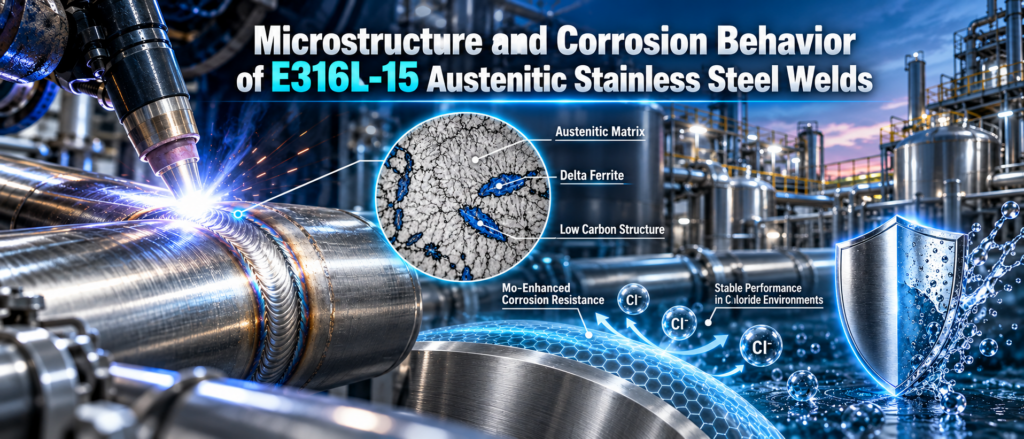
Microstructure and Corrosion Behavior of E316L-15 Austenitic Stainless Steel Welds
Introduction
E316L-15 stainless steel electrodes are widely used for welding corrosion-resistant austenitic stainless steels due to their excellent combination of mechanical performance, weldability, and resistance to aggressive environments. As a low-carbon Cr-Ni-Mo alloy welding material, E316L-15 is designed to provide stable weld metal properties while minimizing the risk of carbide precipitation and intergranular corrosion.
However, the corrosion performance of stainless steel welds is not determined only by chemical composition. During the welding process, rapid heating and cooling cycles create complex metallurgical transformations, including dendritic solidification, element segregation, phase redistribution, and heat-affected zone (HAZ) evolution. These microstructural characteristics directly influence passive film stability and localized corrosion behavior.
Understanding the relationship between the microstructure and corrosion behavior of E316L-15 welds is essential for applications in chemical processing, marine equipment, pressure vessels, and other environments requiring long-term corrosion resistance.
1. Chemical Characteristics of E316L-15 Weld Metal
The corrosion resistance of E316L-15 welds originates from its Cr-Ni-Mo alloy system.
Chromium plays a fundamental role in forming a stable chromium oxide passive film on the weld surface. This protective oxide layer significantly reduces metal dissolution and improves resistance against general corrosion.
Nickel stabilizes the austenitic phase and contributes to improved toughness and ductility, especially under thermal cycling conditions.
Molybdenum is a critical alloying element for improving resistance against localized corrosion. The addition of Mo enhances resistance to chloride-induced pitting and crevice corrosion by improving passive film stability and reducing the susceptibility of the weld metal to localized breakdown.
The low carbon content of E316L-15 further reduces chromium carbide precipitation during welding thermal cycles. Excessive carbide formation at grain boundaries can create chromium-depleted regions, which become preferential sites for intergranular corrosion.
2. Solidification Microstructure of E316L-15 Welds
Unlike wrought stainless steel, weld metals experience rapid non-equilibrium solidification. Therefore, E316L-15 weld deposits typically exhibit a cast-like dendritic microstructure.
During solidification, primary austenite dendrites form first, followed by redistribution of alloying elements between dendrite cores and interdendritic regions.
Typical microstructural features include:
- Austenitic matrix phase
- Delta ferrite formation
- Dendritic growth structures
- Interdendritic chemical segregation
The distribution of chromium, nickel, and molybdenum during solidification affects the local electrochemical behavior of different regions within the weld metal.
Element segregation may create areas with reduced corrosion resistance because regions depleted in protective alloying elements have weaker passive film stability. Studies on 316L-type weld metals have shown that microsegregation of Cr and Mo can significantly influence electrochemical corrosion behavior.
3. Role of Delta Ferrite in E316L-15 Weld Microstructure
A controlled amount of delta ferrite is commonly present in austenitic stainless steel weld metals.
The presence of delta ferrite provides several benefits:
- Reduces hot cracking susceptibility
- Improves weld solidification stability
- Enhances resistance against solidification cracking
However, excessive ferrite content or unfavorable ferrite morphology may negatively affect corrosion resistance.
The reason is that ferrite regions may have different chemical compositions compared with the surrounding austenitic matrix. Variations in chromium, molybdenum, and nickel distribution can create micro-galvanic effects and influence localized corrosion initiation.
Research on 316L weld metals indicates that corrosion initiation can be associated with microstructural heterogeneity, including fusion-line regions, heat-affected zones, and micro-defect locations.
Therefore, optimizing ferrite content is important for balancing weld integrity and corrosion performance.
4. Influence of Welding Thermal Cycles on Corrosion Resistance
The welding process introduces complex thermal histories that affect both the weld metal and surrounding base material.
The heat-affected zone experiences:
- Grain growth
- Phase transformation
- Residual stress development
- Possible chromium redistribution
These changes may influence passive film formation and corrosion resistance.
In particular, sensitization caused by chromium carbide precipitation at grain boundaries can reduce corrosion resistance. Although E316L-15 uses a low-carbon composition to minimize this risk, welding parameters, heat input, and cooling rate remain important factors controlling final microstructure.
Excessive heat input may promote:
- Coarser grains
- Increased segregation
- Reduced corrosion resistance
Optimized welding parameters help maintain a uniform microstructure and stable corrosion performance.
5. Pitting Corrosion Behavior of E316L-15 Welds
Pitting corrosion is one of the most important failure mechanisms for stainless steel weldments, especially in chloride-containing environments.
The initiation of pits is strongly related to:
- Passive film defects
- Alloy segregation
- Non-metallic inclusions
- Microstructural discontinuities
The Cr-Ni-Mo composition of E316L-15 provides improved resistance against chloride-induced pitting compared with lower-alloy stainless steel weld metals.
Molybdenum contributes significantly by improving repassivation ability after local passive film damage.
However, welding-induced microstructural variations may still create preferential corrosion sites. Studies of 316L weld metals have reported that localized corrosion initiation can occur at fusion zones, overlapping heat-affected regions, or microstructural defects depending on welding conditions.
6. Relationship Between Microstructure and Passive Film Stability
The corrosion resistance of E316L-15 welds depends on the interaction between microstructure and electrochemical behavior.
A homogeneous microstructure promotes:
- Uniform passive film formation
- Stable corrosion potential
- Improved resistance to localized attack
Conversely, heterogeneous microstructures containing segregation zones or unfavorable phase distributions may accelerate passive film breakdown.
The passive layer mainly consists of chromium-rich oxides, while molybdenum-containing species contribute to improved protection in chloride environments.
Therefore, controlling weld composition and microstructural uniformity is essential for achieving long-term corrosion resistance.
7. Improving Corrosion Performance of E316L-15 Welds
Several strategies can improve the corrosion resistance of E316L-15 welded joints:
Optimizing Heat Input
Lower and controlled heat input reduces excessive grain growth and minimizes segregation.
Proper Interpass Temperature Control
Maintaining suitable interpass temperatures helps prevent undesirable phase evolution during multipass welding.
Surface Treatment
Post-weld cleaning and surface treatment can remove oxide residues and promote passive film recovery.
Appropriate Welding Parameters
Current, voltage, travel speed, and shielding conditions directly influence weld solidification behavior and final microstructure.
Conclusion
The corrosion behavior of E316L-15 austenitic stainless steel welds is strongly governed by microstructural characteristics generated during welding. The austenitic matrix, delta ferrite distribution, dendritic solidification structure, and alloy element segregation collectively determine passive film stability and localized corrosion resistance.
The low-carbon Cr-Ni-Mo composition of E316L-15 provides excellent corrosion protection, while proper control of welding parameters is essential to maintain a uniform microstructure. By understanding the relationship between microstructure evolution and corrosion mechanisms, E316L-15 welds can achieve reliable performance in demanding industrial environments.
For engineers and manufacturers requiring corrosion-resistant stainless steel welding solutions, controlling weld metallurgy remains a key factor in maximizing service life and structural reliability.