

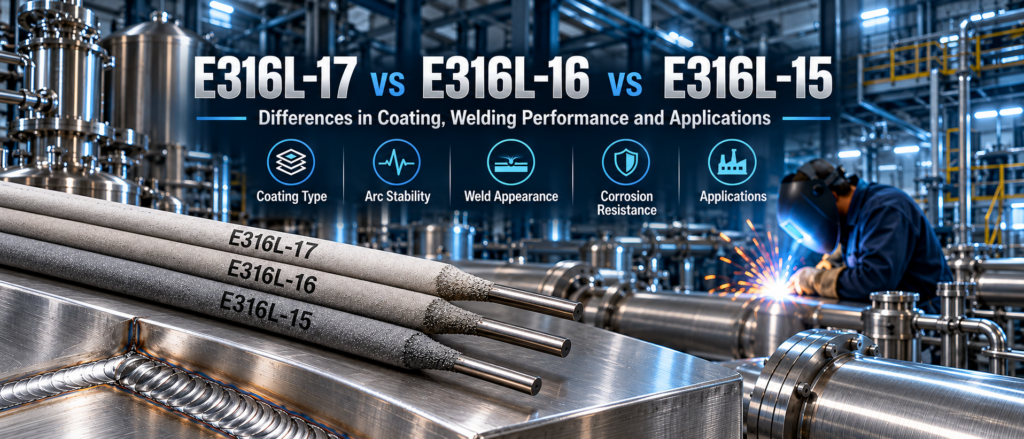
E316L-17 vs E316L-16 vs E316L-15: Differences in Coating, Welding Performance and Applications
Introduction
E316L stainless steel electrodes are widely used for welding low-carbon Cr-Ni-Mo austenitic stainless steels where excellent corrosion resistance, weld integrity, and long-term service stability are required. Although E316L-15, E316L-16, and E316L-17 electrodes share similar weld metal chemistry, their differences mainly come from flux coating composition, arc characteristics, slag behavior, welding position capability, and final weld appearance.
Understanding the differences between E316L-17 vs E316L-16 vs E316L-15 helps engineers select the most suitable electrode for applications such as chemical processing equipment, pressure vessels, marine structures, pharmaceutical facilities, and stainless steel fabrication.
1. Overview of E316L Stainless Steel Electrodes
E316L electrodes are designed for welding 316L stainless steel, which contains chromium, nickel, and molybdenum. The addition of molybdenum improves resistance to chloride-induced pitting corrosion, while the low carbon content reduces the risk of chromium carbide precipitation during welding and elevated-temperature service.
The main characteristics of E316L weld metal include:
- Excellent corrosion resistance
- Good mechanical strength
- Stable austenitic microstructure
- Improved resistance to intergranular corrosion
- Good weld toughness at low temperatures
The suffix numbers -15, -16, and -17 indicate different electrode coating systems and usability characteristics rather than different base alloy grades.
2. Difference in Electrode Coating Composition
The most significant difference between E316L-15, E316L-16, and E316L-17 is the flux coating system.
E316L-15: Basic Lime Coating
E316L-15 electrodes use a basic lime-type coating. This coating provides:
- Strong arc force
- Deep penetration capability
- Excellent weld metal toughness
- Good resistance to hot cracking
The low hydrogen characteristics of basic coatings make E316L-15 suitable for critical welding conditions where weld reliability is the priority.
Typical advantages:
- High impact toughness
- Good performance in demanding environments
- Suitable for heavy-section stainless steel components
However, compared with rutile-based electrodes, E316L-15 generally requires more operator control because the arc behavior is less smooth and slag removal may require additional effort.
E316L-16: Rutile-Based Coating
E316L-16 uses a lime-titania (rutile) coating system. It is one of the most commonly used stainless steel electrodes because of its balanced welding characteristics.
Key features include:
- Smooth and stable arc transfer
- Easy ignition and restriking
- Good slag detachability
- Attractive weld bead appearance
The rutile coating improves arc stability and makes E316L-16 easier to operate compared with basic-coated electrodes.
Advantages:
- Good all-position welding capability
- Excellent weld appearance
- Suitable for general stainless steel fabrication
- Compatible with AC and DC welding conditions
E316L-16 is often selected when productivity, weld appearance, and operating convenience are important.
E316L-17: Modified Rutile Coating
E316L-17 is a modified version of the rutile coating system, with increased silica-related components to improve weld pool fluidity.
Compared with E316L-16, E316L-17 provides:
- Higher weld pool fluidity
- Improved wetting behavior
- Smoother bead profile
- Better surface appearance
The more fluid molten pool allows improved filling ability and produces a flatter weld bead with fine ripple patterns.
Advantages:
- Excellent bead appearance
- Reduced post-weld grinding requirements
- Improved surface finish
- Suitable for high-quality stainless steel fabrication
3. Welding Performance Comparison
Arc Stability
| Electrode | Arc Characteristics |
|---|---|
| E316L-15 | Strong arc force, deeper penetration |
| E316L-16 | Smooth and stable arc, easy operation |
| E316L-17 | Smooth arc with improved weld pool fluidity |
E316L-16 and E316L-17 generally provide a softer and more user-friendly arc compared with E316L-15.
Weld Bead Appearance
Weld appearance is important in stainless steel fabrication because surface defects can influence corrosion performance and increase finishing costs.
E316L-15
Produces:
- Strong penetration profile
- Slightly convex weld bead
- Good structural reliability
E316L-16
Produces:
- Uniform bead shape
- Fine ripple pattern
- Good surface quality
E316L-17
Produces:
- Flatter and smoother bead profile
- Excellent wetting characteristics
- Reduced grinding requirements
For applications requiring aesthetic stainless steel surfaces, E316L-17 often provides advantages due to its superior bead appearance.
4. Slag Characteristics and Welding Position
Flux melting behavior strongly affects welding position capability.
E316L-15
Advantages:
- Fast-freezing slag
- Better control in demanding welding positions
- Good penetration
Suitable for:
- Heavy fabrication
- Critical joints
- Low-temperature service applications
E316L-16
Advantages:
- Balanced slag freezing speed
- Easier operation
- Good versatility
Suitable for:
- General stainless steel fabrication
- Structural welding
- Equipment manufacturing
E316L-17
Advantages:
- More fluid weld pool
- Excellent wetting
- Smooth surface formation
Suitable for:
- Flat welding
- Horizontal welding
- High-quality finishing applications
5. Corrosion Resistance Comparison
Because all three electrodes are based on the E316L alloy system, their deposited weld metal provides similar fundamental corrosion resistance when chemical composition and welding conditions are properly controlled.
The corrosion resistance mainly comes from:
E316L-17 Chromium (Cr)
Chromium forms a passive oxide layer that protects stainless steel from general corrosion.
E316L-17 Nickel (Ni)
Nickel stabilizes the austenitic structure and improves toughness.
Molybdenum (Mo)
Molybdenum significantly improves resistance to:
- Chloride pitting corrosion
- Crevice corrosion
- Chemical environments
E316L-17 Low Carbon Content
The low carbon design minimizes chromium carbide precipitation at grain boundaries, reducing the risk of intergranular corrosion after welding.
6. Mechanical Properties and Metallurgical Performance
Although coating differences influence welding behavior, the final weld metal performance depends primarily on:
- Chemical composition
- Heat input
- Cooling rate
- Ferrite content
- Welding procedure
Proper control of welding parameters helps maintain:
- Stable austenitic structure
- Controlled delta ferrite formation
- Improved crack resistance
- Long-term corrosion performance
E316L-15 may provide advantages where toughness requirements dominate, while E316L-16 and E316L-17 emphasize welding efficiency and surface quality.
7. Application Comparison
E316L-15 Applications
Common applications:
- Pressure vessels
- Cryogenic equipment
- Heavy stainless steel structures
- Critical corrosion-resistant joints
Best choice when:
- High toughness is required
- Structural reliability is the main concern
E316L-16 Applications
Common applications:
- Chemical equipment
- Food processing equipment
- Pharmaceutical manufacturing systems
- General stainless steel fabrication
Best choice when:
- Balanced performance is required
- Welding flexibility is important
E316L-17 Applications
Common applications:
- Stainless steel fabrication requiring excellent appearance
- Thin and medium thickness components
- Horizontal and flat welding operations
Best choice when:
- Smooth weld appearance
- High productivity
- Reduced finishing work are required
8. E316L-17 vs E316L-16 vs E316L-15: Quick Comparison Table
| Feature | E316L-15 | E316L-16 | E316L-17 |
|---|---|---|---|
| Coating Type | Basic lime | Rutile-based | Modified rutile |
| Arc Behavior | Strong penetration | Smooth and stable | Smooth with fluid weld pool |
| Weld Appearance | Good | Very good | Excellent |
| Slag Removal | Moderate | Easy | Easy |
| Toughness | Excellent | Good | Good |
| Corrosion Resistance | Excellent | Excellent | Excellent |
| Productivity | Medium | High | High |
| Main Advantage | Reliability | Versatility | Surface quality |
9. How to Select Between E316L-17, E316L-16 and E316L-15?
The correct electrode selection depends on welding requirements.
Choose E316L-15 when:
- Joint reliability is the highest priority
- Low-temperature toughness is required
- Heavy sections are being welded
Choose E316L-16 when:
- A versatile stainless steel electrode is needed
- Welding conditions vary
- Easy operation is important
Choose E316L-17 when:
- Excellent bead appearance is required
- Surface finishing must be minimized
- Productivity and appearance are key factors
E316L-17 Conclusion
E316L-15, E316L-16, and E316L-17 electrodes all provide reliable corrosion-resistant weld deposits for 316L stainless steel applications. Their main differences are related to coating chemistry and welding characteristics rather than base alloy performance.
E316L-15 focuses on toughness and critical service reliability, E316L-16 provides balanced welding performance and versatility, while E316L-17 delivers improved weld pool fluidity and superior bead appearance.
Selecting the correct E316L electrode according to welding position, surface requirements, mechanical demands, and operating environment can significantly improve weld quality, production efficiency, and long-term stainless steel performance.