

E316LT1-1 vs E316LT1-4: What Is the Difference?
When selecting stainless steel flux-cored welding wire, E316LT1-1 and E316LT1-4 are two common classifications used for welding 316 and 316L stainless steel. At first glance, these two wires may appear almost identical because they have similar alloy systems, welding positions, and applications.
However, there is one important difference: the shielding gas used during welding.
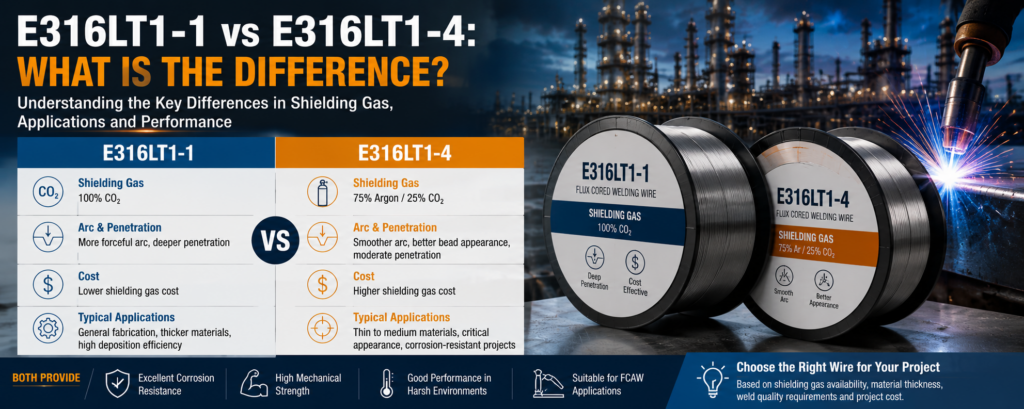
E316LT1-1 is primarily classified for use with 100% CO2 shielding gas, while E316LT1-4 is designed for an argon-CO2 mixed shielding gas, typically 75–80% argon with the balance CO2.
This difference in shielding gas can affect arc characteristics, weld bead appearance, spatter levels, welding parameters, operating cost, and overall welding performance.
This guide explains the differences between E316LT1-1 vs E316LT1-4 and helps welding professionals choose the appropriate flux-cored wire for their applications.
What Is E316LT1-1?
E316LT1-1 is a gas-shielded stainless steel flux-cored welding wire classified according to AWS A5.22.
It is commonly used for welding 316 and 316L austenitic stainless steels, particularly when corrosion resistance is required.
The deposited weld metal contains chromium, nickel, and molybdenum. The addition of molybdenum helps improve resistance to pitting and crevice corrosion, especially in environments where chlorides may be present.
E316LT1-1 is generally designed to operate with:
Shielding Gas: 100% CO2
The wire is suitable for flux-cored arc welding and is widely used in applications requiring good productivity, reliable mechanical properties, and corrosion-resistant stainless steel weld deposits.
Typical applications include:
Stainless steel tanks
Chemical processing equipment
Piping systems
Pressure vessels
Food processing equipment
Marine components
Industrial stainless steel fabrication
316 and 316L stainless steel structures
What Is E316LT1-4?
E316LT1-4 is also a gas-shielded stainless steel flux-cored welding wire under AWS A5.22.
Like E316LT1-1, it is commonly intended for welding 316 and 316L stainless steels and provides a weld deposit containing chromium, nickel, and molybdenum.
The main difference is the recommended shielding gas.
E316LT1-4 is typically used with:
Shielding Gas: 75–80% Argon + 20–25% CO2
The argon-rich shielding gas can provide different arc characteristics compared with pure CO2. In many welding conditions, this may result in smoother arc behavior, reduced spatter, and improved bead appearance.
For fabricators focused on weld appearance and arc control, E316LT1-4 can therefore be an attractive option.
E316LT1-1 vs E316LT1-4: Quick Comparison
| Feature | E316LT1-1 | E316LT1-4 |
|---|---|---|
| Welding Process | FCAW-G | FCAW-G |
| Stainless Steel Type | 316/316L | 316/316L |
| Primary Shielding Gas | 100% CO2 | 75–80% Ar + 20–25% CO2 |
| Welding Positions | All-position capability depending on wire specification | All-position capability depending on wire specification |
| Typical Polarity | DCEP | DCEP |
| Arc Characteristics | Strong, stable arc | Smooth, stable arc |
| Spatter | Generally higher | Generally lower |
| Weld Bead Appearance | Good | Usually smoother |
| Shielding Gas Cost | Usually lower | Usually higher |
| Main Difference | CO2 shielding gas | Ar/CO2 mixed shielding gas |
The most important point is that E316LT1-1 and E316LT1-4 are not fundamentally different stainless steel alloy families. Their key classification difference is associated with the shielding gas used during welding.
What Does E316LT1-1 Mean?
Understanding the AWS classification helps explain the wire’s intended use.
E
The letter E indicates an electrode.
316
316 indicates that the deposited weld metal is based on the 316 stainless steel alloy family.
316-type stainless weld metal normally contains chromium and nickel together with molybdenum.
Molybdenum is particularly important because it improves resistance to localized corrosion such as pitting in many aggressive environments.
L
The letter L means low carbon.
Lower carbon content helps reduce the risk of chromium carbide precipitation in the heat-affected region and supports corrosion resistance after welding.
This makes 316L-type filler metals particularly suitable for corrosion-resistant stainless steel fabrication.
T
The letter T identifies the product as a tubular or flux-cored electrode.
Unlike solid MIG wire, flux-cored wire contains internal flux ingredients that influence arc stability, slag formation, weld shape, and welding characteristics.
1
The T1 designation is associated with gas-shielded flux-cored electrodes designed for broad welding-position capability.
This makes E316LT1 wire suitable for fabrication work involving flat, horizontal, vertical, and overhead welding when used within the manufacturer’s recommended operating range.
-1 and -4
The final suffix is one of the most important differences.
E316LT1-1: 100% CO2 shielding gas
E316LT1-4: Argon-CO2 mixed shielding gas
Therefore, when comparing E316LT1-1 vs E316LT1-4, the shielding gas should be the first factor to check.
Shielding Gas Difference
E316LT1-1: 100% CO2
E316LT1-1 is typically classified using pure carbon dioxide shielding gas.
CO2 is widely available and usually economical, making it practical for high-volume welding operations.
Advantages may include:
Lower shielding gas cost
Easy gas availability
Good penetration
Stable welding performance
Suitable for industrial production
However, pure CO2 can produce a more active arc and may generate more spatter than an argon-rich gas mixture.
For many fabrication shops, this trade-off is acceptable because of the lower gas cost and reliable productivity.
E316LT1-4: Argon-CO2 Mixed Gas
E316LT1-4 normally uses an argon-rich shielding gas containing approximately:
75–80% Argon + 20–25% CO2
The presence of argon changes arc behavior and metal transfer characteristics.
Potential advantages include:
Smoother arc
Reduced spatter
Improved weld bead appearance
Better operator control
Easier welding in certain positions
Less post-weld cleaning in some applications
The disadvantage is that argon-based shielding gas generally costs more than pure CO2.
Therefore, E316LT1-4 may be preferred when weld appearance and welding behavior are more important than minimizing shielding gas cost.
Is the Chemical Composition Different?
In many cases, the deposited weld-metal chemistry of E316LT1-1 and E316LT1-4 is designed to meet the same basic 316L stainless steel weld-metal requirements.
Typical alloying elements include:
Chromium
Nickel
Molybdenum
Manganese
Silicon
Low carbon
The molybdenum content is particularly important for corrosion resistance.
This is why E316LT1 wires are commonly selected for stainless steel equipment used in environments where corrosion resistance is critical.
The exact chemical composition can vary within the limits of the applicable classification, so buyers should always check the product specification and certificate before placing an order.
Welding Performance Differences
Although shielding gas is the primary classification difference, it also influences actual welding behavior.
Arc Stability
Both E316LT1-1 and E316LT1-4 can provide stable welding performance when the correct parameters are used.
However, an argon-rich mixture generally produces a softer and smoother arc.
For welders who prioritize arc control, E316LT1-4 may offer an advantage.
Spatter
Pure CO2 tends to create a more active arc.
As a result, E316LT1-1 may generate more spatter under some welding conditions.
E316LT1-4 can often provide lower spatter levels when used with the correct mixed shielding gas.
Lower spatter can reduce the amount of grinding and cleaning required after welding.
E316LT1-1 Weld Bead Appearance
Both classifications can produce high-quality stainless steel welds.
However, an argon-CO2 shielding mixture often produces a smoother bead profile and more attractive weld appearance.
This can be important for visible stainless steel structures, tanks, machinery, and equipment.
Penetration
CO2 shielding gas generally provides strong arc energy and useful penetration characteristics.
For heavy fabrication or production environments, this can make E316LT1-1 a practical option.
Actual penetration depends on many factors, including:
Welding current
Voltage
Wire feed speed
Travel speed
Joint design
Electrode extension
Welding position
Shielding gas should therefore be considered together with the complete welding procedure.
E316LT1-1 vs E316LT1-4: Which Is Better?
There is no universal answer.
The better option depends on your welding process, production priorities, available gas supply, and required weld appearance.
Choose E316LT1-1 If:
E316LT1-1 may be the better choice when:
100% CO2 is already used in your workshop
Shielding gas cost is important
High-volume production is required
Reliable penetration is a priority
Weld appearance is not the only consideration
You need an economical FCAW solution for 316L stainless steel
Choose E316LT1-4 If:
E316LT1-4 may be more suitable when:
Argon-CO2 mixed gas is available
Smooth arc performance is important
Lower spatter is preferred
Weld appearance is important
Post-weld cleaning should be minimized
Operator comfort and arc control are priorities
For many professional fabrication operations, the decision comes down to balancing gas cost against welding performance and cleanup requirements.
Can the Same Wire Be E316LT1-1 and E316LT1-4?
Yes.
Some stainless steel flux-cored wires carry dual classifications such as:
E316LT1-1 / E316LT1-4
This means the wire has been qualified to meet the relevant classification requirements using both pure CO2 and an approved argon-CO2 shielding gas.
A dual-classified wire can provide greater flexibility for welding shops because the shielding gas can be selected according to production requirements.
However, welders should not automatically change shielding gases without adjusting welding parameters.
Voltage, wire feed speed, travel speed, and other variables may need to be optimized for the selected gas.
Typical Applications of E316LT1 Flux-Cored Wire
E316LT1 flux-cored welding wire is commonly used where 316 or 316L stainless steel is required.
Typical industries and applications include:
E316LT1-1 Chemical Processing
316L stainless steel is widely used for tanks, piping, reactors, and process equipment because of its corrosion resistance.
Food Processing Equipment
Low-carbon stainless steels are frequently used in equipment where corrosion resistance, hygiene, and clean surfaces are important.
Marine Fabrication
The molybdenum-containing 316 alloy family offers improved resistance to pitting compared with many stainless steels without molybdenum.
Pharmaceutical Equipment
316L stainless steel is widely used for process equipment and piping systems requiring high corrosion resistance.
E316LT1-1 Pulp and Paper Equipment
Corrosion-resistant stainless steel weld metals can be useful in equipment exposed to chemically aggressive processing environments.
Pressure Vessels and Tanks
Flux-cored wire can provide high deposition rates, making it suitable for industrial stainless steel vessel fabrication.
E316LT1-1 vs E316LT1-4 for 316L Stainless Steel
Both classifications can be suitable for welding 316L stainless steel.
The choice should usually be based on:
Required shielding gas
Welding position
Joint design
Required mechanical properties
Corrosion resistance requirements
Welding productivity
Spatter requirements
Weld appearance
Gas availability
Applicable welding procedure specification
For critical applications, the welding consumable must also comply with the required project specification, welding procedure, and applicable industry code.
Important Factors When Buying E316LT1 Welding Wire
Before purchasing E316LT1-1 or E316LT1-4 flux-cored wire, buyers should evaluate more than just price.
AWS Classification
Confirm that the product meets the required AWS A5.22 classification.
E316LT1-1 Shielding Gas
Determine whether your welding shop uses:
100% CO2
75–80% Ar with the balance CO2
Both gas systems
This helps determine whether E316LT1-1, E316LT1-4, or a dual-classified wire is appropriate.
Wire Diameter
Common wire diameters may vary according to production requirements and welding equipment.
The correct diameter should be selected based on material thickness, welding current, deposition rate, and welding position.
E316LT1-1 Mechanical Properties
Check the applicable tensile strength, elongation, and impact requirements for your project.
Chemical Composition
For corrosion-sensitive applications, verify the deposited weld-metal chemistry.
Chromium, nickel, molybdenum, and carbon levels can be particularly important.
Welding Position
Confirm that the wire and welding procedure are suitable for the required position, especially for vertical and overhead welding.
E316LT1-1 Packaging
For industrial production, packaging size can affect handling efficiency, storage, and production continuity.
E316LT1-1 Conclusion
When comparing E316LT1-1 vs E316LT1-4, the biggest difference is straightforward: shielding gas.
E316LT1-1 is primarily designed and classified for 100% CO2 shielding, while E316LT1-4 uses an argon-rich CO2 mixture.
Both are commonly used for 316 and 316L stainless steel fabrication and can provide corrosion-resistant weld deposits with good mechanical properties.
If reducing shielding gas cost is the priority, E316LT1-1 may be the more practical choice.
If smoother arc characteristics, lower spatter, and improved weld appearance are more important, E316LT1-4 may be preferable.
For buyers and welding engineers, the correct choice should ultimately be based on the approved welding procedure, shielding gas availability, required weld quality, application environment, and total welding cost.