

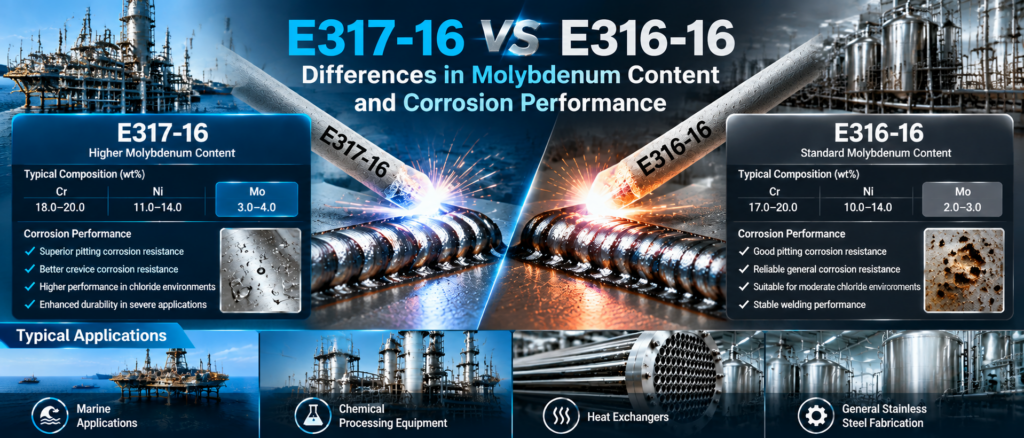
E317-16 vs E316-16: Differences in Molybdenum Content and Corrosion Performance
Introduction
Selecting the right stainless steel welding electrode is critical for achieving reliable corrosion resistance, mechanical stability, and long-term service performance. Among austenitic stainless steel electrodes, E316-16 and E317-16 are widely used for welding corrosion-resistant materials in demanding industrial environments.
Although both electrodes contain chromium, nickel, and molybdenum, E317-16 is designed with a higher molybdenum content to provide enhanced resistance against localized corrosion, especially in chloride-containing and chemically aggressive environments.
Understanding the differences between E317-16 and E316-16 helps engineers select the most suitable welding solution based on corrosion requirements, service conditions, and application demands.
Overview of E316-16 and E317-16 Electrodes
E316-16 Stainless Steel Welding Electrode
E316-16 is an austenitic stainless steel electrode commonly selected for welding corrosion-resistant stainless steels. Its balanced chemical composition provides:
- Good general corrosion resistance
- Stable welding performance
- Excellent weld appearance
- Reliable mechanical properties
The molybdenum content in E316-16 improves resistance to pitting and crevice corrosion compared with molybdenum-free stainless steel grades.
Typical applications include:
- Chemical equipment
- Food processing systems
- Marine components
- Heat exchangers
- Stainless steel fabrication
E317-16 Stainless Steel Welding Electrode
E317-16 is a higher alloyed stainless steel electrode developed for environments requiring improved corrosion protection.
Compared with E316-16, E317 16 contains increased molybdenum content, resulting in:
- Higher resistance to chloride-induced corrosion
- Improved pitting resistance
- Better performance in acidic environments
- Enhanced durability under severe service conditions
E317 16 is often selected when standard stainless steel welding materials cannot provide sufficient corrosion protection.
Difference in Molybdenum Content Between E317-16 and E316-16
Molybdenum is the key alloying element that differentiates E317 16 from E316-16.
Role of Molybdenum in Stainless Steel Weld Metal
Molybdenum improves corrosion resistance through several mechanisms:
- Enhancing passive film stability
- Reducing susceptibility to localized corrosion
- Improving resistance against chloride attack
- Promoting faster surface repassivation after damage
Because E317-16 contains a higher molybdenum level, its weld metal provides stronger protection in aggressive environments.
Corrosion Resistance Comparison
Pitting Corrosion Resistance
Pitting corrosion occurs when localized breakdown of the passive oxide layer creates small but deep corrosion sites.
E316-16 Performance
E316-16 provides good resistance against pitting corrosion due to its molybdenum addition. It performs well in many industrial environments with moderate corrosion exposure.
E317-16 Performance
E317-16 provides improved pitting resistance because the higher molybdenum content increases protection against chloride penetration and passive film breakdown.
For applications involving seawater, chemical solutions, or high chloride concentrations, E317-16 offers additional corrosion protection.
Crevice Corrosion Resistance
Crevice corrosion often occurs in narrow gaps, joints, and areas with limited oxygen availability.
The increased molybdenum content of E317-16 improves resistance to crevice corrosion by maintaining stronger passive protection under unfavorable conditions.
Compared with E316-16, E317-16 provides better performance in:
- Chloride-rich environments
- Acidic solutions
- Chemical processing systems
- High contamination conditions
Weld Metal Performance Comparison
| Performance Factor | E316-16 | E317-16 |
|---|---|---|
| Alloy Type | Austenitic stainless steel electrode | Higher alloyed austenitic electrode |
| Molybdenum Content | Moderate | Higher |
| General Corrosion Resistance | Excellent | Superior |
| Pitting Resistance | Very Good | Enhanced |
| Chloride Resistance | Good | Higher |
| Acidic Environment Performance | Good | Improved |
| Severe Corrosion Applications | Suitable | Preferred |
Microstructural Considerations
Both E316-16 and E317-16 produce austenitic stainless steel weld metal with good toughness and corrosion resistance.
However, the higher alloy content of E317-16 influences weld metal chemistry and improves corrosion-related properties.
A properly controlled weld microstructure contributes to:
- Stable austenitic phase
- Reduced corrosion initiation sites
- Improved long-term reliability
- Better resistance after welding thermal cycles
Proper welding parameters remain important because excessive heat input, contamination, or improper surface preparation may reduce corrosion performance.
Applications: Choosing Between E316-16 and E317-16
When E316-16 Is Suitable
E316 16 is an excellent choice for general corrosion-resistant welding applications, including:
- Stainless steel fabrication
- Food and pharmaceutical equipment
- General chemical equipment
- Indoor and moderate industrial environments
It provides a strong balance between cost efficiency and corrosion resistance.
When E317-16 Is Preferred
E317 16 is better suited for more aggressive environments requiring additional corrosion protection:
Chemical Processing Equipment
Chemical systems exposed to acids, salts, and corrosive solutions benefit from the higher molybdenum content of E317-16.
Marine Applications
Seawater environments contain high chloride levels that accelerate localized corrosion. E317 16 provides enhanced protection for marine-related components.
Pollution Control Equipment
Industrial exhaust and chemical treatment systems often require superior corrosion resistance under harsh conditions.
Heat Transfer Equipment
Heat exchangers operating with corrosive fluids may require the improved pitting resistance provided by E317 16.
How to Select Between E317-16 and E316-16
The choice between E317 16 and E316-16 should consider:
E317-16 Corrosion Environment
For moderate corrosion conditions, E316-16 provides reliable performance.
For high chloride concentration, acidic solutions, or severe chemical exposure, E317 16 offers improved protection.
E317-16 Service Life Requirements
Projects requiring extended maintenance intervals may benefit from the enhanced corrosion resistance of E317 16.
E317-16 Welding Conditions
Both electrodes require proper welding procedures, including suitable heat input control, cleaning, and storage conditions, to achieve optimal weld quality.
E317-16 Conclusion
The main difference between E317 16 and E316-16 lies in their molybdenum content and resulting corrosion performance. While E316-16 provides excellent corrosion resistance for many stainless steel welding applications, E317 16 offers enhanced protection in more severe environments due to its higher molybdenum alloying.
For applications involving chlorides, acidic chemicals, marine exposure, or demanding industrial conditions, E317 16 provides a higher level of corrosion resistance and long-term reliability. Understanding these differences allows engineers to select the appropriate electrode based on actual service requirements.