

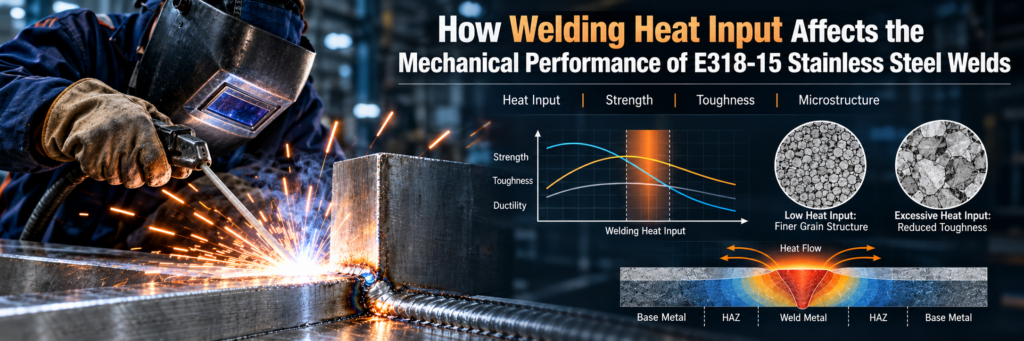
How Welding Heat Input Affects the Mechanical Performance of E318-15 Stainless Steel Welds
Introduction
E318-15 stainless steel welding electrodes are widely used for joining stabilized austenitic stainless steels where mechanical reliability and corrosion resistance are critical. As a niobium-stabilized Cr-Ni-Mo electrode, E318-15 provides excellent resistance against sensitization and maintains stable weld performance under demanding service conditions.
However, the final mechanical properties of E318-15 welds are not determined only by alloy composition. Welding parameters, especially heat input, have a significant influence on weld metal solidification, microstructural evolution, residual stress, and mechanical behavior.
Understanding the relationship between welding heat input and mechanical performance is essential for optimizing E318-15 stainless steel weld quality in industrial applications.
1. Understanding Welding Heat Input in E318-15 Welds
Welding heat input represents the amount of thermal energy transferred into the welded joint during the welding process. It is mainly affected by welding current, arc voltage, and travel speed.
A simplified relationship can be expressed as:
Heat Input = (Voltage × Current × 60) / (Travel Speed × Efficiency)
Higher heat input generally means:
- slower cooling rate;
- longer exposure to elevated temperatures;
- greater heat-affected zone (HAZ) size;
- increased possibility of microstructural changes.
Lower heat input usually produces:
- faster solidification;
- finer weld structures;
- reduced thermal distortion.
For E318-15 electrodes, controlling heat input is particularly important because the weld metal contains alloying elements such as chromium, nickel, molybdenum, and niobium, which strongly affect phase balance and carbide stabilization.
2. Effect of Heat Input on Weld Metal Microstructure
2.1 Low Heat Input: Fine Grain Structure and Improved Strength
When relatively low heat input is applied, the weld pool solidifies rapidly. This promotes:
- finer austenitic grain structures;
- more uniform distribution of alloying elements;
- reduced segregation during solidification.
The refined microstructure can improve:
- yield strength;
- tensile strength;
- fatigue resistance.
For E318-15 weld metal, maintaining a controlled cooling rate helps preserve the beneficial balance between austenite and ferrite phases.
2.2 Excessive Heat Input: Grain Growth and Microstructural Instability
When heat input becomes excessive, the weld metal remains at high temperatures for a longer period.
This may result in:
- austenitic grain coarsening;
- increased elemental segregation;
- reduced microstructural uniformity.
Coarser grains generally reduce resistance to mechanical deformation because fewer grain boundaries are available to hinder dislocation movement.
As a result, excessive heat input may decrease:
- tensile strength;
- impact toughness;
- crack resistance.
3. Influence of Heat Input on Tensile Strength
The tensile performance of E318-15 welds depends strongly on weld metal integrity and phase distribution.
A properly optimized heat input can provide:
- sufficient penetration;
- stable weld bead formation;
- balanced mechanical properties.
Typical E318-15 weld metals are designed to achieve high strength combined with good ductility. The stabilized composition helps maintain reliable mechanical properties after welding.
However, excessive thermal input can negatively affect tensile behavior through:
E318-15 Grain Coarsening
Large grains reduce resistance to plastic deformation and may lower yield strength.
E318-15 Element Segregation
Uneven distribution of alloying elements can create weak regions within the weld metal.
E318-15 Residual Stress Development
High thermal gradients increase welding stresses, which may reduce structural reliability.
Therefore, controlling heat input is essential for achieving consistent tensile properties.
4. Effect of Heat Input on Impact Toughness
Impact toughness is an important consideration for stainless steel welds exposed to dynamic loading or temperature fluctuations.
Heat input affects toughness through changes in:
- grain size;
- ferrite content;
- precipitation behavior;
- weld metal morphology.
Moderate heat input generally provides a favorable combination of:
- adequate strength;
- good ductility;
- improved impact resistance.
However, excessive heat input may reduce toughness because:
- coarse grains increase crack propagation paths;
- prolonged heating can alter phase distribution;
- thermal cycles may promote undesirable precipitation.
For critical welded structures, maintaining appropriate heat input is therefore necessary to prevent premature failure.
5. Role of Niobium Stabilization During Thermal Cycling
One of the key characteristics of E318-15 electrodes is niobium stabilization.
Niobium reacts preferentially with carbon to form niobium carbide (NbC), reducing chromium carbide precipitation at grain boundaries.
This mechanism helps improve resistance against:
- intergranular corrosion;
- weld degradation during thermal exposure.
However, welding heat input influences the effectiveness of this stabilization.
E318-15 Excessive Heat Input
Long thermal exposure may:
- change carbide distribution;
- increase elemental diffusion;
- modify weld metal morphology.
Controlled Heat Input
A suitable thermal cycle helps maintain:
- stable carbide formation;
- improved grain boundary stability;
- reliable mechanical properties.
6. Heat Input Optimization for E318-15 Welding Applications
To achieve optimal mechanical performance, welding parameters should be carefully controlled.
Important factors include:
Welding Current
Higher current increases heat generation and penetration but may enlarge the heat-affected region.
E318-15 Arc Voltage
Higher voltage increases arc energy and may contribute to wider weld beads.
E318-15 Travel Speed
Faster travel speed reduces heat input but may affect fusion quality if excessive.
Interpass Temperature
Maintaining suitable interpass temperatures prevents excessive heat accumulation during multi-pass welding.
A balanced welding strategy should aim for:
- complete fusion;
- controlled cooling;
- minimized distortion;
- stable mechanical properties.
7. Relationship Between Heat Input and Long-Term Weld Reliability
For stainless steel components operating in corrosive or high-temperature environments, mechanical performance must remain stable throughout service life.
Optimized E318-15 welding conditions contribute to:
- improved fatigue resistance;
- reduced cracking tendency;
- better structural durability;
- consistent weld quality.
Incorrect heat input selection can create hidden defects that may not appear immediately after fabrication but can influence long-term performance.
8. Practical Considerations for Industrial Applications
E318-15 welds are commonly selected for applications requiring:
- corrosion-resistant stainless steel joints;
- high-temperature stability;
- reliable mechanical strength.
During fabrication, engineers should evaluate:
- material thickness;
- joint design;
- welding position;
- cooling conditions;
- required mechanical performance.
Heat input should not simply be minimized. Extremely low heat input may cause insufficient penetration or poor fusion. The objective is to achieve the appropriate thermal balance for the specific welding condition.
Conclusion
Welding heat input plays a critical role in determining the mechanical performance of E318-15 stainless steel welds. Proper control of thermal energy during welding helps maintain favorable microstructure, balanced strength, and reliable toughness.
Low to moderate heat input generally promotes refined weld structures and improved mechanical properties, while excessive heat input may cause grain growth, microstructural instability, and reduced performance.
For high-quality E318-15 stainless steel welding, optimizing heat input together with welding parameters is essential to achieve durable and dependable welded joints in demanding industrial environments.