

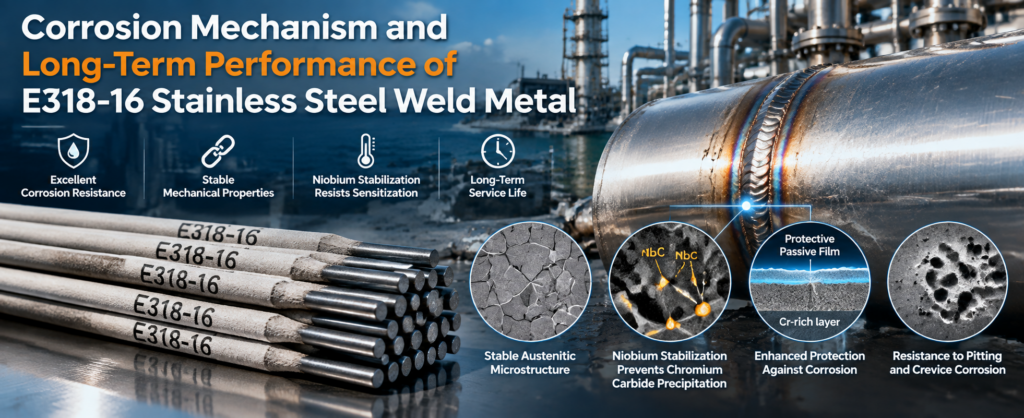
Corrosion Mechanism and Long-Term Performance of E318-16 Stainless Steel Weld Metal
Introduction
E318-16 stainless steel welding electrodes are widely recognized for producing reliable weld joints in applications where corrosion resistance, mechanical stability, and long-term durability are essential. As a niobium-stabilized austenitic stainless steel electrode, E318-16 is designed to maintain stable weld performance under thermal cycling and corrosive service conditions.
The long-term reliability of stainless steel welds depends not only on alloy composition but also on the interaction between weld metal microstructure, thermal history, and corrosion mechanisms. Understanding how E318-16 weld metal resists corrosion provides important guidance for optimizing welding procedures and improving service life.
This article discusses the corrosion mechanism of E318-16 stainless steel weld metal, the role of alloying elements, microstructural factors, and key considerations affecting long-term performance.
1. Characteristics of E318-16 Stainless Steel Weld Metal
E318-16 is a stabilized austenitic stainless steel electrode containing chromium, nickel, molybdenum, and niobium. The alloy design provides a combination of:
- high corrosion resistance;
- stable mechanical properties;
- resistance to sensitization;
- good weld metal integrity.
The presence of molybdenum improves resistance to localized corrosion, while niobium contributes to carbon stabilization by preferentially forming niobium carbide.
During welding, the deposited weld metal undergoes rapid heating and cooling cycles. These thermal processes influence:
- grain structure;
- carbide precipitation behavior;
- phase distribution;
- corrosion resistance.
Therefore, controlling welding conditions is essential for achieving the expected performance of E318-16 welds.
2. Corrosion Mechanisms in E318-16 Weld Metal
2.1 Intergranular Corrosion Resistance
One of the major concerns in austenitic stainless steel welding is intergranular corrosion caused by chromium depletion near grain boundaries. During thermal exposure, carbon can react with chromium to form chromium carbide, reducing chromium availability and weakening corrosion resistance in localized regions.
E318-16 reduces this risk through niobium stabilization.
Niobium has a stronger affinity for carbon than chromium, allowing carbon to form niobium carbide instead of chromium carbide. This helps maintain chromium levels near grain boundaries and preserves the protective passive layer.
The stabilization mechanism improves:
- weld corrosion resistance;
- resistance to sensitization;
- long-term structural reliability.
2.2 Pitting and Crevice Corrosion Resistance
Stainless steel welds exposed to chloride-containing environments may experience localized corrosion, including pitting and crevice corrosion. These corrosion forms are strongly influenced by alloy composition, microstructure, and environmental conditions.
The chromium and molybdenum content in E318-16 contributes to improved resistance by promoting:
- formation of a stable passive film;
- reduced susceptibility to chloride attack;
- improved protection of weld surfaces.
However, welding defects, improper heat input, and unfavorable microstructural changes can create localized corrosion initiation sites.
3. Role of Niobium Stabilization in Long-Term Weld Performance
Niobium stabilization is one of the most important metallurgical characteristics of E318-16 weld metal.
3.1 Prevention of Chromium Depletion
Without stabilization, chromium carbide precipitation may occur during certain thermal cycles, creating chromium-depleted zones.
These zones become more vulnerable to corrosion because the protective chromium oxide layer cannot be maintained effectively.
Niobium helps prevent this mechanism by:
- binding carbon as NbC;
- reducing chromium carbide formation;
- maintaining grain boundary stability.
3.2 Improvement of Thermal Stability
Industrial components often experience repeated heating and cooling cycles.
During long-term service, E318-16 weld metal benefits from:
- stable carbide distribution;
- controlled grain boundary behavior;
- reduced corrosion sensitivity.
This makes stabilized weld metal suitable for applications requiring reliable performance over extended operating periods.
4. Influence of Weld Microstructure on Corrosion Performance
The corrosion resistance of E318-16 weld metal is closely related to its microstructure.
Important microstructural factors include:
4.1 Austenite-Ferrite Balance
A properly controlled phase balance contributes to:
- improved weld integrity;
- reduced cracking tendency;
- stable corrosion performance.
Excessive ferrite or insufficient ferrite may negatively influence weld behavior depending on service conditions.
4.2 Grain Structure
Fine and uniform grain structures generally provide:
- improved mechanical stability;
- reduced localized corrosion sensitivity;
- better resistance to crack propagation.
High heat input or prolonged thermal exposure may promote grain growth and microstructural instability, affecting long-term durability.
4.3 Precipitation Behavior
Secondary phases formed during welding or service exposure can influence corrosion performance.
Controlled precipitation helps maintain alloy stability, while undesirable precipitation may become initiation points for corrosion damage.
5. Effect of Welding Parameters on Corrosion Resistance
The corrosion performance of E318-16 weld metal is affected by welding parameters, especially heat input.
High Heat Input Conditions
Excessive heat input may lead to:
- slower cooling rates;
- grain coarsening;
- increased thermal exposure;
- changes in precipitation behavior.
These effects can reduce corrosion resistance and mechanical reliability.
Optimized Heat Input Conditions
Proper heat control helps maintain:
- stable weld microstructure;
- effective niobium stabilization;
- uniform alloy distribution;
- improved long-term corrosion resistance.
Therefore, welding parameter optimization is essential for maximizing E318-16 weld performance.
6. Long-Term Performance of E318-16 Stainless Steel Weld Metal
The service reliability of welded stainless steel structures depends on maintaining corrosion resistance throughout their operating life.
E318-16 weld metal provides advantages including:
Corrosion Stability
The stabilized composition helps resist corrosion mechanisms associated with thermal exposure.
Mechanical Reliability
A controlled microstructure supports stable strength and toughness during long-term operation.
Environmental Adaptability
The combination of chromium, nickel, molybdenum, and niobium provides balanced performance in challenging environments.
For industrial components exposed to chemicals, elevated temperatures, or cyclic loading, selecting appropriate welding conditions is critical for achieving maximum service life.
7. Applications Requiring High Corrosion Resistance
E318-16 stainless steel weld metal is suitable for applications requiring durable welded joints, including:
- chemical processing equipment;
- heat-resistant stainless steel structures;
- pressure-containing components;
- corrosion-resistant fabrication systems.
In these applications, weld quality directly affects operational safety and maintenance requirements.
8. Strategies to Improve E318-16 Weld Durability
To maximize long-term performance, several factors should be considered:
E318-16 Optimize Welding Heat Input
Balanced heat input reduces undesirable microstructural changes.
E318-16 Control Interpass Temperature
Proper temperature management minimizes excessive thermal accumulation.
E318-16 Maintain Surface Quality
Removing welding defects and contaminants reduces corrosion initiation risks.
E318-16 Select Appropriate Welding Procedures
Proper current, voltage, travel speed, and electrode handling contribute to consistent weld properties.
E318-16 Conclusion
The corrosion resistance and long-term performance of E318-16 stainless steel weld metal are determined by the combined effects of alloy chemistry, weld microstructure, and welding thermal history.
Niobium stabilization plays a critical role by reducing chromium carbide formation and improving resistance against sensitization-related corrosion. Meanwhile, optimized welding parameters help maintain a stable microstructure and enhance long-term reliability.
Through proper control of welding processes and understanding of corrosion mechanisms, E318-16 stainless steel weld metal can provide durable performance in demanding industrial environments.