

E71T-GS Gasless Flux Core Welding Wire: Uses, Benefits and Welding Guide
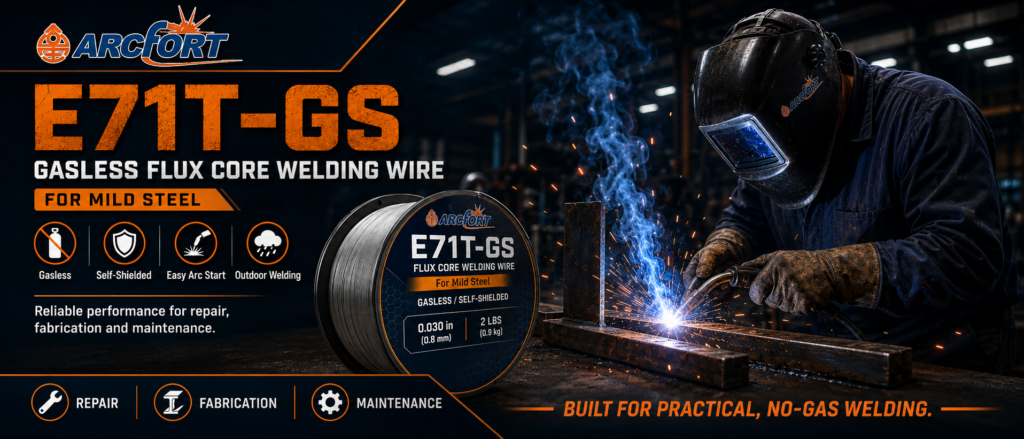
E71T-GS gasless flux core welding wire is a practical choice for welders who need an easy, portable and efficient solution for mild steel welding. Designed for self-shielded flux-cored arc welding, this wire does not require an external shielding gas, making it suitable for outdoor repair, home workshop projects, light fabrication and general maintenance work.
For users who want simple setup and reliable welding performance, E71T-GS is often selected because it works well with compact wire-feed welding machines and can produce strong welds on thin to medium mild steel when used with the correct settings and technique.
What Is E71T-GS Gasless Flux Core Welding Wire?
E71T-GS is a self-shielded flux core welding wire used mainly for welding mild steel and carbon steel. The wire has a tubular structure with flux inside. During welding, the flux creates shielding protection around the molten weld pool, helping reduce contamination from air.
Because it does not need shielding gas, E71T-GS is commonly called gasless flux core welding wire. This makes it different from solid welding wire, which normally requires a gas cylinder, regulator and gas flow control.
The gasless design makes E71T-GS convenient for welders who need mobility, fast setup and better usability in outdoor or drafty environments.
Why Choose E71T-GS Flux Core Wire?
E71T-GS flux core wire is especially useful for repair and light fabrication. It is commonly used for mild steel sheet, brackets, frames, gates, fences, small equipment repairs and general workshop welding.
One major advantage is simplicity. Welders can load the wire, set the correct polarity and begin welding without carrying extra gas equipment. This helps reduce setup time and makes the wire suitable for mobile repair jobs.
For beginners and occasional welders, E71T-GS can also be a practical option because the process is easy to learn. With proper machine settings and good welding technique, it can deliver clean, useful welds for many common steel projects.
Key Benefits of E71T-GS Gasless Welding Wire
1. No Shielding Gas Required
E71T-GS is self-shielded, so it does not require external shielding gas. This makes welding more convenient and reduces the amount of equipment needed.
2. Good for Outdoor Welding
Wind can disturb shielding gas during welding. Since E71T-GS creates its own shielding protection, it is better suited for outdoor work than many gas-shielded options.
3. Easy to Use
This wire is commonly used with small wire-feed welding machines. It is a good choice for users who want a simple welding setup for repair, maintenance and home workshop projects.
4. Suitable for Mild Steel
E71T-GS is widely used for mild steel welding. It can work well on thin and medium mild steel parts when the correct wire size, voltage and wire feed speed are selected.
5. Portable and Practical
Without gas cylinders and hoses, the welding setup becomes lighter and easier to move. This is helpful for field repairs, garage work and quick maintenance tasks.
Common Applications of E71T-GS Flux Core Welding Wire
E71T-GS gasless flux core wire is suitable for many mild steel applications, including:
Home workshop welding
Mild steel repair
Sheet metal welding
Fence and gate repair
Small frame fabrication
Bracket welding
Farm and equipment maintenance
Automotive repair work
Outdoor steel repair
DIY metal projects
Its gasless operation makes it especially useful when the welding location changes often or when working outside.
E71T-GS for Mild Steel Welding
Mild steel is widely used because it is affordable, strong and easy to fabricate. E71T-GS works well for mild steel because it provides good arc action and practical penetration for many light-duty and repair applications.
Before welding, the surface should be cleaned as much as possible. Removing oil, paint, heavy rust and moisture can improve weld quality and reduce spatter, porosity and weak fusion.
Although flux core wire can tolerate less-than-perfect surfaces better than some other processes, cleaner steel still produces better welds.
How to Get Better Welding Results with E71T-GS
To get strong and consistent welds, always use the correct machine settings. Wire feed speed, voltage, polarity and travel speed all affect weld appearance and strength.
For self-shielded flux core wire, the correct polarity is important. Many E71T-GS wires are used with direct current electrode negative, but users should always follow the wire and machine recommendations.
A drag technique is often preferred for gasless flux core welding. Keep a steady travel angle, maintain consistent stick-out and avoid moving too fast. If the travel speed is too fast, the weld may lack fusion. If it is too slow, the weld may become too large or cause burn-through on thinner material.
After welding, remove slag from the weld bead. If multiple passes are needed, clean the slag between passes to help prevent inclusions.
E71T-GS vs E71T-11 Flux Core Wire
E71T-GS and E71T-11 are both gasless flux core welding wires, but they are often used for different needs.
E71T-GS is commonly chosen for general repair, thin steel, hobby welding and light fabrication. It is a practical choice when ease of use and simple setup are important.
E71T-11 is often used for broader mild steel fabrication and may be selected for applications that require different operating characteristics. The best choice depends on material thickness, welding position, project type and required weld performance.
For light repair and simple no-gas welding, E71T-GS is a popular option.
How to Choose the Right E71T-GS Wire
When choosing E71T-GS gasless flux core welding wire, consider these factors:
Wire diameter
Base metal thickness
Welding machine capacity
Welding position
Project type
Required weld appearance
Spool size and feeding stability
Smaller wire diameters are often easier to use on thinner steel and lower-amperage machines. Larger wire sizes may require more power and are better suited for heavier material.
A good E71T-GS wire should feed smoothly, maintain a stable arc, produce manageable spatter and leave slag that can be removed without difficulty.
Is E71T-GS Good for Beginners?
Yes, E71T-GS can be a good welding wire for beginners because it does not require shielding gas and can be used with many compact welding machines. It is suitable for learning basic welding technique, practicing on mild steel and completing small repair projects.
Beginners should practice on scrap steel before starting important work. This helps develop control over travel speed, torch angle and weld bead shape.
Final Thoughts
E71T-GS gasless flux core welding wire is a reliable and convenient choice for mild steel repair, outdoor welding, home workshop use and light fabrication. Its self-shielded design removes the need for external gas, making the welding process simpler and more portable.
For welders who need easy setup, practical performance and dependable results on mild steel projects, E71T-GS flux core wire is a strong option. With proper settings, clean material and steady technique, it can help produce solid welds for repair, maintenance and everyday steel fabrication.