

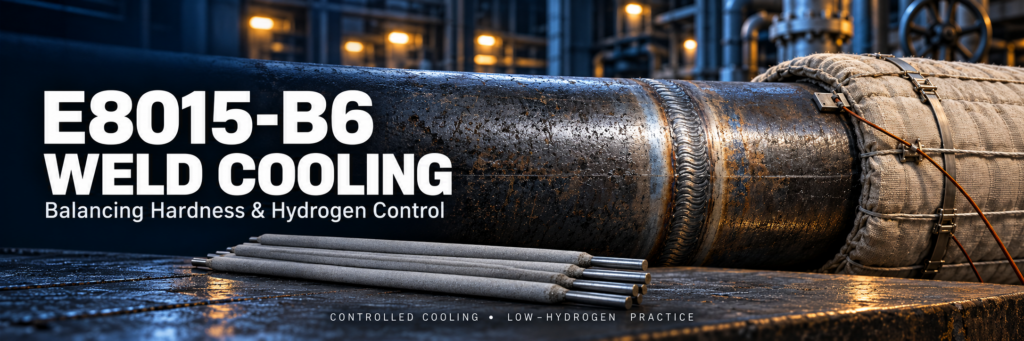
E8015-B6 Weld Cooling: Balancing Hardness and Hydrogen Control
Cooling an E8015-B6 weld is an active part of the welding procedure. The temperature history after each pass and after welding influences microstructure, hydrogen movement, and the stresses acting on the joint.
Cooling too quickly can produce harder, more crack-sensitive regions. Keeping the joint warm can support hydrogen diffusion, but an uncontrolled warm hold does not replace the metallurgical treatment required for the weld. Reliable results depend on coordinating electrode handling, preheat, interpass temperature, cooling, and post-weld heat treatment.
This guide explains how to manage E8015-B6 weld cooling without treating “slower is better” as a universal rule.
Why Cooling Matters in E8015-B6 Welding
E8015-B6 is a low-hydrogen covered electrode used for welding compatible 5Cr-0.5Mo steels. These chromium-molybdenum materials are used in elevated-temperature applications where weld properties must be evaluated alongside the parent material and service conditions.
During welding, the deposited metal solidifies while the adjacent heat-affected zone, or HAZ, experiences different peak temperatures. Both regions then cool, but they do not necessarily develop the same microstructure or hardness.
The resulting condition depends on several interacting factors:
Weld metal and base metal chemistry.
Joint thickness and geometry.
Preheat and interpass temperatures.
Heat input and bead sequence.
Heat loss into surrounding material.
Subsequent thermal treatment.
A cooling method that works on a thin qualification coupon may behave differently on a heavy fitting or a highly restrained repair.
The Connection Between Cooling Rate and Weld Hardness
Chromium-molybdenum steels have sufficient hardenability to develop relatively hard transformation products during welding. Faster cooling can increase the proportion of harder constituents, including martensite under suitable conditions.
Hardness can vary substantially across a joint. A satisfactory weld metal reading does not demonstrate that the HAZ also meets the required limits.
Why the Heat-Affected Zone Needs Attention
The HAZ contains regions with different thermal histories. Material immediately beside the fusion boundary may experience high peak temperatures and grain growth, followed by rapid heat loss into the surrounding steel.
This combination can create a localized hard region even when the bead surface looks acceptable.
Hardness evaluation should therefore consider the weld metal, fusion boundary, and relevant HAZ regions. The required test locations and acceptance limits must come from the applicable specification and qualified procedure.
Why Excessive Heat Input Is Not a Simple Solution
Increasing heat input may reduce cooling speed, but it also changes bead size, penetration, and the thermal exposure of the surrounding material.
Excessive heat input can contribute to grain coarsening, distortion, or reduced toughness. It should not be used as an improvised substitute for proper preheat.
The objective is a qualified thermal cycle that produces acceptable properties throughout the joint.
How Hydrogen Changes the Cooling Strategy
Hydrogen-assisted cracking becomes a concern when diffusible hydrogen, a susceptible microstructure, and tensile stress occur together.
Hydrogen can enter the weld through moisture in electrode coatings, contaminated joint surfaces, and other sources. After deposition, it can redistribute within the joint and accumulate at susceptible locations.
Cracking may be delayed. A weld that passes an immediate visual examination can still develop cracks later.
Low-Hydrogen Electrodes Still Require Controlled Handling
The E8015-B6 classification does not eliminate the need for dry storage and disciplined handling.
Electrodes should be stored, conditioned, and issued according to their product instructions. Joint surfaces should be free from moisture, oil, and other contamination.
Cooling control cannot reliably compensate for excessive hydrogen introduced before or during welding.
Preheat and Interpass Temperature: The First Controls
Preheat reduces the temperature difference between the welding area and the surrounding steel. It helps moderate heat loss and supports hydrogen movement while the joint remains warm.
Interpass temperature maintains the required thermal condition between successive passes.
For E8015-B6 welding, these temperatures should be selected through the welding procedure rather than copied from a generic chart. Relevant considerations include material composition, thickness, restraint, hydrogen level, and heat input.
Uniform Heating Matters
A high temperature reading at one location can hide a cold region elsewhere around the joint.
This is especially relevant to pipe welds, thick sections, and repairs with uneven geometry. Heating arrangements and measurement locations should demonstrate that the required area has reached the specified temperature.
Observe Both Minimum and Maximum Limits
Allowing the joint to fall below the minimum interpass temperature can undermine the intended cooling control.
Exceeding the maximum can also change the thermal cycle and weld properties. Both limits matter when managing multipass heat accumulation.
Cooling After Welding: Define the Sequence Before Starting
The final arc should not mark the point when thermal control becomes uncertain.
Before welding begins, the procedure should establish what happens after completion, including any hydrogen-release hold, controlled cooling stage, transfer to PWHT, and inspection requirements.
When PWHT Will Follow Promptly
A planned transition to PWHT can reduce uncontrolled exposure of the untreated joint. However, the sequence must account for the material’s transformation behavior.
Immediate reheating is not automatically appropriate for every joint. Required transformation and cooling stages must be established by the qualified procedure.
When PWHT Will Be Delayed
If the joint must cool before PWHT, the procedure may require a hydrogen-release treatment or other precautions.
The hold temperature and duration should be specified for the actual application. They should not be improvised from workshop habit.
Handling, restraint, and inspection arrangements also need consideration during the period before final heat treatment.
Hydrogen-Release Postheat and PWHT Serve Different Purposes
Hydrogen-release postheat and PWHT should be distinguished in both planning and documentation.
| Treatment | Main purpose | Key limitation |
|---|---|---|
| Hydrogen-release postheat | Promote the escape of diffusible hydrogen | Does not necessarily provide the required tempering or stress relief |
| PWHT | Develop the specified metallurgical condition and reduce residual stresses | Cannot restore a joint that already contains unacceptable cracks |
A hydrogen-release hold is therefore not a substitute for required PWHT. Equally, planned PWHT does not justify poor electrode handling or uncontrolled cooling beforehand.
Practical Ways to Control E8015-B6 Weld Cooling
Protect the Joint from Unplanned Heat Loss
Drafts, cold fixtures, and contact with large unheated components can change the cooling behavior. Protection and heating arrangements should address these conditions without compromising safe access.
Avoid water cooling or forced-air cooling unless explicitly permitted by the qualified procedure.
E8015-B6 Use Insulation with Temperature Monitoring
Insulation can moderate heat loss, but it does not define a reproducible thermal cycle by itself.
Its effect depends on coverage, material, joint geometry, and starting temperature. Temperature measurements are needed to confirm what the joint actually experiences.
E8015-B6 Plan Welding Interruptions
Unexpected stops can allow an incomplete joint to cool outside the specified limits.
A useful interruption procedure defines temperature maintenance, any permitted cooling, inspection requirements, and reheating before restart. Partial welds deserve particular attention because their geometry and restraint can differ from those of the completed joint.
E8015-B6 Record the Thermal History
For critical work, temperature records help establish whether the intended sequence was followed.
Useful records include preheat and interpass measurements, interruption details, postheat holds, and PWHT charts. These provide a stronger basis for troubleshooting than an operator’s recollection alone.
E8015-B6 Troubleshooting Excessive Hardness or Delayed Cracking
When hardness is unexpectedly high, investigate the complete process before changing the cooling method.
Check material identification, electrode classification, actual heat input, temperature measurements, local heat sinks, and heat-treatment records.
If delayed cracking occurs, also review electrode exposure, surface cleanliness, joint restraint, interruptions, and the interval before thermal treatment.
Simply adding more insulation may leave the underlying cause unresolved.
E8015-B6 Building a Reliable Cooling Procedure
Effective E8015-B6 weld cooling starts with low hydrogen input and a controlled welding temperature. It continues through interruptions, post-weld holds, cooling, and PWHT.
The practical goal is a documented thermal sequence that produces acceptable hardness and mechanical properties while limiting hydrogen-assisted cracking risk. Establish that sequence before welding, verify temperatures during execution, and assess the finished joint against the applicable requirements.