

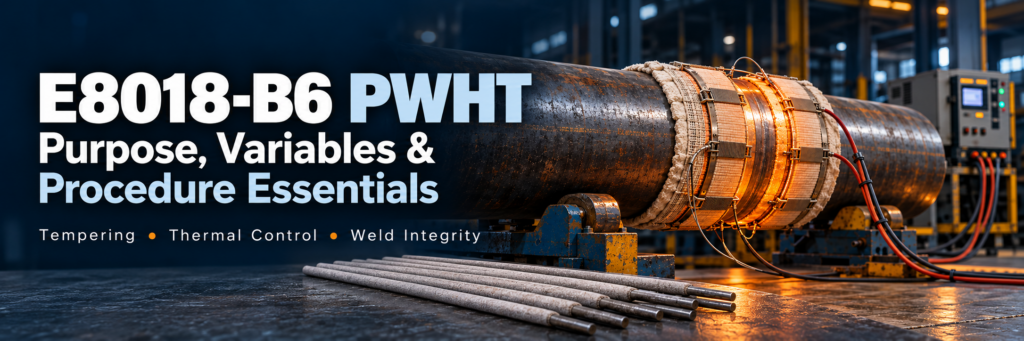
E8018-B6 PWHT: Purpose, Variables, and Procedure Essentials
Post-weld heat treatment is a critical consideration when E8018-B6 electrodes are used to weld matching chromium-molybdenum steels. Selecting the correct filler metal establishes the intended weld chemistry, but the thermal cycle after welding strongly influences the final condition of the joint.
E8018-B6 produces weld metal nominally containing 5% chromium and 0.5% molybdenum. It is commonly selected for matching-alloy applications involving P5 pipe, T5 tubing, and Grade 5 pressure vessel plate.
For these weldments, PWHT involves more than reaching a target temperature. The procedure must coordinate metallurgical transformation, tempering, stress relaxation, temperature uniformity, and the mechanical properties required for service.
What Is the Purpose of E8018-B6 PWHT?
PWHT is a controlled thermal treatment applied after welding. For conventional 5Cr–0.5Mo steel weldments, its main purposes are to temper hard transformation products and reduce welding residual stresses.
These functions are related, but they are not identical.
Tempering the Weld Metal and Heat-Affected Zone
During welding, the deposited metal and adjacent base material experience different thermal histories. The weld metal solidifies and cools, while portions of the heat-affected zone, or HAZ, undergo austenitization and subsequent transformation.
Depending on chemistry and cooling conditions, relatively hard martensitic or bainitic structures can develop. Their properties differ from those of the original heat-treated base metal.
A suitable subcritical PWHT cycle promotes tempering through processes that include recovery of the dislocation structure and changes in carbide precipitation. This can reduce excessive hardness and improve ductility. Toughness must still be verified because its response depends on material composition and the thermal cycle.
PWHT does not make the entire joint microstructurally uniform. The weld metal and individual HAZ regions retain differences arising from their original welding thermal histories.
Reducing Residual Stresses
Uneven heating and cooling during welding produce localized expansion and contraction. Surrounding material restrains these movements, leaving residual stresses in the completed joint.
At an appropriate PWHT temperature, time-dependent deformation allows some of these stresses to relax.
The treatment reduces and redistributes residual stress; it does not guarantee a completely stress-free component. Temperature gradients, restraint, and subsequent cooling can influence the final stress distribution.
Why the Electrode Classification Does Not Define the Entire PWHT Cycle
E8018-B6 identifies a consumable classification, not a complete production heat treatment specification.
An electrode data sheet may report mechanical properties after a particular treatment, such as 740°C for one hour. That condition describes how the reported test results were obtained. It does not automatically establish the permitted production cycle for every thickness, joint design, or construction code.
Production PWHT must reconcile:
The applicable code and edition.
Base metal specification and delivery condition.
Project and service requirements.
Joint geometry and governing thickness.
Consumable performance data.
The qualified welding procedure.
Previous and anticipated heat treatment cycles.
The relevant question is whether the complete weldment meets its requirements after the proposed treatment.
Essential E8018-B6 PWHT Variables
| Variable | Technical significance | Procedure requirement |
|---|---|---|
| Holding temperature | Controls tempering and stress relaxation | Define the permitted range and measurement locations |
| Holding time | Determines exposure at the specified temperature | Establish the required duration and thickness basis |
| Heating rate | Influences temperature gradients and thermal stress | Specify controlled rates over the applicable range |
| Cooling rate | Influences gradients and the final thermal history | Define controlled cooling and release conditions |
| Temperature uniformity | Determines whether the full required region receives treatment | Set allowable differences between monitored locations |
| Heated and insulated widths | Affect axial and through-wall gradients during local PWHT | Define the heating arrangement and insulation extent |
| Cumulative exposure | Can alter properties through repeated tempering | Account for fabrication and repair cycles |
| Cooling before PWHT | Affects the transformation condition entering treatment | Define the permitted sequence after welding |
Selecting PWHT Temperature
PWHT temperature must be high enough to achieve the intended tempering and stress relaxation while remaining compatible with the base metal and weld metal.
Conventional tempering PWHT is conducted below the lower critical transformation temperature. Exceeding that boundary can cause partial austenitization and produce a different microstructure during subsequent cooling.
The lower critical temperature depends on actual composition. It should not be assumed from a generic steel family name alone.
Insufficient Temperature
A treatment below the required range may provide inadequate tempering or stress relaxation.
Possible outcomes include excessive weld or HAZ hardness and failure to achieve qualified mechanical properties. A smooth-looking temperature chart does not demonstrate an effective treatment if the actual component temperature was too low.
Excessive Temperature
Excessive temperature can produce overtempering, reduce strength, or alter the intended base metal condition.
A higher temperature is therefore not automatically more effective. The procedure must satisfy both the minimum treatment requirement and the maximum exposure the materials can tolerate.
Determining Holding Time
Holding time is established using the governing code, specified thickness rules, and qualified procedure. It should not be selected solely from the diameter of the pipe or the electrode used.
The hold normally begins when all required monitored locations have entered the specified temperature range, according to the approved procedure.
Starting the timer when only the hottest thermocouple reaches the minimum can leave cooler parts of the required treatment zone inadequately exposed.
Time and Temperature Work Together
Tempering depends on both temperature and duration. A longer hold at one temperature is not automatically equivalent to a shorter hold at another.
Time–temperature parameters may support an engineering assessment, but they do not independently authorize a departure from a code requirement or qualified WPS.
Cooling Between Welding and PWHT
The sequence between the final weld pass and PWHT requires explicit control.
For hardenable Cr-Mo weldments, the procedure must account for transformation during cooling. Moving directly from welding into the PWHT hold without considering this transformation can leave an unsuitable starting condition for tempering.
Conversely, uncontrolled cooling before treatment can increase cracking risk when hydrogen, susceptible microstructures, and tensile stress are present.
The procedure should define:
Permitted cooling after welding.
Any required hydrogen-release treatment.
The temperature condition before reheating.
Maximum delay before PWHT, where specified.
Protection during interruptions.
Instructions developed for another Cr-Mo grade should not be transferred to 5Cr–0.5Mo steel without review.
Postheating and PWHT Are Different
Hydrogen-release postheating is intended primarily to assist hydrogen diffusion. Tempering PWHT targets the metallurgical condition and residual stresses of the weldment.
They can be parts of the same fabrication sequence, but one does not automatically replace the other.
PWHT also cannot repair a crack that has already formed. Low-hydrogen consumable handling, preheat, and interpass control remain essential before the heat treatment stage.
Local PWHT for P5 Pipe Welds
Local PWHT is often used when a complete piping assembly cannot be placed in a furnace. Electrical resistance or induction heating can provide controlled heating around the joint.
The challenge is achieving the required thermal condition throughout the treatment region without excessive gradients.
Define the Treatment Zones
A local heat treatment procedure should distinguish among:
Soak band: The region required to receive the specified holding temperature and duration.
Heated band: The region over which heating equipment is applied.
Insulated region: The surrounding area protected to manage heat loss and gradients.
These widths serve different functions and should not be treated as interchangeable.
Their dimensions depend on the applicable requirements, pipe geometry, thickness, and heating method.
Consider Circumferential and Through-Wall Differences
Uniform heater output does not guarantee uniform metal temperature.
Supports, attachments, nearby fittings, wall thickness changes, and internal airflow can affect heat distribution. The outside surface may also respond faster than the inside wall.
Where through-wall differences are significant, the procedure needs an appropriate monitoring strategy or validated thermal assessment. External thermocouple readings alone should not be assumed to prove internal temperature uniformity.
Thermocouple Placement and Temperature Recording
Reliable temperature measurement is fundamental to E8018-B6 PWHT.
Thermocouples should monitor locations that demonstrate compliance across the required region. Placement should consider likely hot and cold areas rather than only convenient attachment points.
Before treatment, verify:
Thermocouple type and attachment.
Identification of each measurement channel.
Calibration status of the recording system.
Connection polarity and cable condition.
Heater zones and control channels.
The thermocouple location drawing.
A sensor that becomes detached can record a temperature different from the component surface. Unexpected readings require investigation rather than automatic acceptance.
The final record should identify the joint, treatment procedure, temperature channels, heating and cooling rates, and actual holding period.
Heating and Cooling Rate Control
Heating too rapidly can generate large differences between heated and unheated regions. During cooling, similar gradients can create additional thermal stresses.
Controlled rates help manage these effects, particularly in thick sections, restrained assemblies, and joints near heavy attachments.
The specified rate limits may apply only above a defined temperature. The procedure should state where controlled heating and cooling begin and end, together with any permitted transition to unrestricted cooling.
For local PWHT, insulation and heater layout are as important as the programmed controller settings.
Multiple PWHT Cycles and Cumulative Exposure
Fabrication and repair can expose a joint to more than one heat treatment cycle.
Repeated treatments can continue tempering the weld and base metal. Depending on the material and cumulative exposure, this may affect strength, hardness, and toughness.
Procedure planning should therefore account for:
The initial fabrication treatment.
Additional assembly treatments.
Anticipated repair cycles.
The permitted total exposure.
Mechanical testing needed to represent that exposure.
When required, qualification testing should cover the minimum and maximum anticipated PWHT conditions. Results from one nominal cycle may not represent a joint that later receives several additional treatments.
E8018-B6 Inspection and Testing After PWHT
A compliant thermal record demonstrates that a specified cycle was applied. It does not establish every aspect of weld quality.
Post-treatment verification may include visual examination, surface or volumetric testing, hardness measurements, and review of qualification results.
E8018-B6 Hardness Testing
Hardness traverses can reveal differences among the weld metal, fusion boundary, HAZ, and base metal.
Unexpectedly high hardness may indicate insufficient tempering, uneven treatment, or another metallurgical issue. Unusually low hardness may justify checking for excessive exposure.
Interpretation requires the specified test method, measurement locations, and acceptance criteria. Hardness alone does not prove adequate toughness or long-term creep performance.
E8018-B6 Mechanical Properties
Tensile, bend, and impact results should represent the required final heat treatment condition.
Room-temperature tensile strength is only one part of the assessment. Where elevated-temperature service performance is important, material selection and qualification must address the relevant service requirements separately.
Common E8018-B6 PWHT Mistakes
Several avoidable errors can undermine an otherwise sound welding procedure:
Treating an electrode data sheet’s test cycle as a universal production instruction.
Starting the hold before all required locations reach temperature.
Using inadequate insulation during local treatment.
Ignoring the cooling sequence before PWHT.
Failing to account for repeated heat treatment cycles.
Accepting a chart without verifying thermocouple placement.
Assuming PWHT eliminates existing cracks or slag inclusions.
Using hardness as the sole measure of joint acceptability.
Effective control connects the qualified procedure, physical heating arrangement, recorded cycle, and final inspection results.
Building an Effective E8018-B6 PWHT Procedure
A technically sound E8018-B6 PWHT procedure begins with the required final material condition and works backward to a qualified thermal cycle.
It defines the permitted temperature and duration, manages the transition from welding to heat treatment, controls local gradients, and accounts for cumulative exposure. Temperature records and inspection then confirm that production followed the intended process.
This approach makes PWHT a measurable part of weld quality rather than a final heating operation performed without reference to the joint’s metallurgy.