

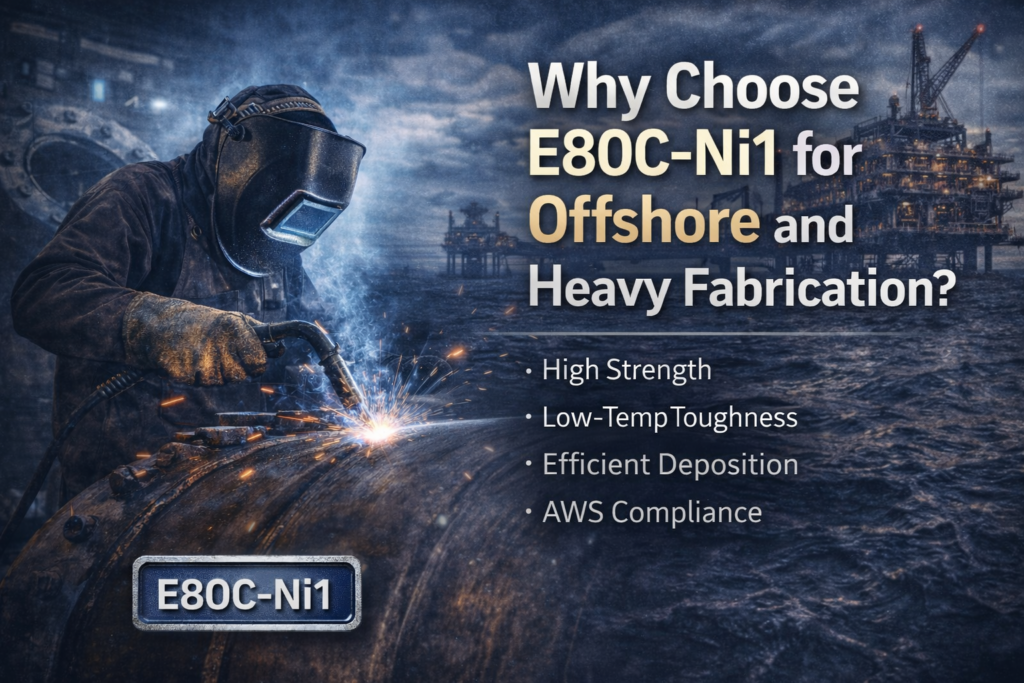
Why Choose E80C-Ni1 for Offshore and Heavy Fabrication?
In offshore platforms and heavy structural fabrication, welding consumables must deliver more than strength — they must provide reliability, toughness, and compliance under extreme service conditions.E80C-Ni1.
Among high-strength consumables, E80C-Ni1 metal-cored wire has become a preferred solution for demanding marine and heavy engineering projects. But what makes it particularly suitable for these environments?
This article explores the technical, operational, and compliance advantages of E80C-Ni1 in offshore and heavy fabrication.
Click to view product data information:https://www.akweld.com/wp-content/uploads/2026/02/E80C-Ni1.pdf
1. E80C-Ni1 Engineered for High-Strength Structural Steel
It is classified under AWS A5.28 for low-alloy steel electrodes used in gas-shielded arc welding.
The “80” classification indicates a minimum tensile strength of 80 ksi (approx. 550 MPa), making it ideal for:
High-strength structural components
Load-bearing offshore modules
Crane booms and heavy equipment frames
Shipbuilding structural sections
Its strength profile aligns well with modern high-strength steels commonly used in offshore fabrication.
2. E80C-Ni1 Enhanced Low-Temperature Toughness
Offshore and marine structures often operate in cold, harsh environments. Impact resistance at low temperatures is critical to prevent brittle fracture.
The “Ni1” designation indicates approximately 1% nickel content. Nickel improves:
Low-temperature impact toughness
Crack resistance
Microstructural stability
E80C-Ni1 is frequently impact-tested at sub-zero temperatures, making it suitable for offshore platforms, marine equipment, and northern climate installations.
For heavy fabrication projects exposed to dynamic loads, improved toughness translates to long-term structural integrity.
3. E80C-Ni1 High Deposition Efficiency for Large Projects
Heavy fabrication demands productivity. Metal-cored wires like E80C-Ni1 offer:
Higher deposition rates compared to solid wires
Reduced spatter
Smooth arc characteristics
Good bead appearance
In large-scale offshore structures or heavy machinery production, these efficiency gains significantly reduce welding time and labor costs.
Better fusion characteristics also reduce the risk of lack-of-fusion defects, improving first-pass inspection acceptance rates.
4. Suitable for Multi-Position Welding
Offshore modules and heavy fabricated structures often require complex joint configurations.
E80C-Ni1 is suitable for flat and horizontal positions, and depending on product classification, can also support limited out-of-position welding.
Stable arc performance under mixed shielding gases (Ar/CO₂ or CO₂) enhances weld consistency in challenging fabrication environments.
5. Compliance with International Engineering Standards
Offshore and heavy fabrication projects typically reference international standards such as:
AWS A5.28 classification
Project-specific structural codes
EPC technical specifications
Using certified E80C-Ni1 ensures:
Alignment with approved WPS
Easier third-party inspection approval
Full traceability documentation
Reduced compliance risk
In global engineering projects, documented compliance is as important as weld performance.
6. Reduced Risk in Harsh Service Conditions
Offshore structures face:
Saltwater corrosion
Cyclic loading
Temperature fluctuations
Wind and wave-induced stresses
The combination of strength, toughness, and stable weld metallurgy provided by E80C-Ni1 helps mitigate fatigue cracking and brittle failure risks.
For heavy fabrication exposed to repetitive stress, selecting the correct consumable directly impacts long-term structural durability.
7. A Strategic Choice for Global Projects
Choosing E80C-Ni1 is not just a technical decision — it is a risk management strategy.
It provides:
High strength for structural reliability
Nickel-enhanced toughness for cold service
Efficient productivity for large fabrication
Compliance support for international projects
For offshore and heavy fabrication contractors, this balance of performance and compliance makes E80C-Ni1 a practical and dependable solution.
Conclusion
In offshore and heavy structural fabrication, welding consumables must perform under pressure — both mechanically and from a compliance standpoint.
E80C-Ni1 delivers strength, low-temperature toughness, and production efficiency while supporting international engineering standards.
For demanding environments where failure is not an option, selecting the right metal-cored wire makes a measurable difference.