

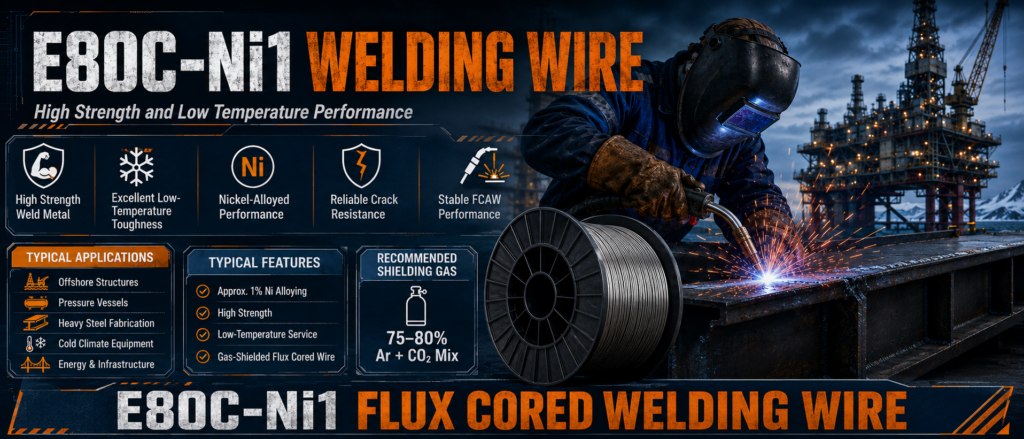
E80C-Ni1 Welding Wire: High Strength and Low Temperature Performance
In industries where steel structures operate under extreme conditions, welding consumables must provide more than basic joint strength. Heavy equipment, offshore structures, pressure vessels, pipelines, bridges, and low-temperature service components require weld metal with excellent mechanical properties, toughness, and crack resistance.E80C-Ni1
This is where E80C-Ni1 welding wire becomes an important solution.
E80C-Ni1 is a high-strength, nickel-alloyed flux-cored welding wire designed for welding low-alloy steels where strength and low-temperature impact toughness are critical requirements. Its controlled nickel content improves weld metal toughness, especially in cold environments where conventional welding materials may not provide sufficient performance.
The combination of high tensile strength, reliable weldability, low hydrogen characteristics, and excellent impact performance makes E80C-Ni1 suitable for demanding industrial applications. The AWS A5.28 classification system covers low-alloy steel electrodes and includes requirements related to weld metal chemical composition, mechanical properties, and usability characteristics.
This article explains the properties, advantages, applications, and welding considerations of E80C-Ni1 welding wire.
What Is E80C-Ni1 Welding Wire?
E80C-Ni1 is a nickel-alloyed flux-cored welding wire designed for gas-shielded welding of high-strength low-alloy steels.
The classification name provides important information:
E = Electrode
80 = Minimum tensile strength level of approximately 80 ksi
C = Composite or metal-cored flux-cored electrode classification
Ni1 = Approximately 1% nickel alloy addition
E80C-Ni1 is mainly designed for applications requiring:
High weld strength
Low-temperature toughness
Good crack resistance
Stable arc performance
Low diffusible hydrogen characteristics
Typical applications include:
High-strength structural steel
Low-temperature service equipment
Pressure vessels
Heavy fabrication
Offshore structures
Weathering steel applications
Industrial machinery
It belongs to the family of low-alloy welding consumables where alloy chemistry is carefully controlled to achieve specific weld metal performance.
Why Is Nickel Added to E80C-Ni1 Welding Wire?
The most important feature of E80C-Ni1 is the addition of nickel.
Nickel plays a significant role in improving weld metal toughness, especially at low temperatures.
Improved Low-Temperature Toughness
When steel structures operate in cold environments, impact resistance becomes a critical factor.
Low temperatures can reduce the ability of metals to absorb energy before fracture.
Nickel helps maintain toughness by improving the weld metal microstructure and reducing sensitivity to brittle fracture.
This makes E80C-Ni1 suitable for applications involving:
Arctic environments
Cold climate structures
Offshore facilities
Storage equipment
Heavy machinery
Some E80C-Ni1 welding wires are designed to provide excellent impact toughness at temperatures down to approximately -60°C when properly welded and tested under suitable conditions.
High Strength Performance of E80C-Ni1
One of the main reasons to select E80C-Ni1 is its high strength capability.
Typical weld metal performance includes:
| Property | Typical Value |
|---|---|
| Tensile Strength | ≥550 MPa (approximately 80 ksi) |
| Yield Strength | ≥470 MPa |
| Elongation | ≥20% |
| Impact Toughness | High low-temperature performance |
Actual values depend on shielding gas, welding procedure, heat treatment condition, and applicable specification.
The high strength of E80C-Ni1 makes it suitable for welding:
High-strength structural steels
Heavy steel plates
Load-bearing components
Critical welded assemblies
The goal is not simply to create a strong weld. A weld must maintain a balance between strength, toughness, and reliability.
Humans occasionally discover that making something stronger does not automatically make it better. Materials science has been reminding engineers of this for centuries.
Key Advantages of E80C-Ni1 Welding Wire
1. Excellent Low-Temperature Impact Toughness
The biggest advantage of E80C-Ni1 is its performance in cold environments.
Applications exposed to low temperatures require weld metal that can resist brittle fracture.
Nickel alloying improves:
Impact absorption capability
Crack resistance
Structural reliability
This is especially important for:
Offshore platforms
Cold-region pipelines
Storage tanks
Heavy steel structures
2. High Strength Weld Metal
E80C-Ni1 provides weld metal strength suitable for high-strength low-alloy steels.
Benefits include:
Higher load-bearing capability
Reduced risk of weld failure
Better compatibility with strong base materials
For large structures, weld strength must match the mechanical requirements of the steel being joined.
3. Good Crack Resistance
High-strength steels require careful welding control because they can be more sensitive to hydrogen-assisted cracking.
E80C-Ni1 helps reduce cracking risks through:
Controlled alloy composition
Nickel addition
Low hydrogen characteristics
Stable weld metal properties
However, welding procedure control remains essential.
Important factors include:
Preheat temperature
Interpass temperature
Welding heat input
Surface cleanliness
Storage conditions
A good wire cannot rescue a careless welding procedure. Unfortunately, metallurgy refuses to cooperate with shortcuts.
4. Stable Welding Performance
E80C-Ni1 flux-cored wire provides several practical welding advantages:
Stable arc characteristics
Good deposition efficiency
Controlled weld bead formation
Reduced cleanup requirements
These characteristics improve productivity in industrial fabrication.
E80C-Ni1 Applications
1. Low-Temperature Steel Structures
One of the most important applications of E80C-Ni1 is welding structures exposed to cold environments.
Examples include:
Cold storage equipment
Arctic structures
Low-temperature pressure equipment
Offshore facilities
Energy infrastructure
These applications require both strength and toughness.
2. Offshore Structures
Offshore environments create demanding welding conditions because structures experience:
Low temperatures
Dynamic loading
Corrosive atmosphere
Continuous mechanical stress
E80C-Ni1 can be used for suitable offshore steel fabrication where high strength and impact toughness are required.
Potential applications include:
Offshore platforms
Marine structures
Heavy support frames
Structural modules
3. Pressure Vessel Fabrication
Pressure vessels require strict control of:
Mechanical properties
Weld integrity
Toughness
Crack resistance
E80C-Ni1 can be considered for pressure equipment requiring high-strength low-temperature weld performance.
Applications may include:
Storage vessels
Process equipment
Heavy tanks
Industrial pressure systems
4. Heavy Steel Fabrication
Heavy fabrication projects often involve thick steel plates and large welded joints.
Typical examples include:
Construction equipment
Industrial machinery
Heavy structural frames
Transportation equipment
E80C-Ni1 provides a combination of strength and toughness suitable for demanding fabrication environments.
5. Weathering Steel Applications
E80C-Ni1 may also be used in certain weathering steel applications where color matching is not a primary requirement.
The nickel alloy addition helps provide improved toughness while maintaining suitable weld performance.
However, filler selection should always consider:
Base steel grade
Corrosion requirements
Mechanical requirements
Project specifications
E80C-Ni1 Chemical Composition
A typical E80C-Ni1 weld metal composition includes:
| Element | Function |
|---|---|
| Carbon | Controls strength and hardness |
| Manganese | Improves strength and deoxidation |
| Silicon | Supports weld cleanliness |
| Nickel | Improves low-temperature toughness |
| Other alloying elements | Adjust weld performance |
Nickel content is the defining feature of this classification.
The approximately 1% nickel addition helps improve impact properties in cold environments.
E80C-Ni1 Welding Process
E80C-Ni1 is commonly used with:
Flux-cored arc welding (FCAW)
Gas-shielded welding systems
Mechanized welding equipment
Typical welding conditions may involve:
DC electrode positive polarity
Argon-carbon dioxide mixed shielding gases
Controlled heat input
The exact welding parameters depend on:
Wire diameter
Base metal thickness
Joint design
Welding position
Required toughness
Shielding Gas Selection for E80C-Ni1
Shielding gas affects:
Arc stability
Weld appearance
Penetration
Mechanical properties
Hydrogen control
Common shielding gas options may include:
Argon-rich CO₂ mixtures
Other approved gas combinations
Typical examples include:
80% Argon + 20% CO₂
75% Argon + 25% CO₂
The recommended gas depends on the specific electrode classification and welding procedure.
Welding Parameters for E80C-Ni1
Typical welding variables include:
Current
Higher current increases deposition rate but may increase heat input.
Voltage
Voltage affects:
Arc length
Bead shape
Penetration
Wire Feed Speed
Controls deposition rate and welding productivity.
Heat Input
Heat input must be controlled carefully because excessive heat can reduce toughness.
Important factors:
Plate thickness
Welding position
Required impact performance
Cooling rate
E80C-Ni1 vs Standard Carbon Steel Welding Wire
| Feature | E80C-Ni1 | Standard Carbon Steel Wire |
|---|---|---|
| Strength | High | Moderate |
| Nickel Addition | Yes | Usually No |
| Low Temperature Toughness | Excellent | Limited |
| Heavy Structure Applications | Suitable | Depends |
| Cold Climate Performance | Better | Lower |
| Critical Welding Applications | Suitable | Limited |
For demanding low-temperature applications, E80C-Ni1 provides performance advantages over conventional welding wires.
E80C-Ni1 vs E81T1-Ni1
Both are nickel-alloyed welding consumables, but they may differ in:
Flux design
Welding position capability
Shielding gas requirements
Deposition characteristics
E80C-Ni1 is typically a metal-cored classification, while E81T1-Ni1 is a flux-cored electrode classification.
The selection depends on:
Welding process requirements
Position capability
Required toughness
Production conditions
Factors Affecting E80C-Ni1 Weld Quality
1. Proper Storage
Moisture control is important.
Poor storage conditions can increase hydrogen risk.
2. Joint Preparation
Before welding:
Remove oil
Remove moisture
Clean rust
Remove contaminants
3. Heat Input Control
Incorrect heat input may affect:
Weld toughness
Microstructure
Mechanical properties
4. Preheat and Interpass Temperature
High-strength steels may require temperature control to reduce cracking risks.
5. Welding Procedure Qualification
Critical applications should follow qualified welding procedures.
Variables include:
Welding current
Voltage
Shielding gas
Heat input
Welding sequence
Common Problems When Welding E80C-Ni1
Porosity
Possible causes:
Poor gas shielding
Contamination
Moisture
Incorrect torch position
Cracking
Possible causes:
Hydrogen
Excessive restraint
Improper heat control
Incorrect welding procedure
Reduced Toughness
Possible causes:
Excessive heat input
Incorrect interpass temperature
Improper shielding conditions
How to Choose E80C-Ni1 Welding Wire
Choose E80C-Ni1 when the application requires:
High weld strength
Low-temperature toughness
Nickel-alloy weld metal
Heavy steel fabrication
Critical structural reliability
Before selection, consider:
Base steel grade
Operating temperature
Mechanical requirements
Welding process
Applicable standards
Inspection requirements
Conclusion
E80C-Ni1 welding wire provides a reliable solution for high-strength and low-temperature welding applications.
Its main advantages include:
High weld metal strength
Excellent low-temperature toughness
Nickel-enhanced performance
Good crack resistance
Stable welding characteristics
Suitability for critical industrial structures
For offshore equipment, pressure vessels, heavy steel fabrication, and cold-environment structures, E80C-Ni1 offers a balanced combination of strength and toughness.
Selecting the correct welding wire is not simply about choosing the strongest option. The best solution is the one that matches the base metal, service environment, mechanical requirements, and qualified welding procedure.