

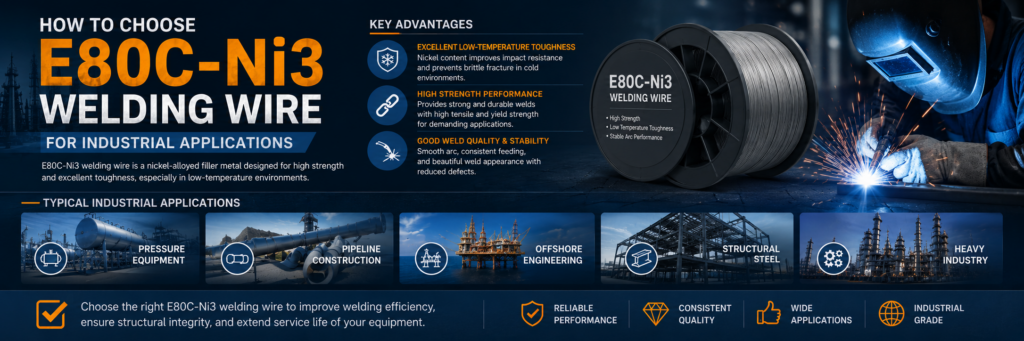
How to Choose E80C-Ni3 Welding Wire for Industrial Applications
Selecting the right welding wire is essential for achieving strong, durable, and reliable welded joints in industrial applications. Among various high-strength welding materials, E80C-Ni3 welding wire is widely recognized for its excellent mechanical properties, low-temperature toughness, and suitability for demanding engineering environments.
When choosing E80C-Ni3 welding wire, engineers and purchasing teams need to consider factors such as base material compatibility, welding process, operating conditions, wire specifications, and required weld performance. Making the correct choice can improve welding quality, reduce defects, and increase the service life of industrial structures.
This guide explains the key factors to consider when selecting E80C-Ni3 welding wire for industrial projects.
What Is E80C-Ni3 Welding Wire?
E80C-Ni3 is a nickel-alloyed welding wire designed for welding high-strength and low-temperature steels. The wire contains approximately 3% nickel, which helps improve weld toughness and impact resistance, especially in cold environments.
Due to its balanced chemical composition and mechanical performance, E80C-Ni3 welding wire is commonly selected for applications requiring high strength and reliable performance under challenging conditions.
The material is often used for welding low-alloy steels, fine-grained steels, pressure-related equipment, pipelines, and structures exposed to low temperatures.
Key Advantages of E80C-Ni3 Welding Wire
1. Excellent Low-Temperature Toughness
One of the main reasons industries choose E80C-Ni3 welding wire is its ability to maintain toughness in cold environments.
Nickel improves the weld metal’s resistance to brittle fracture, making the material suitable for projects where welded components may experience freezing temperatures or sudden temperature changes.
This advantage is especially important for applications involving storage equipment, pipelines, and outdoor structures operating in cold climates.
2. High Strength Performance
E80C-Ni3 welding wire provides strong weld deposits with good tensile strength and yield strength. This allows welded joints to withstand heavy loads, vibration, and mechanical stress.
When selecting welding wire for industrial applications, matching the strength level of the filler metal with the base material is critical. Using a wire with insufficient strength may reduce overall structural reliability.
3. Good Weld Quality and Stability
A suitable welding wire should provide stable arc performance, consistent feeding, and smooth weld formation.
E80C-Ni3 welding wire is designed to support reliable welding operations, helping reduce common welding issues such as cracking, porosity, and inconsistent weld appearance.
Proper welding parameters, shielding gas selection, and surface preparation are also important for achieving optimal results.
How to Select the Right E80C-Ni3 Welding Wire
1. Confirm Base Material Compatibility
Before purchasing E80C-Ni3 welding wire, identify the type of steel being welded.
The wire should be selected according to:
Chemical composition of the base metal
Required mechanical properties
Operating temperature
Service environment
Welding standards
For low-alloy and nickel-containing steels, E80C-Ni3 can provide improved toughness and strength compared with standard welding wires.
2. Choose the Correct Welding Process
Different industrial welding processes require different wire forms and specifications.
E80C-Ni3 welding wire can be used in several welding methods depending on the product type and project requirements, including:
Gas metal arc welding (GMAW)
Gas tungsten arc welding (GTAW)
Submerged arc welding (SAW)
The selected wire diameter should match the welding equipment, material thickness, and production requirements.
3. Consider Working Temperature Requirements
Industrial equipment often operates under extreme temperature conditions. If the welded structure is exposed to low temperatures, impact toughness becomes a key selection factor.
E80C-Ni3 is particularly suitable for applications requiring dependable performance in cold environments because nickel content helps maintain weld toughness.
Before selecting the wire, always check the required impact test temperature and mechanical specifications for the project.
4. Evaluate Wire Size and Packaging Options
Choosing the correct wire diameter can improve welding efficiency.
Common considerations include:
Material thickness
Welding position
Welding speed
Equipment capability
Production volume
For large industrial projects, packaging options and storage conditions should also be considered to maintain wire quality before use.
Common Industrial Applications of E80C-Ni3 Welding Wire
E80C-Ni3 welding wire is suitable for industries where strength and low-temperature performance are important.
Typical applications include:
E80C-Ni3 Pressure Equipment
The wire can be used for welding pressure-related components where reliable mechanical performance is required.
E80C-Ni3 Pipeline Construction
For pipelines exposed to cold environments, weld toughness and crack resistance are essential factors.
Offshore Engineering
Marine and offshore structures often require welding materials that can withstand changing temperatures and harsh conditions.
E80C-Ni3 Heavy Industrial Structures
Equipment frames, structural components, and engineering machinery may benefit from high-strength welding solutions.
Tips for Better E80C-Ni3 Welding Performance
To achieve high-quality welds, consider the following practices:
Maintain Proper Storage
Keep welding wire in a clean and dry environment. Moisture contamination can negatively affect weld quality.
Prepare the Base Material
Remove oil, rust, paint, and other contaminants before welding to reduce the risk of defects.
Optimize Welding Parameters
Adjust:
Welding current
Voltage
Travel speed
Shielding gas
Heat input
according to material thickness and welding conditions.
Follow Welding Procedures
Industrial projects should follow approved welding procedures and quality control requirements to ensure consistent results.
E80C-Ni3 Conclusion
Choosing the right E80C-Ni3 welding wire requires careful consideration of material compatibility, welding process, operating temperature, and required mechanical performance.
With its high strength, excellent toughness, and reliable performance in low-temperature environments, E80C-Ni3 welding wire is a suitable choice for demanding industrial welding applications.
By selecting the correct specifications and applying proper welding practices, manufacturers and engineers can achieve stronger joints, improved durability, and better long-term performance.