

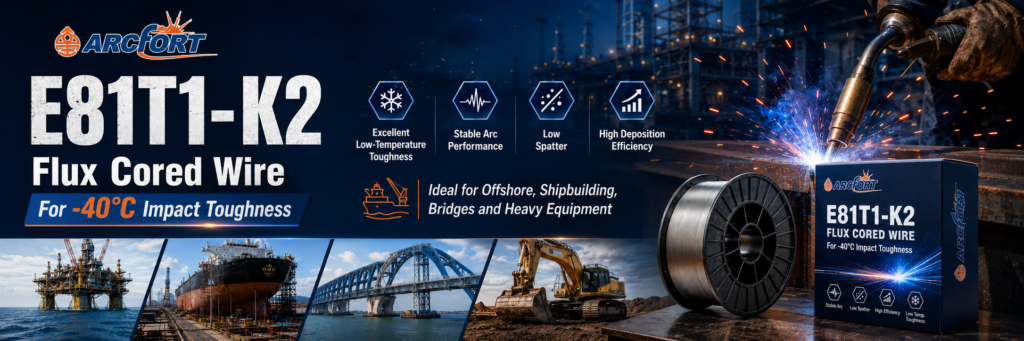
E81T1-K2 Flux Cored Wire for -40°C Impact Toughness
When welding low alloy steel structures that must perform in cold environments, choosing the right welding consumable is essential. E81T1-K2 flux cored wire is designed for applications that require reliable weld strength, stable performance, and excellent impact toughness at low temperatures, including demanding service conditions down to -40°C.
This gas-shielded flux cored welding wire is widely used in structural fabrication, offshore engineering, shipbuilding, bridge construction, pressure vessels, heavy machinery, and other industries where weld quality and low-temperature toughness are critical.
What Is E81T1-K2 Flux Cored Wire?
E81T1-K2 is a low alloy steel flux cored welding wire used for gas-shielded arc welding. It is developed to produce weld deposits with high tensile strength, good crack resistance, and excellent impact toughness.
The “K2” classification highlights its suitability for applications requiring low-temperature impact performance. This makes E81T1-K2 an ideal choice for projects exposed to cold climates, dynamic loads, or demanding structural requirements.
Key Advantages of E81T1-K2 Flux Cored Wire
Excellent -40°C Impact Toughness
One of the most important features of E81T1-K2 flux cored wire is its ability to deliver strong impact toughness at -40°C. This helps welded structures maintain reliability in cold service environments, reducing the risk of brittle fracture.
Stable Arc Performance
E81T1-K2 provides a smooth and stable arc during welding. A stable arc helps improve weld appearance, reduce spatter, and support consistent weld penetration.
High Deposition Efficiency
Compared with solid wire welding, flux cored wire usually offers higher deposition rates. This helps improve welding productivity, especially in large-scale fabrication projects.
Good Weld Bead Appearance
The wire produces clean and uniform weld beads with good slag detachability. This reduces post-weld cleaning time and improves overall working efficiency.
Suitable for All-Position Welding
E81T1-K2 flux cored wire can be used in multiple welding positions, making it suitable for complex structural components and field welding conditions.
Typical Applications
E81T1-K2 flux cored wire is suitable for welding low alloy steels used in:
Offshore platforms
Shipbuilding structures
Bridges and steel structures
Heavy equipment frames
Pressure vessels
Petrochemical equipment
Construction machinery
Low-temperature service components
High-strength structural steel fabrication
For projects requiring dependable weld performance in cold environments, E81T1-K2 flux cored wire for -40°C impact toughness is a practical and efficient welding solution.
Why -40°C Impact Toughness Matters
In cold environments, steel structures may become more sensitive to brittle fracture. If the weld metal does not have enough toughness, cracks can form and spread under impact, vibration, or heavy loading.
Using E81T1-K2 flux cored welding wire helps improve the toughness of the weld deposit. This is especially important for welded structures used outdoors, offshore, in cold regions, or in equipment exposed to low-temperature service conditions.
Welding Performance of E81T1-K2
E81T1-K2 flux cored wire offers a good balance of mechanical properties and welding usability. It provides strong weld deposits, stable arc behavior, and reliable performance when used with proper shielding gas and welding parameters.
To achieve the best results, welders should control:
Welding current and voltage
Travel speed
Heat input
Interpass temperature
Shielding gas flow
Base metal cleanliness
Proper storage of welding wire
Correct welding procedures help ensure that the weld metal achieves the required strength and low-temperature impact toughness.
Recommended Shielding Gas
E81T1-K2 flux cored wire is commonly used with gas shielding such as CO₂ or mixed gas, depending on the welding procedure and project requirements. The choice of shielding gas can affect arc stability, spatter level, weld appearance, and mechanical properties.
For critical low-temperature applications, welding procedure qualification should be performed to confirm that the final weld meets the required impact toughness standard.
How to Choose Quality E81T1-K2 Flux Cored Wire
When selecting E81T1-K2 flux cored wire, buyers should consider more than price. Stable quality, consistent chemical composition, reliable mechanical properties, and professional technical support are all important.
A good E81T1-K2 wire should provide:
Consistent wire feeding
Stable arc performance
Low spatter
Easy slag removal
Good weld bead shape
Reliable tensile strength
Verified low-temperature impact toughness
Consistent batch quality
These factors help reduce welding defects, improve productivity, and ensure long-term structural reliability.
E81T1-K2 Flux Cored Wire for Industrial Welding Projects
For manufacturers, fabricators, and contractors working on low alloy steel structures, E81T1-K2 offers an efficient solution for high-strength welding. Its combination of productivity and low-temperature toughness makes it suitable for demanding industries where weld failure is not acceptable.
Whether used in workshop fabrication or field welding, E81T1-K2 flux cored wire helps deliver strong, tough, and reliable welds for critical steel structures.
Conclusion
E81T1-K2 flux cored wire for -40°C impact toughness is an excellent welding consumable for low alloy steel applications requiring strength, toughness, and stable welding performance. It is especially suitable for offshore structures, shipbuilding, bridges, heavy machinery, and cold-environment steel fabrication.
By choosing the right welding wire and following proper welding procedures, fabricators can achieve high-quality welds with reliable mechanical performance and excellent low-temperature toughness.