
E81T1-Ni1M Flux Cored Wire: Uses, Gas, and Key Benefits
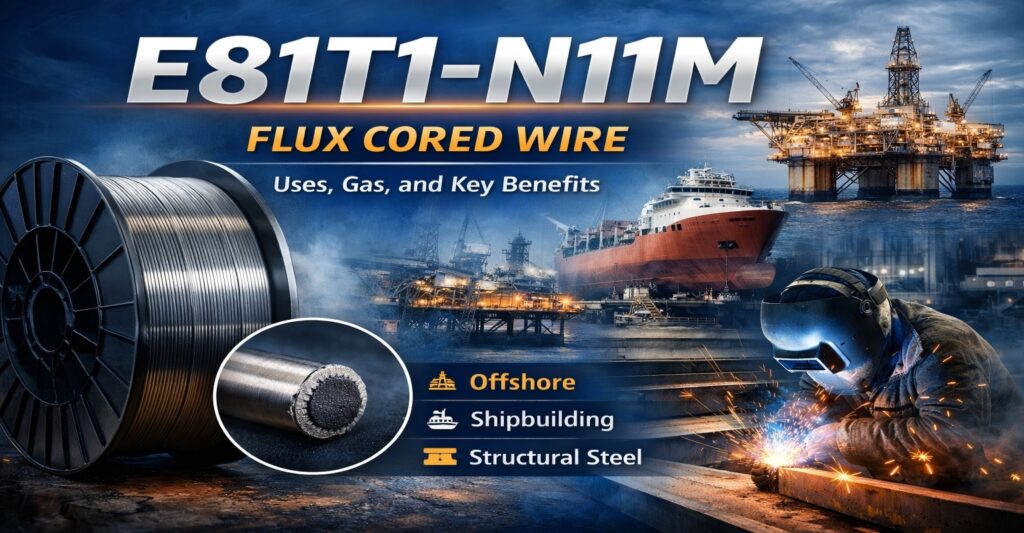
If you are sourcing welding consumables for offshore fabrication, structural steel, shipbuilding, or low-temperature service, E81T1-Ni1M flux cored wire is a classification worth understanding. It is widely selected for projects that require reliable mechanical properties, good impact toughness, and stable all-position welding performance.
For buyers in Australia and Europe, this wire is especially relevant in sectors such as marine engineering, heavy fabrication, energy projects, and steel structures exposed to demanding environments.
In this guide, we explain what E81T1-Ni1M means, where it is used, which shielding gas it requires, and why many fabricators choose it for high-strength and low-temperature applications.
What Is E81T1-Ni1M?
E81T1-Ni1M is a gas-shielded flux cored welding wire designed for welding certain high-strength low-alloy steels. The classification provides useful information about performance, position, alloying, and shielding gas.
Here is a simple breakdown:
E = electrode
81 = tensile strength class
T1 = tubular flux cored wire with specific usability characteristics
Ni1 = approximately 1% nickel alloy addition
M = designed for use with mixed shielding gas, commonly argon and CO2 blends
The nickel addition is important because it helps improve low-temperature toughness, which is one reason this wire is often chosen for demanding structural applications.
Why E81T1-Ni1M Is Popular in Australia and Europe
In Australia and many European markets, welding consumables are often selected not only by price, but by application fit, consistency, and compliance with project requirements. E81T1-Ni1M is popular because it supports several needs at once:
Good toughness for lower-temperature service
Strong weld metal performance for structural work
Stable arc characteristics with mixed gas
Suitable all-position welding capability
Strong fit for offshore, marine, and heavy fabrication sectors
These advantages make it a practical option for manufacturers, contractors, and distributors serving industries where weld reliability matters more than simply choosing the lowest-cost wire.
Typical Applications of E81T1-Ni1M
One of the reasons this classification has steady demand is its versatility. E81T1-Ni1M flux cored wire is commonly used in applications such as:
Offshore Structures
Offshore platforms, support modules, and related steelwork often require welding consumables with dependable mechanical properties and good toughness. E81T1-Ni1M fits this environment well.
Shipbuilding and Marine Fabrication
Marine fabrication involves heavy sections, positional welding, and strict performance expectations. Fabricators often value flux cored wire because it offers productivity and strong weld quality in fabrication shops and site work.
Structural Steel Fabrication
For bridges, industrial buildings, plant structures, and engineered steel components, E81T1-Ni1M can be used where higher strength and better toughness are required than standard carbon steel welding wires may provide.
Low-Temperature Service
Because of its nickel content, this wire is often considered for fabricated components that must perform in colder service environments.
Energy and Heavy Equipment
It is also relevant in selected oil and gas, mining, transport, and heavy equipment applications where strength and service reliability are important.
What Shielding Gas Does E81T1-Ni1M Use?
This is one of the most important questions for buyers and welding engineers.
The “M” in E81T1-Ni1M indicates that the wire is intended for use with mixed shielding gas, rather than pure CO2. In practice, this usually means an argon/CO2 blend.
A mixed gas setup is chosen because it can help provide:
A smoother and more stable arc
Reduced spatter
Better bead appearance
Improved operator control
Consistent mechanical performance under the intended classification
If a buyer is comparing E81T1-Ni1M with E81T1-Ni1C, the key difference is typically the shielding gas category:
Ni1M = mixed gas
Ni1C = CO2 shielding gas
That distinction matters in purchasing, because shielding gas choice affects both welding performance and final application suitability.
Key Benefits of E81T1-Ni1M Flux Cored Wire
When overseas buyers compare welding wires, they usually focus on real production advantages rather than just classification codes. Here are the main reasons buyers choose E81T1-Ni1M.
1. Good Toughness for Demanding Service
The 1% nickel content helps support improved impact performance, which is useful in colder environments or projects with stricter mechanical requirements.
2. Strong Productivity in Fabrication
Flux cored wires are widely used because they support efficient deposition and practical shop productivity. For many structural and fabrication operations, this can improve throughput compared with slower alternatives.
3. Suitable for All-Position Welding
Many E81T1-Ni1M products are designed for all-position use, which is valuable in shipbuilding, steel construction, and repair work where weld positions vary.
4. Better Arc Characteristics with Mixed Gas
With the correct mixed shielding gas, welders can often achieve stable arc performance and a cleaner welding experience, which supports consistent workmanship.
5. Good Fit for High-Strength Structural Applications
This wire is often selected for higher-performance steelwork where standard general-purpose consumables may not be the best match.
E81T1-Ni1M What Buyers Should Check Before Purchasing
Not every project should use the same wire, even within the same classification. Before buying E81T1-Ni1M, it is smart to confirm the following:
Base Material Compatibility
Check whether the steel grade and project specification match the intended mechanical properties of the wire.
Required Toughness and Test Conditions
If your project includes low-temperature testing or specific impact requirements, verify the actual product data sheet rather than relying only on the AWS classification.
Shielding Gas Availability
Because E81T1-Ni1M uses mixed gas, buyers should ensure their workshop or end customer has the correct gas supply.
E81T1-Ni1M Approval and Certification Requirements
Projects in Europe and Australia may require additional documentation, classification approvals, batch traceability, or testing records depending on the industry.
Wire Diameter and Packaging
Different customers need different spool sizes, drum packaging, and wire diameters depending on production scale and feeding equipment.
E81T1-Ni1M vs Standard Flux Cored Wire
Some buyers ask whether they should simply use a lower-cost standard flux cored wire instead. The answer depends on the application.
A general-purpose wire may be sufficient for basic fabrication, but E81T1-Ni1M becomes more attractive when the project involves:
Higher strength steel
Better low-temperature performance
Offshore or marine exposure
More demanding engineering requirements
Customer specifications calling for nickel-alloy flux cored wire
In other words, E81T1-Ni1M is not only a welding consumable classification. It is often a specification-driven solution for more demanding fabrication work.
How Exporters Can Position E81T1-Ni1M for Overseas Buyers
If you are selling to Australia or Europe, your product page and content should focus on buyer concerns, not only technical tables. The strongest sales message usually combines:
Classification and shielding gas clarity
Application scenarios
Mechanical property highlights
Available sizes and packing
OEM/private label options
Consistent supply capability
Technical support and documentation
Most overseas buyers want fast answers to practical questions:
Is it mixed gas or CO2?
What steels can it weld?
Is it suitable for offshore or shipbuilding?
What approvals or test reports are available?
Can you supply distributor or container quantities?
Your content should answer those clearly.
E81T1-Ni1M Final Thoughts
For fabricators and distributors serving Australia and Europe, E81T1-Ni1M flux cored wire is a highly relevant solution for structural, offshore, marine, and low-temperature welding applications. Its combination of mixed-gas performance, nickel-alloy toughness, and all-position usability makes it a strong option for demanding industrial projects.
If your customers need a flux cored wire for higher-performance steelwork, E81T1-Ni1M is a classification they are likely to search, compare, and specify.