

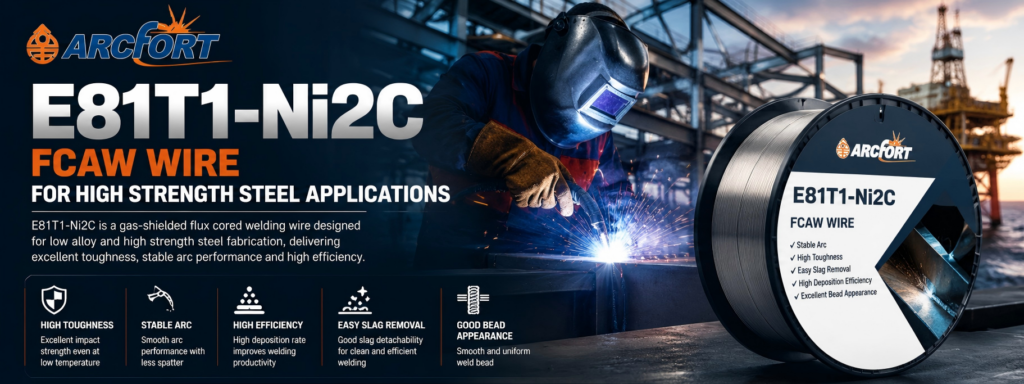
E81T1-Ni2C FCAW Wire for High Strength Steel Applications
E81T1-Ni2C FCAW wire is a gas-shielded flux cored welding wire designed for low alloy and high strength steel fabrication. It is commonly used in applications that require strong weld metal, stable arc performance, good impact toughness, and reliable welding efficiency.
For industries such as structural fabrication, shipbuilding, offshore engineering, bridge construction, heavy equipment manufacturing, and pressure-related steel structures, choosing the right flux cored wire is essential. E81T1-Ni2C provides a practical solution for welding high strength steels where both mechanical performance and productivity are important.
What Is E81T1-Ni2C FCAW Wire?
E81T1-Ni2C is a flux cored arc welding wire suitable for welding low alloy steels and high strength structural steels. The “Ni” in the classification indicates nickel alloying, which helps improve weld metal toughness, especially in demanding service environments.
This type of FCAW wire is typically used with carbon dioxide shielding gas and is valued for its smooth arc, easy slag removal, stable bead appearance, and good deposition efficiency. Compared with solid welding wire, flux cored wire can offer higher productivity and better performance in heavy-duty welding applications.
Key Features of E81T1-Ni2C Welding Wire
1. Suitable for High Strength Steel
E81T1-Ni2C FCAW wire is developed for applications where weld strength and toughness are required. It helps produce weld metal with reliable mechanical properties, making it suitable for medium and high strength steel fabrication.
2. Excellent Impact Toughness
Nickel alloying improves the toughness of the weld metal. This makes E81T1-Ni2C a strong choice for structures exposed to low temperatures, dynamic loads, or demanding working conditions.
3. Stable Arc Performance
A stable arc helps reduce spatter, improve welding control, and create a cleaner weld bead. This is especially important in multi-pass welding, thick plate welding, and long production runs.
4. High Welding Efficiency
As a flux cored welding wire, E81T1-Ni2C offers high deposition rates and good productivity. It is suitable for factories and fabrication workshops that require consistent welding quality and efficient production.
5. Good Bead Appearance
The wire provides smooth weld formation and easy slag removal, helping welders achieve clean and uniform weld beads with less post-weld cleaning.
Main Applications of E81T1-Ni2C FCAW Wire
E81T1-Ni2C flux cored wire is widely used in industries that require strong and tough weld joints. Typical applications include:
High strength steel structures
Bridge fabrication
Offshore platforms
Shipbuilding and marine structures
Heavy machinery manufacturing
Construction equipment
Low alloy steel components
Pressure-related steel fabrication
Mining and engineering equipment
Wind power and energy structures
Its strong mechanical performance makes it suitable for both workshop fabrication and large-scale industrial welding projects.
Why Choose E81T1-Ni2C for High Strength Steel Welding?
High strength steel welding requires more than basic tensile strength. The weld metal must also have good toughness, stable performance, and compatibility with the base material. E81T1-Ni2C FCAW wire is designed to meet these requirements by combining strength, toughness, and welding efficiency.
For thick steel plates, multi-pass welds, and demanding structural applications, this wire helps improve welding productivity while maintaining reliable weld quality. Its smooth arc and stable slag system also make it easier for welders to control the welding process.
Welding Performance Advantages
E81T1-Ni2C FCAW wire provides several practical advantages in industrial fabrication:
Stable arc with reduced spatter
Smooth and uniform weld bead
Easy slag removal after welding
Good fusion and penetration
Reliable performance in multi-pass welding
Strong weld metal for structural applications
Good toughness for demanding service conditions
These advantages make it a preferred choice for fabricators looking for both performance and efficiency.
Recommended Welding Considerations
To achieve the best results with E81T1-Ni2C FCAW wire, proper welding procedures should be followed. Welding current, voltage, travel speed, interpass temperature, shielding gas flow, and preheating requirements should be selected according to the base material, plate thickness, joint design, and project standard.
For critical structures, welding procedure qualification and mechanical testing are recommended before production welding. This helps ensure that the final weld meets the required strength, toughness, and quality standards.
E81T1-Ni2C vs Solid Welding Wire
Compared with solid welding wire, E81T1-Ni2C flux cored wire can provide higher deposition efficiency and better productivity in heavy fabrication. It is especially useful for thick plate welding, long weld seams, and applications that require high-quality multi-pass welds.
Flux cored wire also offers better arc stability and slag coverage in many structural welding conditions, helping improve bead shape and weld consistency.
Conclusion
E81T1-Ni2C FCAW wire is an excellent choice for high strength steel applications that require reliable weld metal strength, good impact toughness, stable arc performance, and high welding efficiency. It is suitable for bridge construction, shipbuilding, offshore structures, heavy machinery, and other demanding low alloy steel fabrication projects.
For manufacturers and fabricators seeking a dependable flux cored welding wire for high strength steel, E81T1-Ni2C offers a strong balance of productivity, weld quality, and mechanical performance.