

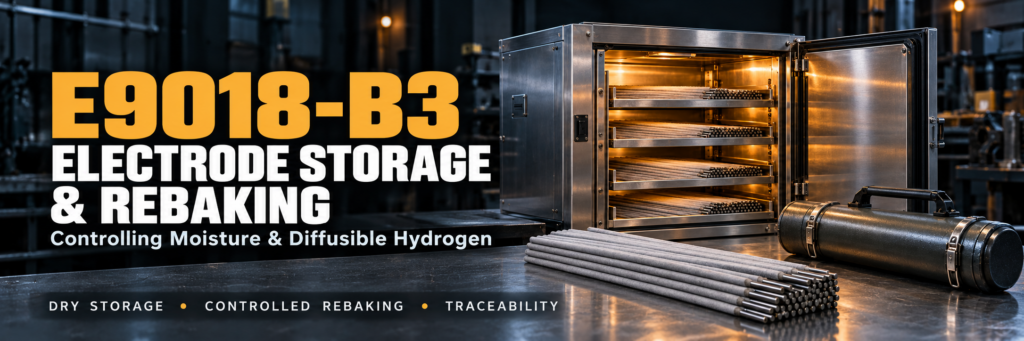
E9018-B3 Electrode Storage and Rebaking: Controlling Moisture and Diffusible Hydrogen
E9018-B3 electrodes are used for welding suitable 2.25Cr-1Mo steels in applications where weld integrity and elevated-temperature performance matter. Their low-hydrogen coating supports reliable welding, but its effectiveness depends on how the electrodes are stored and handled.
Once packaging is opened, moisture exposure becomes a fabrication variable. An electrode can look dry while its coating contains enough absorbed moisture to affect hydrogen control.
Effective E9018-B3 electrode storage therefore requires more than a heated oven. It requires a documented system for receiving, holding, issuing, returning, and—where permitted—rebaking consumables.
Why Moisture Matters in E9018-B3 Welding
At welding temperatures, moisture associated with the electrode coating can contribute hydrogen to the arc and molten weld pool. Some hydrogen remains mobile within the deposited metal after solidification.
This diffusible hydrogen can contribute to hydrogen-assisted cracking when a susceptible microstructure and sufficient tensile stress are also present.
Electrode moisture is only one possible source. Water, condensation, oil, and other contamination on the joint can also undermine hydrogen control.
Proper consumable handling reduces hydrogen input, but it must work alongside joint cleaning, temperature control, and an appropriate welding procedure.
Storage, Holding, and Rebaking: Three Different Operations
These terms describe different stages of consumable control.
| Operation | Main purpose | Key consideration |
|---|---|---|
| Unopened storage | Protect the original packaging and consumable condition | Keep packages dry, undamaged, and identifiable |
| Heated holding | Limit moisture pickup after opening or approved drying | Maintain the product-specific holding conditions |
| Rebaking or redrying | Remove absorbed moisture where reconditioning is permitted | Follow the specified temperature, duration, and cycle limits |
A holding oven is primarily a preservation tool. It should not be assumed to restore moisture-exposed electrodes merely because they have remained warm for several hours.
Likewise, a rebaking cycle is a controlled treatment. Applying more heat or extending the duration does not automatically improve the result.
How to Store Unopened E9018-B3 Electrodes
Protect the Packaging
Store electrodes in a dry, sheltered area where packages are protected from water, condensation, and physical damage. Keep them off damp floors and away from conditions that could compromise the seal.
Inspect incoming packages for punctures, corrosion, broken seals, and missing identification.
A package that appears closed is not necessarily hermetically sealed. Confirm the packaging type and its stated handling requirements.
Preserve Identification and Traceability
Keep the classification, product identification, diameter, and batch information available throughout storage and use.
Separate consumables that require different handling schedules. Mixing electrodes in an unmarked container makes it difficult to confirm both material identity and exposure history.
Manage Inventory
Use a stock-rotation system consistent with the supplier’s shelf-life guidance and project requirements. Retain relevant certificates and handling instructions with the consumable records.
Long storage periods do not automatically make electrodes unusable, but packaging condition and documented storage history remain important.
What to Do After Opening the Package
Before opening, establish whether the electrodes can be used directly from their packaging or require initial drying.
Then transfer them promptly to the specified holding arrangement. Avoid opening more material than the work can reasonably consume.
For field welding, use a suitable heated electrode quiver where required. An unheated carrying tube may protect against dirt and rain, but it does not provide controlled heated holding.
Track when electrodes leave the holding oven and how long they remain exposed. A return to warm storage should not be treated as an automatic reset of their allowable exposure.
What Temperature Should Be Used for E9018-B3 Rebaking?
There is no single rebaking temperature that should be applied to every E9018-B3 product.
The classification identifies a consumable category; it does not provide a complete handling schedule for every coating formulation and packaging system.
Use the current instructions for the exact electrode, together with the governing project requirements. Confirm:
Whether initial drying is required.
The permitted redrying temperature range.
The required holding duration.
Any specified heating sequence.
The subsequent holding temperature.
The maximum permitted number of redrying cycles.
Copying a schedule from a different electrode can result in inadequate drying or coating damage.
Account for the Oven Load
The oven display indicates the temperature at its sensor. A newly loaded batch of cold electrodes may take time to reach the required treatment temperature.
Loading arrangement, batch size, and airflow influence heating. Avoid tightly packed loads that prevent uniform treatment, and apply the holding-time definition specified in the approved drying procedure.
Managing Atmospheric Exposure
Moisture pickup depends on environmental conditions and the electrode coating. Humidity, temperature, packaging, and handling all matter.
Do not adopt a universal exposure limit simply because it is commonly used for another electrode or project.
A practical issue-and-return system should record:
Electrode identity and batch.
Time of issue.
Applicable exposure limit.
Return time and condition.
Reconditioning status, where relevant.
Final disposition.
Electrodes with unknown exposure history should be segregated until their suitability is resolved.
When Rebaking Is Not Enough
Rebaking cannot correct every form of deterioration.
Electrodes exposed to liquid water, oil, chemicals, or physical damage require evaluation under the applicable acceptance rules. Cracked, flaking, or detached coatings may make them unsuitable regardless of a subsequent drying cycle.
Repeated rebaking also requires control. If the permitted cycle count has been exceeded—or cannot be established—do not assume that another cycle restores compliance.
Neither visual appearance nor acceptable arc behavior proves that an electrode meets the required diffusible hydrogen level.
Common E9018-B3 Handling Mistakes
Using One Oven Schedule for All Electrodes
Different consumables can have different drying and holding requirements. Separate them physically or use a verified arrangement that satisfies each product’s instructions.
Confusing Holding with Reconditioning
Warm storage helps preserve suitable electrodes. It does not necessarily remove absorbed moisture to the required level.
E9018-B3 Leaving Electrodes Beside the Welding Station
Open trays expose electrodes to ambient moisture and contamination. Issue controlled quantities and use the specified protection.
E9018-B3 Returning Unidentified Electrodes to Stock
Returned consumables need an established identity and handling history. Uncontrolled mixing defeats traceability.
E9018-B3 Focusing Only on the Electrodes
Dry electrodes cannot compensate for a wet joint, contaminated groove, or an unsuitable welding thermal cycle.
E9018-B3 Consumable Control Checklist
Before welding, confirm that:
The electrode matches the approved welding procedure.
Packaging and coating condition are acceptable.
Product-specific handling instructions are available.
Holding and drying equipment operate within the required limits.
Exposure and rebaking histories are traceable.
Joint surfaces are clean and dry.
Preheat, interpass, and post-weld requirements are ready to implement.
E9018-B3 Conclusion
Reliable E9018-B3 electrode storage combines intact packaging, controlled heated holding, documented exposure, and approved rebaking where needed.
The essential principle is to preserve a verified consumable condition from receipt to the arc. That discipline helps reduce one important source of diffusible hydrogen and supports consistent Cr-Mo weld quality.