
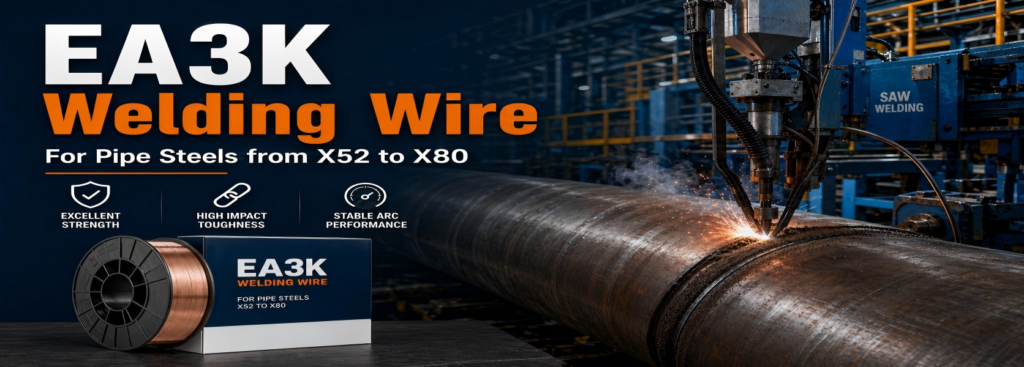
EA3K Welding Wire for Pipe Steels from X52 to X80
Ir a la página de detalles del producto EA3K:https://www.akweld.com/wp-content/uploads/2026/03/EA3K.pdf
In submerged arc welding, wire selection becomes especially important when the project involves pipe steels from X52 to X80. These grades are widely used in line pipe and pressure-related fabrication, where buyers usually need a balance of strength, weld consistency, productivity, and dependable mechanical performance. Public product pages and standards references consistently place EA3K welding wire in this application range, especially for pipe seam welding and other submerged arc welding operations on higher-strength steels.
EA3K belongs to the AWS A5.23 classification system for low-alloy and high-manganese steel electrodes and fluxes for submerged arc welding. AWS notes that this specification covers the classification of low-alloy steel electrodes and fluxes, and that submerged arc consumables are used within both multiple-pass and two-run classification systems depending on the application. That standards framework is important because pipe welding often depends not only on the wire itself, but also on how the wire performs in a specific process setup.
What EA3K Welding Wire Is
Public distributor and product pages describe EA3K as a low-carbon, high-manganese, high-silicon, 0.5% molybdenum special-purpose wire. Lincolnweld LA-90, which is sold under the EA3K classification, is specifically presented as being recommended for seam welding of pipe and for the general welding of high-strength plate. That positioning makes EA3K a more targeted submerged arc wire rather than a broad general-purpose option for routine mild-steel work.
Visible technical pages also show that EA3K is associated with pipe steels from X52 to X80. Bavaria’s BA-S2MoSi, classified as EA3K mod., lists base materials according to ISO 3183, EN 10208, and API-5 from L360N / X52 to L555Q / X80. Xiangind’s EA3K and EA3K mod. pages show the same application range and emphasize that the wire is intended for submerged arc welding of pipe steels with low Si and Mn or low Si depending on the variant.
Why EA3K Is Used for X52 to X80 Pipe Steels
The reason EA3K appears in this pipe-steel range is straightforward: X52 to X80 applications demand more than simple deposition efficiency. Pipe manufacturers and fabricators need weld metal that supports the target strength level, while also maintaining stable operation in long seam welds. Public product descriptions link EA3K directly with pipe seam welding, which suggests that its chemistry and process behavior are designed for that production environment.
In practical terms, seam welding of pipe requires a wire that feeds consistently, behaves predictably under flux, and can support production rates without sacrificing quality. AWS’s broader guidance on submerged arc welding also highlights why SAW remains a preferred process for heavy-duty, long, continuous welds: it offers high deposition, deep penetration, and strong consistency in mechanized or automated welding. That makes EA3K particularly relevant in mills and fabrication lines where throughput and repeatability both matter.
Chemical Profile and Its Relevance
Product pages for EA3K consistently describe the alloy concept as 0.5% molybdenum with relatively high manganese and high silicon compared with simpler SAW wires. Bavaria’s EA3K mod. data, for example, lists a typical analysis around 0.10% carbon, 0.60% silicon, 1.20% manganese, and 0.50% molybdenum, while its AWS classification range for EA3K mod. is shown as 0.05–0.15% C, 0.50–0.80% Si, 0.95–1.30% Mn, and 0.40–0.60% Mo.
That chemistry matters because the wire is being marketed for steels that require more than a simple mild-steel weld deposit. In pipe steels up to X80, buyers often care about whether a wire can help support the required property window without introducing unnecessary selection risk. The combination of molybdenum, manganese, and silicon is one of the main reasons EA3K is positioned as a suitable wire for higher-strength pipe applications rather than for ordinary low-demand fabrication. This is an inference from the published chemistry and application range, not a substitute for project-specific qualification.
Typical Applications for EA3K in Pipe Welding
The strongest application signal around EA3K is longitudinal seam welding of pipe. Lincoln’s LA-90 is explicitly recommended for seam welding of pipe, and the X52–X80 range shown on the Bavaria and Xiangind pages suggests a natural fit for line-pipe and pipeline-related fabrication where SAW is used for long production welds.
EA3K can also be relevant where the same shop or project involves high-strength plate welding. Public product descriptions mention that it is suitable not only for pipe seams but also for general welding of high-strength plate, which expands its appeal for manufacturers that work across both pipe and related structural or pressure applications.
Flux Matching Is Part of the Answer
In submerged arc welding, the wire does not work alone. The visible product pages make this clear by naming suitable fluxes and warning that flux suitability is strongly dependent on the application. Bavaria and Xiangind both state that the most suitable flux should match the requirements of the plate material as closely as possible under the actual welding conditions. For the X52 to X80 range, those pages list flux options such as BF 6.30 and BF 6.5, depending on the system.
For buyers, this is one of the most important practical points in the whole discussion. A page may say that EA3K is suitable for X52 to X80 pipe steels, but real welding results still depend on the wire-flux combination, heat input, welding procedure, and base material chemistry. That is why the best purchasing decision is never based on the wire classification alone. It should always include the recommended flux and the qualified procedure.
What Buyers Should Check Before Ordering
If you are buying EA3K for pipe steels from X52 to X80, the first thing to verify is the exact classification and product variant. Public results show both EA3K and EA3K mod., and while they are closely related, their chemistry descriptions are not identical. That means a buyer should request the supplier’s exact datasheet rather than assuming all EA3K-labeled products are interchangeable.
The second thing to check is whether the wire is actually intended for pipe seam welding in your process. Lincolnweld LA-90 is clearly described for this use case, which makes it a useful benchmark. If another supplier offers an EA3K wire, it is reasonable to compare it against that same commercial expectation: seam-welding suitability, chemistry, and lot documentation. Airgas and eSafety Supplies both note that Type 3.1 certificates showing chemical composition are available for each lot of Lincoln’s product, which is relevant for traceability-sensitive projects.
The third thing to verify is the pipe grade and required service condition. Public pages show X52 to X80 as the visible base-material range, but that does not mean every flux, welding procedure, and seam design will automatically qualify across the full range. In real procurement, the project specification and procedure qualification record still decide whether the system is acceptable.
EA3K Welding Wire vs More General SAW Wires
Compared with more general submerged arc wires, EA3K is marketed as a special-purpose low-alloy wire rather than a broad commodity consumable. The visible results consistently connect it with pipe seam welding, high-strength plate, and pipe steels up to X80, while public pages for related classifications like EA3 emphasize somewhat different application mixes. That makes EA3K particularly relevant when the buyer’s search intent is pipe-related rather than just general submerged arc welding.
This also explains why good SEO topics around EA3K usually focus on pipe steels, X52 to X80, seam welding, chemical composition, and flux matching. Those are the themes that public ranking pages already reinforce, and they align closely with what actual technical buyers are trying to confirm before they place an order.
EA3K Welding Wire Conclusion
EA3K welding wire is closely associated with pipe steels from X52 to X80 because the publicly visible product literature repeatedly places it in exactly that range. It is presented as a 0.5% molybdenum special-purpose SAW wire with higher manganese and silicon, recommended for seam welding of pipe and for high-strength plate. That makes it a relevant option for buyers who need a submerged arc wire aimed at line-pipe style fabrication rather than ordinary general-purpose welding.
For the best result, EA3K should be evaluated as part of a welding system, not as a wire name by itself. The practical decision should include the exact classification, wire variant, flux pairing, pipe grade, and qualified welding procedure. When those elements align, EA3K can be a strong choice for submerged arc welding of pipe steels from X52 to X80.