
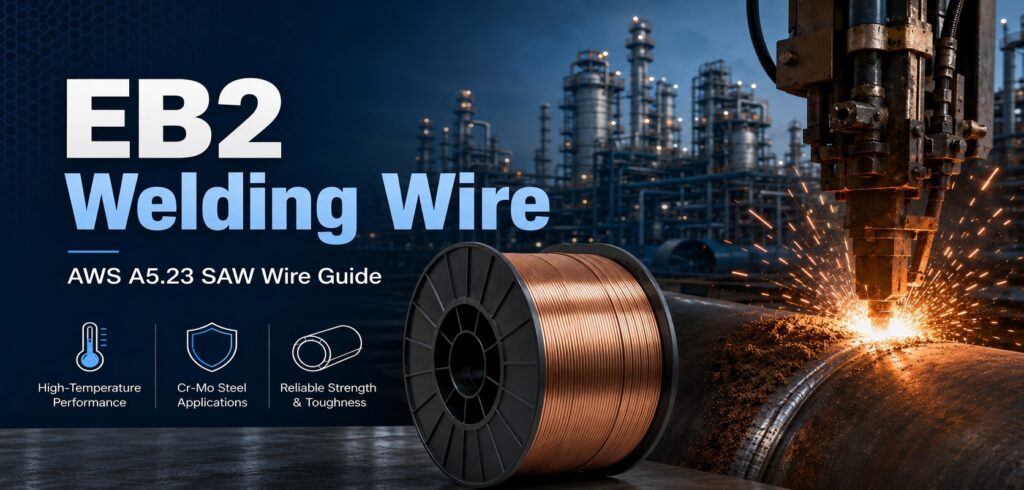
EB2 Welding Wire: AWS A5.23 SAW Wire for 1.25Cr-0.5Mo Steel
EB2 SAW , also written as EB-2 welding wire, is a low-alloy solid wire mainly used for submerged arc welding, or SAW, of 1.25Cr-0.5Mo heat-resistant steels. It is widely selected for boilers, pressure vessels, heat exchangers, refinery piping, petrochemical equipment, ammonia synthesis equipment, and other components that require reliable performance at elevated temperature.
For buyers, engineers, and welding fabricators, the key question is simple: is EB2 the correct welding wire for the base metal, service temperature, flux, and welding procedure? This guide explains the specification, chemistry, common applications, welding guidance, and purchasing points for EB2 welding wire.
Link to the detailed data page for AK EB2:
https://www.akweld.com/wp-content/uploads/2026/03/EB2.pdf
What Is EB2 Welding Wire?
EB2 is a chromium-molybdenum low-alloy welding wire classified under AWS A5.23 for submerged arc welding. In practical purchasing language, it is often described as a 1.25% chromium and 0.5% molybdenum SAW wire.
The alloy system is designed for welding creep-resistant and heat-resistant steels with similar chemistry. The chromium and molybdenum content helps the weld deposit match the high-temperature performance requirements of Cr-Mo steels used in pressure and process equipment.
EB2 SAW is commonly associated with:
| Item | Typical Description |
|---|---|
| Product name | EB2 welding wire / EB-2 SAW wire |
| AWS classification | AWS A5.23 EB2 |
| Welding process | Submerged arc welding, SAW |
| Alloy type | 1.25Cr-0.5Mo low-alloy steel wire |
| Common applications | Boilers, piping, pressure vessels, heat exchangers |
| Common industries | Power generation, refinery, petrochemical, chemical plants |
| Typical supplied sizes | 3/32 in, 1/8 in, 5/32 in, or metric equivalents |
| Typical packaging | Coil, spool, drum, or customer-specified package |
EB2 Welding Wire Chemical Composition
Exact chemistry must always follow the applicable purchase specification, project code, and material certificate. A typical AWS A5.23 EB2 chemistry range is shown below:
| Element | Typical AWS EB2 Range |
|---|---|
| Carbon, C | 0.07–0.15% |
| Manganese, Mn | 0.45–1.00% |
| Silicon, Si | 0.05–0.30% |
| Chromium, Cr | 1.00–1.75% |
| Molybdenum, Mo | 0.45–0.65% |
| Phosphorus, P | 0.025% max |
| Sulfur, S | 0.025% max |
| Copper, Cu | 0.35% max |
This chemistry makes EB2 suitable for weld deposits that need to match 1.25Cr-0.5Mo base materials.
Main Applications of EB2 Welding Wire
EB2 SAW is used when the welded joint must perform in high-temperature or pressure-service conditions. Typical applications include:
Boilers and power plant components
EB2 is used for Cr-Mo steels in boiler fabrication and repair where temperature resistance and weld deposit compatibility are important.
Pressure vessels and heat exchangers
Pressure equipment often requires filler metals that match the strength and high-temperature behavior of the base metal. EB2 is commonly specified for 1.25Cr-0.5Mo steel assemblies.
Refinery and petrochemical piping
Cr-Mo steels are common in refinery and petrochemical service. EB2 SAW wire is suitable for many heavy-wall pipe, vessel, and process equipment welds when approved by the project welding procedure.
Chemical and ammonia synthesis equipment
Some supplier data sheets list chemical plants, ammonia synthesis equipment, heat exchangers, boilers, piping, and pressure vessels as common EB2 applications.
Base Metals Commonly Welded with EB2 Wire
EB2 SAW is commonly selected for base metals with similar 1.25Cr-0.5Mo chemistry. Depending on the project specification and welding procedure qualification, common base materials may include:
| Base Metal Group | Examples |
|---|---|
| Forgings | ASTM A182 F11, F12 |
| Tubes | ASTM A213 T11, T12 |
| Pipes | ASTM A335 P11, P12 |
| Fittings | ASTM A234 WP11, WP12 |
| Plates | ASTM A387 Grade 11, Grade 12 |
| Castings | ASTM A217 WC6, WC11 |
Always confirm the filler metal with the engineering specification, WPS/PQR, service temperature, post-weld heat treatment requirement, and applicable code. Pinnacle’s EB2 data sheet, for example, lists several of these F11/F12, T11/T12, P11/P12, and A387 Grade 11/12 base materials.
EB2 Welding Wire vs. ER80S-B2: What Is the Difference?
EB2 and ER80S-B2 are often connected because both relate to 1.25Cr-0.5Mo welding applications. However, they are not always used in the same welding process.
EB2 is normally associated with AWS A5.23 submerged arc welding wire. It is commonly used with a compatible SAW flux for heavy fabrication, pressure equipment, and long welds.
ER80S-B2 is commonly associated with GMAW and GTAW filler metals for similar Cr-Mo steel applications. When a drawing, purchase order, or WPS says “EB2,” confirm whether it is calling for AWS A5.23 SAW wire or another process-specific filler classification.
For purchasing, the safest approach is to specify the full requirement, such as:
AWS A5.23 EB2 submerged arc welding wire, diameter 1/8 in, copper-coated, supplied with mill test certificate, suitable flux to be confirmed by WPS.
Welding Guidelines for EB2 SAW Wire
EB2 SAW is usually used with a suitable submerged arc flux. The flux-wire combination affects weld metal chemistry, mechanical properties, usability, and bead profile. Weld Wire notes that both agglomerated and fused fluxes may be used for submerged arc welding, and that flux chemistry can influence weld metal chemistry and mechanical properties.
Typical welding guidance includes:
| Parameter | Typical Guidance |
|---|---|
| Process | Submerged arc welding |
| Flux | Neutral or project-approved SAW flux |
| Preheat / interpass | Often around 300°F minimum; some data sheets list 300–390°F |
| PWHT | Often required for Cr-Mo pressure-service welds; confirm project code |
| Welding position | Usually flat and horizontal fillet for SAW |
| Procedure | Use qualified WPS/PQR for production welding |
Some supplier data sheets list preheat and interpass temperatures around 300°F–390°F, and PWHT around 1270°F for one hour, but these values must be verified against the actual material, thickness, code, and procedure.
How to Choose High-Quality EB2 Welding Wire
When sourcing EB2 SAW, do not judge by price alone. For pressure equipment and high-temperature service, documentation and consistency are just as important as the wire itself.
Use this checklist before purchasing:
AWS and ASME conformance
Confirm AWS A5.23 EB2 and, when required, ASME SFA A5.23 compliance.Chemical composition certificate
Request a material test certificate or CMTR for each heat or lot.Compatible flux
EB2 wire should be paired with an approved SAW flux. The flux-wire combination should be tested or qualified for the project.Diameter and packaging
Confirm whether you need 3/32 in, 1/8 in, 5/32 in, or metric sizes such as 2.4 mm, 3.2 mm, or 4.0 mm.Clean surface and feedability
A stable copper-coated surface helps wire feeding and arc stability in production welding.Low impurity control
For high-temperature Cr-Mo service, low levels of P, S, Sn, As, and Sb may be important. Some suppliers highlight low impurity control or X/J factor control for temper embrittlement resistance.Technical support
Choose a supplier that can provide welding parameters, flux matching suggestions, certificates, SDS documents, and batch traceability.
Why EB2 Welding Wire Is Important for Cr-Mo Steel Fabrication
Cr-Mo steels are chosen because they can operate under demanding temperature and pressure conditions. The filler metal must support the same service goal. EB2 welding wire helps fabricators produce weld deposits that match 1.25Cr-0.5Mo steels in chemistry and performance when used with the correct flux and qualified welding procedure.
For heavy fabrication, submerged arc welding also offers high deposition efficiency, stable weld quality, and good productivity. This makes EB2 SAW wire a practical choice for pressure vessels, boiler components, large-diameter pipe, and other long-seam or heavy-section welds.
EB2 Welding Wire Buying Information
When sending an inquiry for EB2 SAW, include the following details:
| Inquiry Item | Example |
|---|---|
| Classification | AWS A5.23 EB2 |
| Process | SAW |
| Diameter | 3/32 in, 1/8 in, 5/32 in, 2.4 mm, 3.2 mm, 4.0 mm |
| Package | Coil, spool, drum, or customized package |
| Quantity | kg, lb, pallet, or container quantity |
| Certificate | MTC / CMTR required |
| Flux | Need matching flux recommendation |
| Application | Boiler, pressure vessel, pipe, heat exchanger |
| Base metal | A335 P11/P12, A387 Gr 11/12, A213 T11/T12, etc. |
A complete inquiry helps the supplier recommend the right EB2 wire and flux combination faster.
FAQ About EB2 SAW
Is EB2 welding wire used for submerged arc welding?
Yes. EB2 is commonly used as a solid wire electrode for submerged arc welding of 1.25Cr-0.5Mo steels.
What does EB2 SAW mean?
EB2 refers to an AWS A5.23 low-alloy submerged arc welding wire classification. It is commonly described as a 1.25Cr-0.5Mo wire.
What base metals can EB2 SAW weld?
It is commonly used for similar Cr-Mo steels such as P11, P12, T11, T12, F11, F12, and A387 Grade 11 or Grade 12, depending on the approved welding procedure.
Does EB2 SAW need preheating?
Yes, preheating is commonly required for Cr-Mo steel welding. Actual preheat and interpass temperatures must follow the qualified WPS, base metal thickness, and applicable code.
Can EB2 SAW be used without PWHT?
Many Cr-Mo pressure-service welds require PWHT. Whether PWHT is required depends on the code, base metal, thickness, service condition, and qualified welding procedure.
Conclusion
EB2 welding wire is a specialized AWS A5.23 submerged arc welding wire for 1.25Cr-0.5Mo heat-resistant steels. It is widely used in boilers, pressure vessels, petrochemical equipment, heat exchangers, and high-temperature piping. For best results, select EB2 wire with verified chemistry, traceable certificates, suitable diameter, compatible flux, and a qualified welding procedure.
For buyers looking for reliable EB2 welding wire, the most important information to confirm is simple: AWS classification, chemical composition, wire diameter, flux compatibility, certificates, packaging, and delivery schedule.