
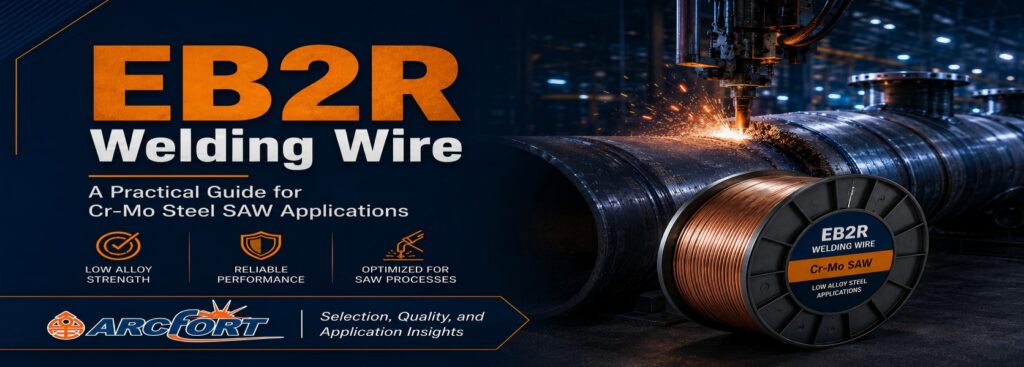
EB2R Welding Wire: A Practical Guide for Cr-Mo Steel Submerged Arc Welding
What Is EB2R?
EB2R is a low-alloy submerged arc welding wire mainly used for welding chromium-molybdenum steels. It is commonly classified under AWS A5.23 EB2R and is also often matched with EN ISO 24598-A S CrMo1 in international welding consumable specifications.
In practical applications, It is associated with 1.25%Cr-0.5%Mo steel systems. These steels are widely used where strength, heat resistance, and long-term service reliability are required. Common industries include pressure vessel fabrication, boiler manufacturing, heat exchangers, process piping, petrochemical equipment, and power generation components.
For buyers and welding engineers, It should not be treated as just another SAW wire grade. It is a welding consumable for demanding service conditions, where chemical control, flux matching, weld metal properties, and documentation all matter.
Product Details:https://www.akweld.com/wp-content/uploads/2025/08/EB2R.pdf
Why the “R” in EB2R Matters
The letter “R” in EB2R is important. In many welding consumable references, the R designator is related to ultra-low residual elements, which helps achieve a lower Bruscato factor, also known as X-factor. This is especially important for applications where temper embrittlement resistance and long-term high-temperature performance are concerns.
This is one reason It is often selected for critical Cr-Mo steel applications instead of a general low-alloy SAW wire. When a project specification calls for It, customers usually expect controlled chemistry, stable mechanical performance, and reliable traceability.
Typical Applications of EB2R
EB2R welding wire is mainly used in submerged arc welding of heat-resistant Cr-Mo steels. Typical application areas include:
Pressure vessels
Boilers and boiler components
Heat exchangers
Process piping
Petrochemical equipment
Power plant fabrication
Creep-resistant steel structures
Lincoln Electric describes EB2R-type SAW wire as designed for 1.25% chromium and 0.5% molybdenum steels used in high-temperature service applications such as pressure vessels and piping. INE also lists It for heat-resistant steels, including use in chemical industry, ammonia synthesis processes, heat exchangers, boilers, pipes, and pressure vessels up to about 550°C.
EB2R and Flux Matching
EB2R is used in the submerged arc welding process, so the final weld performance depends not only on the wire but also on the flux-wire combination.
A correct flux can help achieve stable arc behavior, good bead appearance, proper slag detachability, and the required mechanical properties. Different fluxes may influence weld metal chemistry, impact toughness, diffusible hydrogen level, and performance after post-weld heat treatment.
This is why project specifications may not only mention It wire, but also require a specific classification such as F8P2-EB2R-B2R or another approved flux-wire combination. Some flux-wire combination data sheets specifically describe EB2R combinations for Cr-Mo steels, pressure vessels, oil reactors, and applications requiring control of impurity indexes.
For this reason, buyers should not only ask, “Do you have EB2R?” They should also ask:
Which flux is recommended with this It wire?
Can the supplier provide test data for the flux-wire combination?
Does the combination meet the required AWS or EN ISO classification?
Is the product suitable for PWHT requirements?
Can the supplier provide chemical composition and mechanical test certificates?
Key Quality Factors Buyers Should Check
When purchasing EB2R welding wire, customers should focus on more than diameter and price. The following points are especially important.
1. Standard Classification
The certificate should clearly show the requested standard, such as:
AWS A5.23: EB2R
EN ISO 24598-A: S CrMo1
If the project requires a complete flux-wire classification, the certificate should also reflect the qualified flux-wire combination.
2. Chemical Composition Control
EB2R is used for Cr-Mo steels, so elements such as carbon, manganese, silicon, chromium, molybdenum, phosphorus, sulfur, and residual elements should be carefully controlled. For R-grade requirements, residual elements are especially important because they are connected with the Bruscato factor or X-factor.
3. Wire Surface and Feeding Performance
Good EB2R wire should have a clean, smooth, and consistent surface. Uniform copper coating, stable wire diameter, good cast and helix, and reliable feeding performance are important for SAW productivity. Some product references highlight smooth feeding, close dimensional tolerance, and controlled chemistry as key features for SAW wires.
4. Packaging and Rust Protection
SAW wire is often supplied in coils, spools, drums, or other bulk packaging. Packaging should protect the wire from moisture, rust, deformation, and contamination during long-distance transport and storage.
For export customers, packaging quality is not only about appearance. It directly affects wire feeding stability and production efficiency.
5. Documentation and Traceability
For pressure vessels, boilers, and petrochemical projects, documentation is critical. Buyers should request material certificates, batch numbers, chemical composition, mechanical properties where applicable, packing information, and standard compliance.
A reliable supplier should understand that EB2R is often used in regulated or project-controlled welding applications, where traceability is part of the purchasing decision.
EB2R vs General EB2: What Buyers Should Know
EB2 and EB2R are closely related, but they are not always interchangeable in project purchasing.
The “R” version is normally selected when lower residual elements are required. This can be important in high-temperature service or applications sensitive to temper embrittlement. If a customer’s specification clearly says It, it is safer to quote and supply EB2R rather than EB2 unless the customer approves the substitution.
In international trade, this distinction matters because the wrong classification on the certificate or label may cause rejection during inspection.
How to Select a Reliable EB2R Welding Consumables Supplier
A good EB2R supplier should provide more than a product name. The supplier should be able to support customers with:
Clear standard classification
Stable chemical composition
Recommended flux matching
Export packaging
Batch traceability
Product certificates
Technical communication before shipment
Consistent quality between batches
For distributors and industrial buyers, supplier reliability is especially important because EB2R is often purchased for demanding welding applications rather than general fabrication.
Why EB2R Matters in Critical Welding Projects
In pressure vessel, boiler, piping, and petrochemical fabrication, welding consumables influence not only weld appearance but also long-term service performance. EB2R is selected because it supports Cr-Mo steel welding where high-temperature performance, controlled chemistry, and stable submerged arc welding results are important.
Choosing the right EB2R welding wire can help reduce welding risk, improve production consistency, and support compliance with project specifications.
Working with WUHAN ARCFORT WELDING CO., LTD
WUHAN ARCFORT WELDING CO., LTD focuses on welding consumables and supports international customers with professional welding material solutions.
For customers sourcing EB2R welding wire or related submerged arc welding consumables, we understand that stable quality, correct classification, reliable packaging, and clear documentation are essential. Our goal is to help distributors, importers, and industrial users reduce sourcing risks and build long-term cooperation in the welding materials industry.
Conclusion
EB2R is not just a simple SAW wire grade. It is a low-alloy Cr-Mo submerged arc welding consumable used in applications where heat resistance, chemical control, flux matching, and traceability matter.
When selecting EB2R, buyers should check the AWS and EN ISO classification, residual element control, flux compatibility, welding performance, packaging, and documentation. A professional welding consumables supplier can help make the purchasing process more reliable and support stable welding performance in demanding industrial projects.