
EB3R Welding Wire: Applications, Standards, and Selection Guide for Cr-Mo Steel SAW
What Is EB3R Welding Wire?
EB3R welding wire is a low-alloy submerged arc welding wire mainly used for welding chromium-molybdenum steels, especially 2.25Cr-1Mo type heat-resistant steels. It is commonly classified under AWS A5.23 EB3R and is often associated with EN ISO 24598-A S CrMo2 in international welding consumable specifications.
EB3R Product Data Details::https://www.akweld.com/wp-content/uploads/2025/08/EB3R.pdf
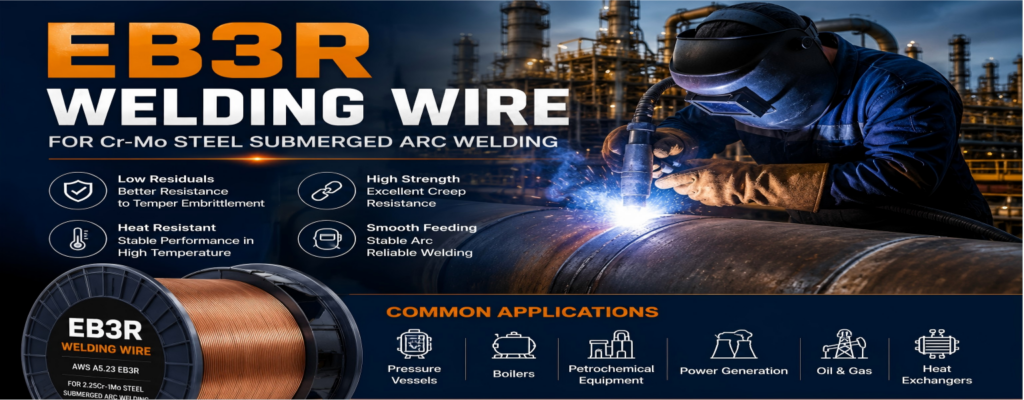
It is not a general-purpose submerged arc welding wire. It is designed for demanding industrial applications where heat resistance, creep performance, controlled chemistry, and long-term service reliability are important. Typical applications include pressure vessels, boilers, high-temperature piping, heat exchangers, refineries, petrochemical equipment, and power generation components.
For buyers and welding engineers, the key point is simple: It should be selected based on project requirements, base material, flux matching, welding procedure, heat treatment, and documentation—not only by product name or price.
EB3R Meaning: Why the “R” Matters
The difference between EB3 and EB3R is important. EB3 is a Cr-Mo submerged arc welding wire for 2.25Cr-1Mo steels, while EB3R is generally used when low residual elements and improved resistance to temper embrittlement are required. Some technical references describe EB3R as a low-impurity wire electrode suitable for step-cooling applications in heat-resistant steel welding.
This matters because Cr-Mo steels are often used in high-temperature service. Over long service periods, impurity elements can affect toughness and embrittlement behavior. Airgas describes Lincolnweld LA-93 EB3R as a B3 alloyed steel wire designed to meet requirements for improved temper embrittlement resistance during prolonged service at elevated temperatures.
Therefore, if a project specification clearly requires EB3R welding wire, it is not recommended to replace it with standard EB3 unless the customer, welding engineer, or project authority approves the substitution.
Common Standards for EB3R Welding Wire
The most common standard classification for EB3R is:
AWS A5.23: EB3R
In some markets, it may also be referenced as:
EN ISO 24598-A: S CrMo2
AWS A5.23/A5.23M covers low-alloy steel, high manganese steel electrodes, and fluxes for submerged arc welding. The standard includes requirements for classification, electrode chemistry, flux-wire combinations, sizes, marking, manufacturing, and packaging.
This is why EB3R purchasing should always involve checking the certificate and product label. A professional quotation should clearly show the required standard, wire diameter, lot number, packaging, and any project-specific requirements.
Typical Applications of EB3R Welding Wire
EB3R welding wire is mainly used for submerged arc welding of heat-resistant Cr-Mo steels. These materials are common in heavy industry because they can maintain strength and stability under elevated-temperature service conditions.
Typical applications include:
Pressure vessels
Boilers and boiler components
Power plant piping
Refinery equipment
Petrochemical equipment
Heat exchangers
Gasification plants
High-pressure piping
Fertilizer and chemical equipment
D&H Sécheron describes its EB3R-type SAW wire as suitable for creep-resistant and similar high-strength steels, with applications in power plants, refineries, petrochemicals, and fertilizer industries. Airgas also lists EB3R applications such as elevated-temperature piping, heat exchangers, oil and gas, petrochemical equipment, power generation, and pressure vessels.
Chemical Composition: What Buyers Should Check
EB3R welding wire is used for Cr-Mo steel welding, so chemical composition control is critical. Typical EB3R chemical ranges often include chromium around 2.25–3.00% and molybdenum around 0.90–1.10%, with controlled carbon, manganese, silicon, sulfur, phosphorus, and copper levels.
For EB3R, buyers should pay special attention to:
Chromium and molybdenum levels
Sulfur and phosphorus control
Copper and residual element limits
Lot-to-lot consistency
Compliance with AWS A5.23 EB3R
Whether the product is suitable for project-required step-cooling or low residual requirements
A small difference in chemistry may affect weld metal performance, especially in high-temperature or pressure equipment applications.
EB3R and Flux Matching
EB3R is used in submerged arc welding, so the final weld performance depends not only on the wire but also on the flux-wire combination.
The correct flux can influence:
Arc stability
Slag detachability
Weld bead appearance
Weld metal chemistry
Mechanical properties
Impact toughness
Diffusible hydrogen level
Performance after post-weld heat treatment
AWS A5.23 allows fluxes to be classified based on weld metal properties produced with classified electrodes, which means the flux-wire combination is a key part of the classification system.
Before purchasing EB3R welding wire, buyers should ask the supplier:
Which flux is recommended with this EB3R wire?
Has the flux-wire combination been tested?
Can the supplier provide chemical and mechanical test data?
Is the combination suitable for PWHT requirements?
Does the final weld metal meet the project specification?
For critical projects, buying only the wire without confirming flux compatibility may increase welding risk.
EB3R vs EB3: Can They Be Replaced?
EB3 and EB3R are closely related, but they should not be treated as identical.
EB3 is commonly used for submerged arc welding of 2.25Cr-1Mo steels.
EB3R is typically selected when low residual elements, step-cooling suitability, or improved resistance to temper embrittlement is required.
If the customer’s drawing, WPS, or project specification says It, the quotation, certificate, label, and delivered goods should show EB3R. Supplying EB3 instead of EB3R may lead to inspection rejection, even if the general alloy system looks similar.
For international orders, this distinction is especially important because buyers may need to submit certificates to third-party inspectors, pressure vessel authorities, or end users.
Key Quality Requirements for EB3R Welding Wire
When sourcing It welding wire, buyers should evaluate more than price. For industrial welding projects, the following points are important.
1. Clear Standard Classification
The certificate should clearly state:
AWS A5.23 EB3R
If required, it may also show the equivalent EN ISO classification, such as:
EN ISO 24598-A S CrMo2
The product label, packing list, and material certificate should be consistent.
2. Stable Wire Surface and Feedability
SAW wire should have a clean, smooth surface and consistent diameter. A copper-coated wire surface should be free from serious defects, contamination, rust, and feeding problems. Some It product descriptions highlight copper-coated smooth finish and standard package forms such as coils, spools, drums, and spiders.
Good feedability helps improve arc stability and production efficiency, especially in automated or long-seam welding.
3. Reliable Packaging
It welding wire is often shipped internationally, so packaging must protect the wire from moisture, deformation, rust, and contamination. Poor packaging may cause wire feeding problems and reduce welding consistency.
For distributors, export packaging is also part of customer satisfaction. A product may meet the standard chemically, but if the packaging is weak, customers may still face problems during storage and welding.
4. Complete Documentation
For pressure vessels, boilers, and petrochemical projects, documentation is essential. Buyers should request:
Material test certificate
Chemical composition report
Lot number and traceability
Wire diameter and packaging details
Standard classification
Recommended flux information
Mechanical property data if applicable
PWHT-related information if required
Airgas notes that Type 3.1 certificates containing chemical composition for each lot of It wire are available for Lincoln Electric’s LA-93 product.
How to Choose a Reliable EB3R Welding Wire Supplier
A reliable It welding wire supplier should understand both product standards and real welding applications. Buyers should look for a supplier that can provide:
Correct AWS A5.23 EB3R classification
Stable chemical composition
Low residual element control
Suitable flux recommendation
Export-grade packaging
Batch traceability
Technical documents and certificates
Consistent supply capability
Clear communication before shipment
For distributors and industrial users, supplier reliability is often more important than a small price difference. EB3R is commonly used in critical applications, so quality consistency and documentation support are essential.
Working with WUHAN ARCFORT WELDING CO., LTD
WUHAN ARCFORT WELDING CO., LTD focuses on welding consumables for international markets. We support customers with welding wires, welding electrodes, TIG rods, flux-cored wires, submerged arc welding wires, fluxes, and related welding materials.
For customers sourcing EB3R welding wire, we understand that standard compliance, stable quality, correct classification, reliable packaging, and complete documentation are important for successful project delivery.
We welcome cooperation with welding distributors, importers, industrial suppliers, fabricators, and end users who need reliable welding consumables for demanding industrial applications.
Conclusion
EB3R welding wire is a specialized low-alloy submerged arc welding wire for Cr-Mo steels, especially 2.25Cr-1Mo type heat-resistant steel applications. It is commonly used in pressure vessels, boilers, high-temperature piping, refineries, petrochemical equipment, and power generation projects.
When selecting It, buyers should check the standard classification, chemical composition, low residual element control, flux compatibility, packaging, certificates, and supplier experience. A professional supplier can help ensure that It welding wire not only meets the standard on paper, but also performs reliably in real welding production.