

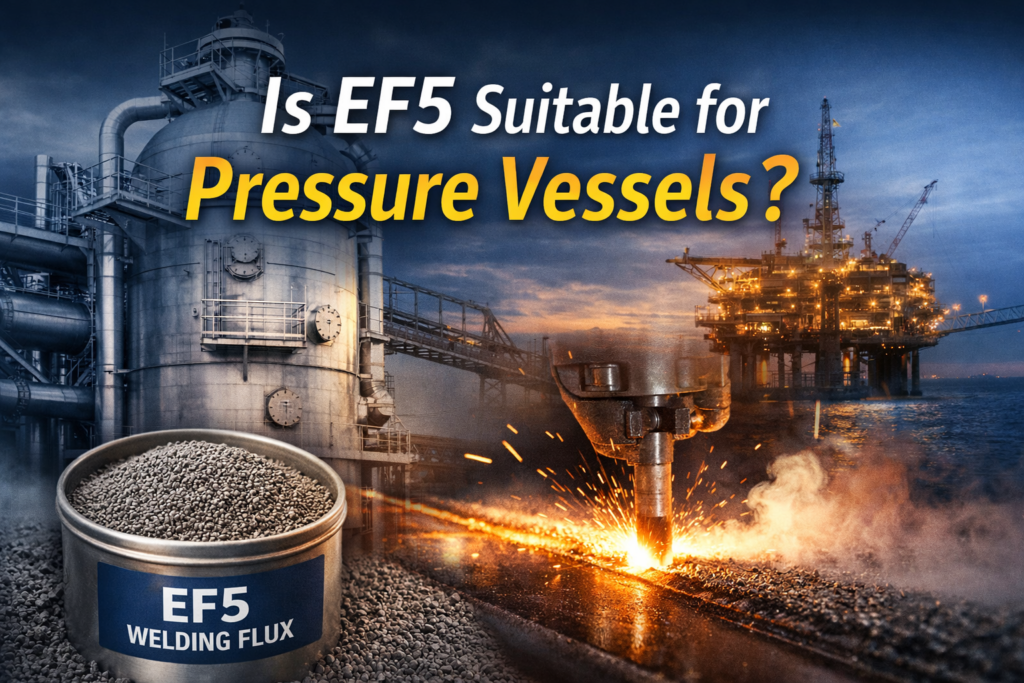
Is EF5 Suitable for Pressure Vessels?
Pressure vessels operate under extreme internal pressure, thermal cycling, and strict regulatory control. In such applications, welding consumables must meet not only strength requirements but also impact toughness, hydrogen control, and certification standards.EF5
So the critical question is:
Is EF5 submerged arc welding flux suitable for pressure vessel fabrication?
The answer depends on classification, wire pairing, mechanical performance, and compliance with project standards.
1️⃣ Understanding EF5 Flux Classification
It is classified under the standards of the American Welding Society for submerged arc welding (SAW) flux systems.
In this classification:
E – Electrode
F – Flux
5 – Mechanical property grouping
It is typically used with carbon or low-alloy welding wires such as EM12K or EH14, depending on required strength levels.
Its design generally supports medium- to high-strength structural welding.
2️⃣ EF5 Mechanical Requirements for Pressure Vessels
Pressure vessels must meet strict mechanical standards, often governed by:
ASME Section VIII
EN pressure equipment regulations
Project-specific engineering specifications
Typical weld metal requirements include:
Controlled tensile strength
Adequate yield strength
Minimum elongation
Verified Charpy V-Notch (CVN) impact toughness
Low diffusible hydrogen
The suitability of EF5 depends on whether the complete flux-wire combination meets these criteria.
3️⃣ EF5 Tensile Strength and Yield Performance
When paired with appropriate wires, EF5 systems typically achieve:
Tensile strength: 480–620 MPa (standard carbon steel systems)
Higher values when used with alloy wires
Good ductility and elongation
For standard carbon steel pressure vessels, these strength levels are often acceptable.
However, high-strength pressure vessel materials may require matched alloy systems.
4️⃣ EF5 Impact Toughness and Low-Temperature Performance
Pressure vessels—especially those in energy, chemical, or offshore sectors—may require:
27J @ -20°C
47J @ -40°C
Or project-specific impact levels
It can provide acceptable impact toughness when:
Properly matched with suitable wire
Welding parameters are optimized
Flux is correctly stored and rebaked
Impact performance must always be validated through procedure qualification testing (PQR).
5️⃣ Hydrogen Control and Weld Integrity
Hydrogen-induced cracking is a major concern in thick pressure vessel welds.
EF5, when properly handled:
Offers controlled hydrogen levels
Supports multi-pass thick plate welding
Provides stable slag removal
Proper storage and rebaking are essential to maintain low moisture content.
6️⃣ Certification and Compliance Considerations
For pressure vessel applications, compliance is critical.
Fabricators typically require:
Mill Test Certificates (MTC)
Welding Procedure Qualification Records (WPQR/PQR)
Third-party inspection approval
Full batch traceability
EF5 itself is a classification, but final approval depends on the complete welding system and documented qualification.
7️⃣ When Is EF5 a Good Choice?
EF5 is suitable for pressure vessels when:
✔ Carbon steel or moderate-strength steels are used
✔ Impact requirements are within achievable test values
✔ Welding procedures are properly qualified
✔ Documentation is complete
It is widely used in:
Storage tanks
Boilers
Industrial reactors
Medium-pressure vessels
Structural components of pressure systems
8️⃣ When Might It Not Be Suitable?
EF5 may not be ideal for:
Extremely low-temperature service
High-alloy pressure vessels
Specialized corrosion-resistant applications
Projects requiring special alloy weld deposits
In such cases, alternative flux classifications may be necessary.
Final Conclusion
Yes — EF5 can be suitable for pressure vessels, provided that:
The flux-wire combination meets mechanical requirements
Impact testing is verified
Hydrogen levels are controlled
Proper qualification procedures are completed
For many standard carbon steel pressure vessel applications, EF5 offers a balanced solution between performance, productivity, and cost efficiency.
However, final suitability should always be confirmed through project-specific welding procedure qualification.