
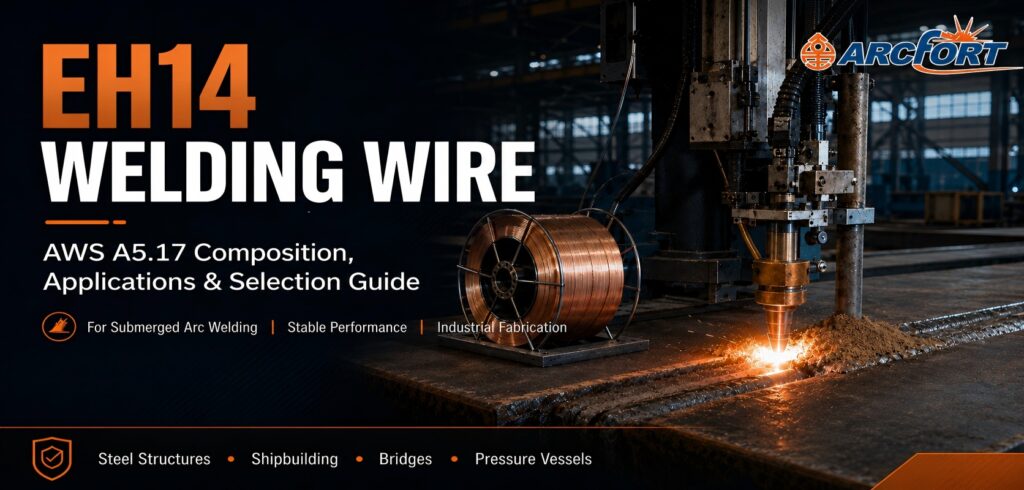
EH14 Welding Wire: AWS A5.17 Composition, Applications and Selection Guide
EH14 welding wire is one of the most widely used solid wires for submerged arc welding. In many markets, it is also known by related classifications such as H10Mn2, S4, or AWS A5.17 EH14. For fabricators, distributors, and welding engineers, EH14 is often selected when a stable arc, good bead formation, reliable mechanical properties, and efficient automatic welding are required.
This guide explains what EH14 welding wire is, where it is used, how it works with welding flux, and what buyers should check before choosing an submerged arc welding wire supplier.
What Is EH14 Welding Wire?
EH14 is a solid carbon steel wire used mainly for submerged arc welding, also called SAW. It is designed for automatic or mechanized welding processes where the arc is covered by a layer of granular flux. The flux protects the molten weld pool, supports stable welding, and helps produce a clean, smooth weld bead.
The “EH14” classification is commonly associated with AWS A5.17. In simple terms, It refers to a high-manganese, low-silicon submerged arc welding wire. This chemistry helps the wire deliver stable weld metal performance when paired with the correct flux.
EH14 is often used for welding mild steel and low-alloy steel structures. It is especially suitable for production environments where long, continuous welds are required, such as steel structures, shipbuilding, pressure vessels, boilers, bridges, wind towers, and heavy machinery.
Key Features of EH14 Submerged Arc Welding Wire
A good EH14 welding wire should provide more than just compliance with a standard. In real production, users usually care about welding stability, bead appearance, slag removal, and mechanical performance.
Typical advantages of welding wire include:
Stable arc performance during automatic submerged arc welding
Smooth wire feeding in continuous welding operations
Good bead appearance with suitable flux
Reliable mechanical properties of deposited metal
Compatibility with common SAW fluxes
Suitability for single-wire or multi-wire welding setups
High productivity for medium and heavy steel fabrication
Because submerged arc welding is often used in high-volume production, consistent wire quality is critical. Even small variations in chemistry, surface finish, cast, helix, or packaging can affect welding efficiency and final weld quality.
EH14 Chemical Composition
EH14 is generally recognized as a low-carbon, high-manganese, low-silicon welding wire. The exact composition should always be confirmed with the supplier’s certificate of analysis, but this wires typically focus on controlled levels of carbon, manganese, silicon, phosphorus, sulfur, and copper.
Manganese is one of the most important elements in EH14 wire. It contributes to weld metal strength and helps support stable mechanical performance. Low silicon content is also part of the typical EH14 profile, making flux selection especially important because the final weld deposit depends on the wire-flux combination.
When comparing EH14 welding wire from different manufacturers, buyers should check whether the wire meets the required AWS A5.17 classification and whether the supplier can provide batch-level quality documents.
Mechanical Properties and Weld Performance
EH14 wire is usually selected for applications that require dependable strength and impact performance. However, the final mechanical properties do not depend on the wire alone. They are influenced by several factors, including:
Welding flux type
Heat input
Welding current and voltage
Travel speed
Base metal grade
Joint design
Pre-weld surface condition
Post-weld requirements
This is why EH14 is normally evaluated as part of a complete wire-flux system. A wire that performs well with one flux may produce different results with another. For critical projects, procedure qualification testing should be performed before production welding.
Common Applications of EH14 Welding Wire
EH14 submerged arc welding wire is used across many heavy fabrication industries. Common applications include:
1. Steel Structures
EH14 is suitable for welding structural steel components where long weld seams and high deposition efficiency are needed. It can be used in beams, columns, frames, and other fabricated steel assemblies.
2. Shipbuilding
Shipyards often use submerged arc welding for long, straight seams and thick plate welding. This can support efficient production when paired with the correct flux and welding procedure.
3. Bridges
Bridge fabrication requires consistent weld quality and reliable mechanical performance. This wire is often used for structural components where productivity and weld appearance both matter.
4. Pressure Vessels and Boilers
For pressure vessel and boiler fabrication, welding consumables must be selected carefully according to project specifications. EH14 may be used when the required strength level, base metal, and welding procedure are compatible.
5. Wind Towers and Heavy Machinery
Wind tower sections, machinery frames, and large industrial components often require long welds on medium and thick plates. EH14 wire can help improve welding efficiency in these applications.
EH14 and Flux Selection
Flux selection is one of the most important decisions when using EH14 welding wire. The flux affects arc stability, slag detachability, bead shape, weld metal chemistry, and mechanical properties.
EH14 is often paired with suitable fused or agglomerated fluxes depending on the application. For example, some users choose flux systems designed for good impact toughness, while others prioritize high-speed welding or smooth bead appearance.
Before choosing a wire-flux combination, confirm:
Required AWS or project classification
Tensile strength requirement
Impact toughness temperature
Base metal grade
Welding position and joint type
AC or DC polarity
Required approvals or certifications
A reliable supplier should be able to recommend suitable flux options and provide test data for common wire-flux combinations.
Available Diameters and Packaging
EH14 submerged arc welding wire is commonly available in diameters such as 2.0 mm, 2.4 mm, 3.2 mm, 4.0 mm, and 4.8 mm, although exact sizes vary by manufacturer. Larger diameters are often used for high-deposition welding, while smaller diameters may be selected for specific joint designs or process requirements.
Common packaging options include coils, spools, drums, and bulk packaging. For automated production lines, packaging quality matters because poor winding or inconsistent feeding can cause downtime.
When purchasing EH14 wire, buyers should check:
Wire diameter tolerance
Surface finish
Copper coating quality, if applicable
Coil weight or drum weight
Feeding performance
Moisture protection during transport
Batch traceability
How to Choose a Reliable EH14 Welding Wire Supplier
Not all EH14 wires perform the same in production. A supplier should be evaluated based on both technical capability and quality control.
Important points to check include:
Standard Compliance
Confirm that the product meets AWS A5.17 EH14 or the equivalent standard required by your project.
Quality Documentation
Ask for mill test certificates, chemical composition reports, mechanical test data, and traceability documents.
Wire-Flux Test Data
For real welding performance, wire-flux combination data is often more useful than wire data alone.
Production Consistency
A good supplier should maintain stable chemistry, consistent surface quality, and reliable feeding performance from batch to batch.
Application Support
For large projects, choose a supplier that can help with welding parameters, flux matching, and procedure qualification support.
EH14 vs Other SAW Wires
EH14 is often compared with other submerged arc welding wires such as EL8, EM12, and EM12K. The main difference is chemical composition, especially manganese and silicon levels.
EH14 generally has higher manganese than some lower-strength or general-purpose SAW wires. This makes it suitable for applications that require stronger weld metal when used with the correct flux. However, the best choice depends on base metal, required mechanical properties, flux type, and welding procedure.
For this reason, EH14 should not be selected only by name. It should be selected as part of a complete welding system.
Practical Tips for Using EH14 Welding Wire
To get stable results with EH14 wire, follow these practical guidelines:
Remove rust, oil, moisture, and heavy scale from the welding area before welding.
Store wire and flux properly to avoid contamination.
Match the wire with a suitable flux for the required weld properties.
Control heat input to avoid changes in mechanical performance.
Use qualified welding procedures for critical components.
Check wire feeding before production welding.
Verify final weld quality through inspection and testing when required.
Conclusion
EH14 welding wire is a proven choice for submerged arc welding of mild steel and low-alloy steel structures. Its low-carbon, high-manganese, low-silicon chemistry makes it suitable for efficient automatic welding when paired with the right flux.
For buyers, the most important step is not simply finding an EH14 wire, but choosing a stable and well-documented wire-flux system. By checking chemical composition, mechanical performance, flux compatibility, packaging, and supplier quality control, manufacturers can achieve cleaner welds, higher productivity, and more reliable fabrication results.