
EM113K Welding Wire: Specifications, Applications and Selection Guide
EM113K welding wire is commonly searched by buyers and welding engineers who need a reliable submerged arc welding wire for carbon steel and low-alloy steel fabrication. In many product catalogs, this wire is also associated with H10MnSiA, EM13K, and ISO 14171-B SU25. Because different suppliers may use slightly different naming formats, buyers should check the full standard, chemical composition, flux combination, and welding procedure before purchasing.
This guide explains what EM113K welding wire is, where it is used, how to choose the right size, and what to confirm when selecting a supplier.
What Is EM113K Welding Wire?
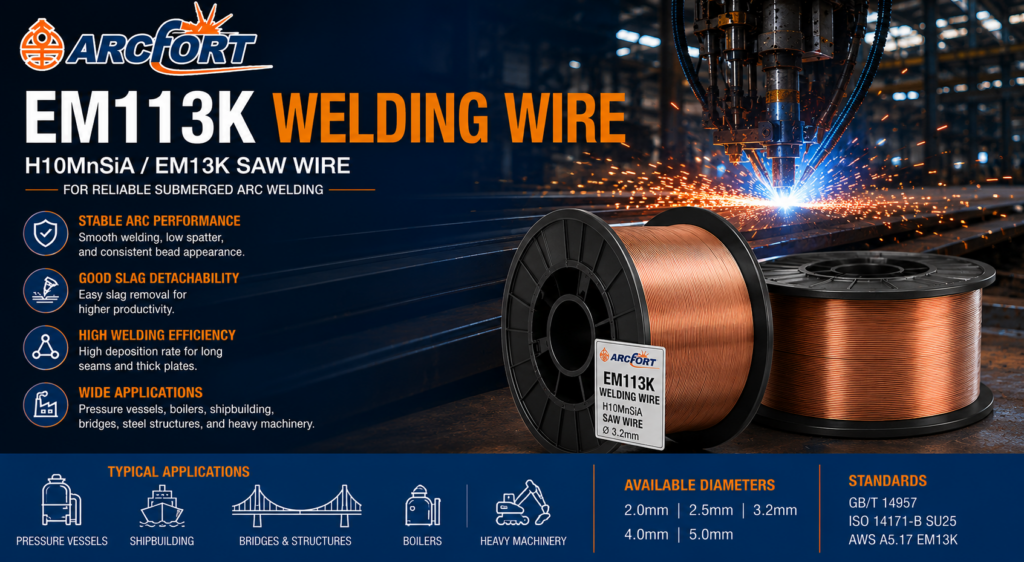
EM113K welding wire is generally used as a copper-coated submerged arc welding wire for automatic or semi-automatic submerged arc welding. It is designed to work under a layer of welding flux, which protects the molten weld pool from atmospheric contamination and supports stable weld formation.
In practical use, EM113K welding wire is selected for applications that require:
Stable arc performance
Smooth weld bead appearance
Good slag detachability
High welding efficiency
Reliable performance on carbon steel structures
Suitable mechanical properties when matched with the correct flux
Because submerged arc welding is widely used for long seams and thick plates, EM113K welding wire is often supplied in coils, spools, reels, or drums for continuous industrial production.
EM113K, EM13K and H10MnSiA: What Is the Relationship?
When searching online, buyers may see EM113K, EM13K, and H10MnSiA used in similar product descriptions. In many markets, H10MnSiA is the Chinese grade name, while EM13K is commonly used as the AWS-related classification for submerged arc welding wire. Some supplier pages and datasheets also display the keyword EM113K.
For this reason, buyers should not rely only on the product name. A correct purchase should be based on:
Applicable standard
Wire chemical composition
Flux-wire combination
Base metal grade
Required tensile strength
Impact toughness requirement
Welding position and plate thickness
Project approval or welding procedure qualification
For general structural welding, the grade name may be enough for quotation. For pressure vessels, bridges, boilers, ships, or critical structures, the complete technical data should always be confirmed.
Typical Applications of EM113K Welding Wire
EM113K welding wire is mainly used for submerged arc welding of carbon steel and low-alloy steel structures. Its stable arc, good bead appearance, and high deposition efficiency make it suitable for heavy fabrication.
1. Pressure Vessels and Boilers
Pressure vessels and boilers often require long, continuous welds with consistent mechanical properties. EM113K welding wire can be used with suitable submerged arc welding flux for longitudinal seams, circumferential seams, and thick-plate joints.
For these applications, the selected wire and flux combination should meet the project’s required tensile strength, impact value, heat treatment condition, and inspection standard.
2. Shipbuilding
Shipbuilding requires efficient welding of large steel plates, panels, stiffeners, and structural components. EM113K welding wire is suitable for automatic welding lines where productivity, bead uniformity, and stable feeding are important.
3. Bridges and Steel Structures
For bridges, buildings, beams, columns, and other steel structures, EM113K welding wire can provide good weld formation and dependable performance when used with the correct flux and welding parameters.
4. Heavy Machinery
Heavy equipment manufacturers often weld thick carbon steel components. EM113K helps improve production efficiency and supports consistent weld quality in repetitive fabrication.
5. Storage Tanks and Large Fabricated Parts
Storage tanks, large shells, and cylindrical components often require long weld seams. Submerged arc welding with EM113K wire is suitable for these applications because of its high deposition rate and stable operation.
Key Features of EM113K Welding Wire
Stable Welding Performance
A properly manufactured EM113K provides stable arc burning and smooth welding operation. This is important for automatic welding systems where interruption can reduce production efficiency.
Good Bead Appearance
The manganese and silicon content in the wire helps support clean weld formation. With the correct flux, the finished weld bead can be smooth, uniform, and easy to inspect.
Easy Slag Removal
Good slag detachability reduces cleaning time after welding. This is especially valuable in high-volume fabrication, where every extra cleaning step affects productivity.
High Welding Efficiency
Submerged arc welding is known for high deposition efficiency. EM113K is suitable for long weld seams, thick plates, and continuous industrial welding.
Practical Surface Tolerance
EM113K welding wire is often used in structural fabrication where the base metal may have light rust or mill scale. However, clean base metal is still recommended for best weld quality and lower defect risk.
Typical Chemical Composition
The exact chemical composition depends on the manufacturer and standard. A typical EM113K / H10MnSiA submerged arc welding wire may contain controlled levels of carbon, manganese, and silicon, with strict limits on sulfur and phosphorus.
| Element | Function in Welding Wire |
|---|---|
| Carbon | Supports strength and weld metal performance |
| Manganese | Helps deoxidation and contributes to strength |
| Silicon | Improves deoxidation and bead appearance |
| Sulfur | Kept low to reduce weld defect risk |
| Phosphorus | Kept low to support weld metal reliability |
| Copper | Often related to copper coating and storage protection |
Buyers should request the actual material certificate for each batch instead of relying only on a general catalog table.
Common Wire Diameters
EM113K welding wire is commonly supplied in the following diameters:
| Diameter | Typical Application |
|---|---|
| 2.0 mm | Lighter submerged arc welding work |
| 2.5 mm | Medium plate welding and general fabrication |
| 3.2 mm | Common industrial SAW applications |
| 4.0 mm | Higher current welding and thick plates |
| 5.0 mm | Heavy fabrication and high deposition welding |
The best diameter depends on plate thickness, joint design, welding current, travel speed, and the required deposition rate.
Flux Matching for EM113K Welding Wire
EM113K welding wire must be used with a suitable submerged arc welding flux. The flux is not only a protective material; it directly affects weld quality and mechanical properties.
A suitable flux can influence:
Arc stability
Slag detachability
Weld bead shape
Tensile strength
Impact toughness
Porosity resistance
Welding speed
Suitability for single-pass or multi-pass welding
Common flux choices may include fused flux or sintered flux designed for carbon steel submerged arc welding. For important projects, the wire and flux should be tested together before mass production.
EM113K Welding Wire vs Other SAW Wires
Compared with lower manganese or lower silicon submerged arc welding wires, EM113K welding wire is often selected when the welding process requires improved bead formation, good slag removal, and stable welding on structural steels.
However, it is not automatically the best choice for every project. Other SAW wires such as EL8, EM12K, EM13K, EH14, or special low-alloy wires may be more suitable depending on the base metal and mechanical property requirements.
The correct selection should be based on:
Base metal strength level
Welding flux type
Welding procedure qualification
Required impact toughness
Heat input range
Post-weld heat treatment
Inspection and acceptance standard
How to Choose a Reliable EM113K Welding Wire Supplier
When buying EM113K, price should not be the only factor. A low-cost product with unstable chemistry, poor wire feeding, or inconsistent packaging can cause production delays and weld defects.
Before ordering, check the following points:
1. Standard and Grade Confirmation
Ask the supplier to confirm whether the product is supplied as EM113K, EM13K, H10MnSiA, or another equivalent grade. The quotation and certificate should clearly state the applicable standard.
2. Material Test Certificate
Request a batch certificate showing actual chemical composition. For critical welding work, mechanical property data should also be reviewed.
3. Flux Recommendation
A professional supplier should be able to recommend compatible submerged arc welding flux based on your base metal, thickness, welding parameters, and performance requirements.
4. Wire Surface Quality
The wire should have smooth copper coating, clean surface condition, and uniform winding. Poor surface quality can affect feeding and arc stability.
5. Packaging Options
Choose packaging according to your production line. Small coils may be suitable for limited production, while drums or large reels are better for continuous automatic welding.
6. Batch Consistency
For large projects, batch-to-batch stability is very important. The supplier should be able to provide consistent chemistry, diameter tolerance, winding quality, and documentation.
7. Technical Support
A reliable supplier should support customers with product selection, flux matching, parameter guidance, sample testing, and after-sales service.
Storage and Handling Recommendations
To maintain stable welding performance, EM113K should be stored in a dry, clean, and ventilated warehouse. Keep the package sealed before use and avoid exposure to moisture, dust, oil, or corrosive environments.
Before welding, operators should check:
Wire surface condition
Flux dryness
Contact tip condition
Wire feeding system
Base metal cleanliness
Welding current and voltage
Travel speed
Stick-out length
Proper storage and preparation can reduce porosity, unstable arc, poor bead appearance, and other welding defects.
EM113K Welding Wire Frequently Asked Questions
Is EM113K welding wire used for MIG welding?
EM113K is mainly used for submerged arc welding. Some similar solid wires may be listed for different processes by certain suppliers, but buyers should confirm the exact process before use.
Is EM113K the same as EM13K?
In online search results, EM113K and EM13K are often shown together with H10MnSiA. However, naming may vary by supplier. Always check the applicable standard and material certificate.
What base metals can EM113K welding wire weld?
It is commonly used for carbon steel and low-alloy steel structures. The exact base metal range depends on the welding flux, procedure qualification, and required mechanical properties.
What flux should be used with EM113K welding wire?
The flux should be selected according to the base metal, welding condition, and required weld metal properties. For critical work, the flux-wire combination should be tested before production.
What information should I provide when requesting a quote?
Provide the required grade, standard, diameter, quantity, packaging type, destination port, flux requirement, and any certificate or inspection requirements.
EM113K Welding Wire Conclusion
EM113K is a practical submerged arc welding wire for carbon steel and low-alloy steel fabrication. It is widely searched together with EM13K and H10MnSiA, especially by buyers looking for reliable SAW wire for boilers, pressure vessels, bridges, shipbuilding, steel structures, and heavy machinery.
For the best welding results, buyers should evaluate EM113K as part of a complete system: wire, flux, base metal, welding parameters, and inspection requirements. A qualified supplier should provide stable product quality, complete certificates, suitable packaging, and technical support for flux matching and welding procedure development.